
China upgraded the Su-27 into the J-16, surpassing the Russian version.
The Chinese Air Force is gradually phasing out older Su-27s and J-11As, shifting their use to ground training, while the J-16s and J-15Bs, based on the Su-27 platform, are being mass-produced, integrating the PL-12 missile with superior performance compared to upgraded Russian Su-27 variants.
The People's Liberation Army (PLA) Air Force is accelerating the decommissioning of its Soviet-era Su-27 fighter jets, while simultaneously deploying large-scale, deeply modernized variants such as the J-16 and J-15B. This process of "unscrewing, learning, and evolving" from the original Su-27 has helped China create a new family of heavy fighter aircraft, considered significantly superior to Russia's own Su-27 upgrades.
The J-11A has left the front lines and become a ground training frame.
Chinese state media reported that the first J-11A aircraft from the initial production batch have been delivered to the Air Force Engineering University for ground training. This marks a milestone indicating that the J-11A is rapidly moving out of frontline combat service.
The images show these aircraft carrying Russian-made R-27 air-to-air missiles, as well as the domestically produced successor, the PL-12. Ground technicians used J-11A airframes for weapons loading and maintenance practice, consistent with personnel training requirements in the context of the PLA operating more modern variants based on the Su-27 platform.
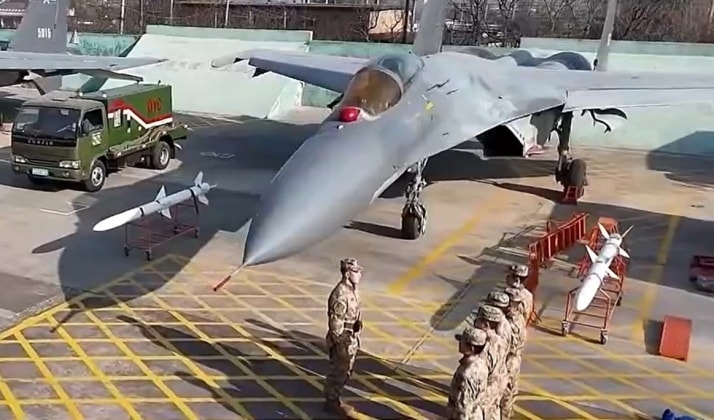
Although the J-11A aircraft at the Air Force Technical University are used for training in handling the PL-12 missile, these aircraft are generally considered incapable of carrying and deploying this weapon in actual combat. This reflects the generational gap between the J-11A and newer variants such as the J-11B or J-16, which are designed and upgraded to fully integrate the domestically produced missile.
From Su-27 customers to the J-11, J-15, and J-16 ecosystem.
In late 1991, China became the first international customer for the Su-27 fighter jet. Following this deal, the country began domestic production of the Su-27 using components manufactured in Russia, under the new designation J-11. This marked the beginning of the gradual localization of the airframe and systems based on the Su-27.
As Russian components were gradually phased out, China undertook a deep modernization, applying composite materials to the airframe, resulting in the J-11A variant. This program, launched in the mid-1990s, paved the way for the J-11B – a variant with significantly superior capabilities and virtually no significant use of Russian components except for the engine.
Building on that experience, the J-16 "4th generation+" fighter jet entered service in 2013. The J-11B fleet was subsequently upgraded with similar avionics and weapons systems to the J-16 through the J-11BG program, while the J-11A and older Su-27 airframes are being phased out at a rapid pace.
Currently, the PLA has more fighter jets developed from the Su-27 platform than any other military force in the world. Among them, the J-16 has been purchased in very large numbers, with over 350 currently in operation, making it the most heavily armed fighter jet purchased by a single military branch since the end of the Cold War.
Air-to-air missile evolution: from R-27, R-77 to PL-12
The R-27 missile was designed as the primary beyond-visual-range (BVR) air-to-air weapon for the Su-27. When the Su-27 and J-11A were first introduced into service, the R-27 was a breakthrough for the Chinese Air Force, giving the PLA significantly greater BVR combat capabilities than before.
However, in the 1990s, the R-27 quickly became obsolete, forcing the PLA to acquire the R-77 active radar-guided missile in the same decade to maintain its long-range combat capability.
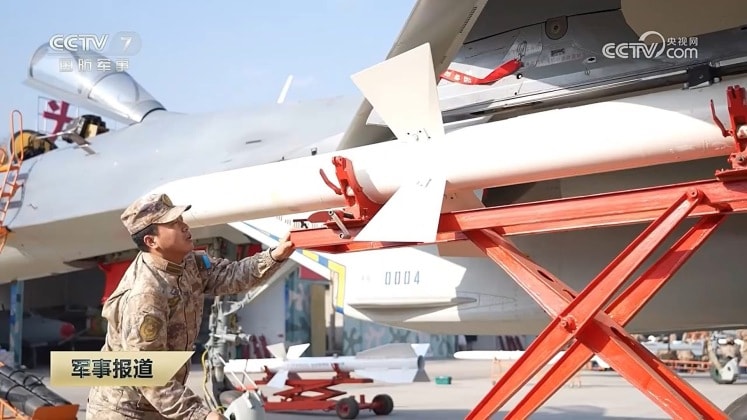
Belarusian experts are believed to have played a key role in helping the Su-27 and J-11A, which used Soviet-era avionics, integrate the R-77. This was a crucial intermediate step before China fully transitioned to domestically produced missiles.
Building upon that foundation, the more advanced J-11B fighters have successfully integrated the PL-12 – a missile considered to possess superior capabilities compared to any Russian-made air-to-air missile. The PL-12 is regarded as a significant milestone in China's independent development of air-to-air missiles, freeing its BVR weapon system from dependence on Russian technology.
The technological gap with Russia is widening.
Simultaneously with the PLA's expansion of its J-16 fleet and the commissioning of the J-15B, the technological gap between the Chinese and Russian defense industries is assessed to be widening rapidly. Based on the Su-27 platform, China has created variants such as the J-16 and J-15B, which possess significantly superior capabilities compared to upgraded Russian Su-27 versions, including the Su-35.
The difference lies in the fact that the original Su-27, when first introduced, was designed with superior maneuverability, a longer range than any Western fighter of its time, a large and powerful radar, and the use of advanced airframe materials and avionics in many aspects. The decline of the Russian defense industry has limited the possibility of further deep upgrades to this design.
Meanwhile, the Chinese defense industry has fully leveraged the inherent advantages of the Su-27, combined with its capabilities in developing new materials, avionics, and missiles, to ensure that modern variants such as the J-16 and J-15B maintain their world-leading position in many performance indicators.
The military significance of the Su-27 "evolution" process in China.
The gradual withdrawal of the J-11A from the front lines and its shift to ground training roles indicates that the technological cycle of the early generations of Su-27s in China has essentially closed. The current focus is on developing highly localized variants, fully integrating weapons, sensors, and materials developed by China.
With a large number of J-16s in active service, combined with upgraded J-11Bs and J-15Bs, the PLA possesses a heavy fighter force based on the Su-27 platform but with technology primarily developed by China. Along with the PL-12 and other generations of domestically produced weapons, this significantly strengthens China's long-range air combat capabilities, no longer relying on upgrade packages from Russia.


