
China upgrades Type 99B tanks for new combat operations.
CCTV has for the first time released live-fire footage of the Type 99B, showing that this main battle tank has moved from parade demonstrations to field trials, with upgrades focusing on situational awareness, proactive defense, and optimization for high-altitude battlefields like the Himalayas.
The Type 99B main battle tank of the People's Liberation Army of China has been deployed in live-fire exercises, marking a shift from parade displays to testing on a simulated battlefield. Upgrades focus on enhanced situational awareness, proactive defense, and optimization for combat in mountainous terrain, placing the Type 99B in an intermediate position between traditional heavy tank design and the mobility and network connectivity trends of the next generation.
From parades to live firing ranges
China Central Television (CCTV) has broadcast for the first time images of the Type 99B tank participating in live-fire exercises. Previously, this tank model attracted attention when it appeared in the September 3rd military parade, leading the armored vehicle formation of the 112th Combined Brigade of the 82nd Army Group, marching through Tiananmen Square in central Beijing.
The rapid deployment of the Type 99B in live firing exercises shows that Beijing does not view this as merely a symbolic upgrade, but as a genuine component of the army's combat capabilities.
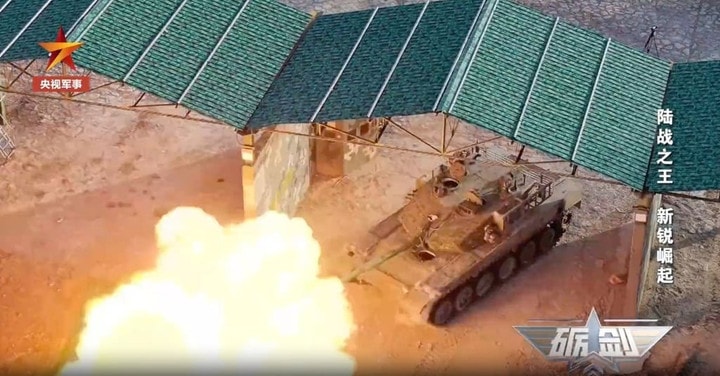
The design reflects lessons learned from the Russian-Ukrainian battlefield.
The design of the Type 99B is considered to directly reflect new trends in armored warfare, which were clearly demonstrated during the Russia-Ukraine conflict, where tanks from both Russia and the West proved vulnerable to UAVs, anti-tank missiles, and precision strikes.
Compared to its predecessor, the Type 99A, the focus of the upgrades on the Type 99B is on enhancing situational awareness and proactive self-defense capabilities. The vehicle integrates two GL-6 active defense system launchers with four radars, and significantly improves its central network combat capabilities thanks to new generation information technology and data sharing systems.
Enhance situational awareness and proactive self-defense.
According to Chinese media, the Type 99B's crew is supported by a 360-degree observation system, significantly reducing "blind spots"—a fatal weakness of traditional tanks in a combat environment saturated with UAVs and anti-tank weapons.
The fire control system has been modernized with a new generation of thermal imaging equipment. It is reported to be the world's first fourth-generation thermal imaging system, although specific details have not been widely released. Electro-optical sensors and supplementary sensor systems significantly expand the ability to detect and track targets in complex weather and terrain conditions, from fog and darkness to obscured areas.
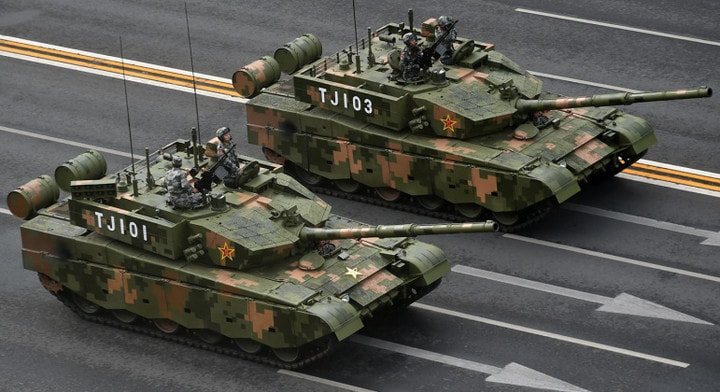
Alongside its sensor system, the Type 99B is believed to utilize improved explosive reactive armor modules, although specific details remain classified. This approach suggests that China has not abandoned the "heavy armor, powerful gun" philosophy of the Type 99 series, which was developed using a "high-low" model alongside the lighter, cheaper Type 96 and produced in large quantities for the re-equipment of units nationwide.
Instead of radical changes, the Type 99B adds layers of active protection and sensor-network capabilities to help the heavy chassis of the Type 99 better adapt to the modern battlefield, where aerial and long-range threats are increasingly prevalent.
Optimized for high-altitude battlefields.
Chinese state media emphasizes that the Type 99B is optimized for combat at high altitudes and in cold climates. Its design focuses on ensuring rapid maneuverability and maintaining high combat intensity in mountainous regions such as the Himalayas.
Previously, the Type 99A was deployed in Sino-Indian border tensions and was believed to offer a significant advantage over Russia's T-90MS, the main battle tank currently in service with India. The continued improvement of the Type 99 series to optimize it for mountainous terrain indicates that Beijing considers this a key operational scenario.
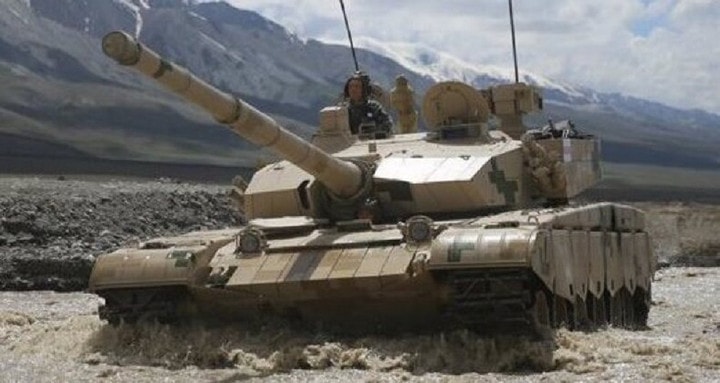
The position of the Type 99B in the Chinese armored vehicle system.
It is currently unclear whether the majority of Type 99B tanks will be entirely new production or upgraded from the older Type 99 chassis. Meanwhile, China is reportedly producing up to six different tank variants simultaneously.
Among these, the Type 99 remains the heaviest and best-protected tank, even though its successor, the Type 100, has appeared and been launched last September. Therefore, the Type 99B can be seen as an attempt to extend the lifespan and update the capabilities of the existing heavy tank platform, while the new generation system like the Type 100 is still in its early stages of deployment.
Between Type 99B and Type 100: Two Different Approaches
The appearance of the Type 100 has sparked much debate, particularly in the context of the Russia-Ukraine conflict which exposed the vulnerability of traditional tanks to precision weapons and UAVs. Many Western analysts question the long-term viability of new designs that still follow the traditional heavy tank path, such as the British Challenger 3 or the German Panther.
In contrast to that approach, China's Type 100 program drastically reduced weight, increased mobility, accepted thinner armor, and used a 105mm gun – weaker than the 125mm guns on the Type 96 and Type 99. In return, the Type 100 focused on active defense systems, anti-UAV and anti-missile capabilities, along with data connectivity and multi-domain coordination, allowing for safer combat ranges and close integration with reconnaissance and target designation UAVs.
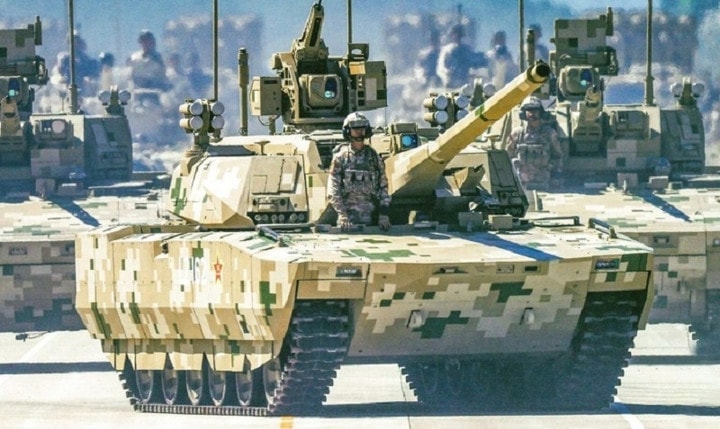
In that picture, the Type 99B is seen as an intermediate adjustment: it retains the heavy chassis, thick armor, and powerful firepower of traditional tanks, but incorporates many new lessons in active defense and cyber warfare.
Qualitative comparison table of Type 99B and Type 100
| Characteristic | Type 99B | Type 100 |
|---|---|---|
| Design philosophy | Thick armor, powerful cannon, heavy chassis | Weight reduction, increased mobility, thinner armor. |
| Main artillery | 125mm (like the Type 96 and Type 99 series) | 105mm, weaker firepower. |
| Active defense | GL-6 system, four radars, improved explosive reactive armor. | Focus on active defense and anti-UAV systems. |
| Operational role | Heavy tank, frontline assault, optimized for high altitudes. | Slightly more powerful, fighting at a safer distance, dependent on sensor networks - UAVs. |
| Networking and data sharing | Enhancing central network warfare capabilities and next-generation data sharing. | Data connectivity, multi-domain coordination, and close integration with reconnaissance UAVs for target designation. |
Viewed from these two perspectives, the Type 99B shows that China still maintains the role of heavy tanks in its army doctrine, but at the same time is gradually shifting towards a combat model based on sensor networks, active defense, and coordination with unmanned platforms, which is more clearly demonstrated in the Type 100.


