
China tests LY-1 laser on Ro-Ro cargo ship.
The images show the LY-1 laser on a Ro-Ro vessel, testing its ability to intercept UAVs and light helicopters in a maritime environment; China has not commented.
China is testing laser weapons on a civilian Ro-Ro cargo ship. Images show a camouflaged military vehicle, secured by heavy chains on a flat deck; atop it is a large electro-optical turret containing a LY-1 laser device. China has not yet issued an official comment on this.
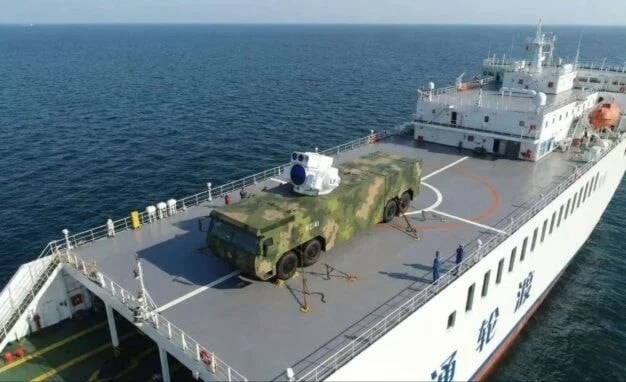
LY-1: Target and Mechanism of Action
LY-1 is a directed energy system designed to neutralize small, low-signal airborne threats, including unmanned aerial vehicles (UAVs) and light helicopters. Its mechanism of action involves emitting a focused laser beam to damage sensors, detonate warheads, or force UAVs to lose control. For amphibious forces, this ship-based laser solution offers a rapid, low-cost, and virtually silent interception method.
Why conduct tests on Ro-Ro vessels?
Ro-Ro vessels have a flat, wide deck and the ability to receive and deploy vehicles via ramps, making them suitable for carrying large military equipment during testing. In recent years, China has increasingly used this type of vessel as a support force in amphibious landing exercises. Some vessels have been structurally modified to carry heavier military vehicles, creating room for testing new systems.
Using commercial platforms like Ro-Ro allows for the rapid deployment of test equipment without altering the structure of military vessels already on duty. This also enables measurements and data recording under real-world sea conditions.
The concept of combat suggests
The decision to install lasers on Ro-Ro vessels reflects a broader operational concept. A laser-equipped Ro-Ro vessel can act as a mobile defense node, deterring small targets that threaten landing craft. With its anti-UAV and anti-light helicopter capabilities, this layer of protection aims to fill close-range gaps, supporting landing vehicles during the critical phase of approaching the shore.
In that role, the mobility of the Ro-Ro platform combined with the "low-cost firing" characteristics of directed energy weapons creates a solution for continuous combat readiness against the high-intensity threat from UAVs. The focus is on maintaining the ability to respond repeatedly while minimizing consumable material losses.
Marine testing: technical variables that need verification
Testing on civilian vessels allows for the assessment of the system's suitability in a real-world maritime environment. Factors to be verified include platform stability, vibration, visibility and firing angle while the vessel is in motion, as well as the influence of marine weather conditions on the laser beam.
- Lasers are sensitive to humidity and sea spray, which can degrade beam transmission.
- The ship's movement requires the ability to lock onto and track targets stably across the vast ocean surface.
- The placement of the electro-optical tower and observation field must meet line-of-sight requirements and minimize obstructions.
Ensuring the system can lock onto, track, and engage targets under these conditions is a crucial step before integration into routine operations.
Context for using the civilian platform
Over the past decade, Chinese commercial ferries and Ro-Ro vessels have participated in beach landing exercises, troop transport, and logistical support operations. These practices pave the way for testing and adoption of new equipment on civilian platforms when needed.
The addition of directed energy weapons to such a platform would be another step forward in integrating civilian infrastructure with military capabilities. If operating reliably, a laser-equipped Ro-Ro vessel could significantly enhance landing site safety against small, hard-to-detect targets.
Level of information verification
Currently, the data is primarily based on images of a camouflaged military vehicle, secured by heavy tracks on the deck of a Ro-Ro vessel, along with a large electro-optical turret containing a LY-1 laser system. China has not yet issued an official comment. Detailed parameters are not disclosed in this document; therefore, the assessment focuses on the target, usage scenario, and environmental and technical factors specified in the source description.


