
Provincial Political School: Incorporating rich practical examples into every lecture.
(Baonghean) - Recognizing the importance of improving the quality of its staff, in recent years, the Party Committee and Board of Directors of the Provincial Political School have focused on directing the construction of an organizational structure that ensures both quantity and quality; improving the qualifications of civil servants and employees in all aspects, with a particular emphasis on enhancing the knowledge and practical skills of the teaching staff.
The teaching staff of the Nghe An Political School currently consists of 46 people, the majority of whom are young lecturers (accounting for 67%). Young lecturers possess many strengths, but at the same time, they face many difficulties and challenges in meeting the requirements for improving the quality of training and education. They are dynamic, enthusiastic in their work, eager to strive, and actively study and improve their professional skills.
Initially, some young lecturers demonstrated their abilities and strengths in researching and teaching political theory. Some possessed good pedagogical skills and teaching methods, creatively combining different approaches and modern tools for each subject and student group, resulting in high effectiveness and fostering the students' initiative, active participation, and creativity. However, they lacked practical knowledge and in-depth expertise in various fields and sectors, failing to build a solid practical foundation. Consequently, the effectiveness of knowledge transfer was low, persuasiveness was limited, and building trust among students proved challenging.
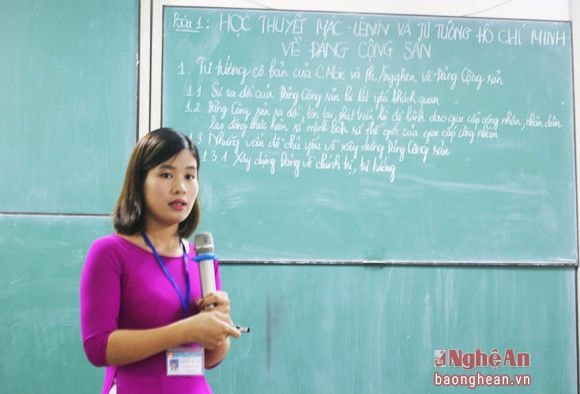 |
| Lecturer Nguyen Thi Hong Giang from the Department of Party Building opened the competition with a lecture titled "Marxist-Leninist Theory and Ho Chi Minh Thought on the Communist Party". |
Therefore, sending lecturers from the Nghe An Provincial Political School to conduct practical research at the grassroots level is a crucial step in cadre training. It is one of the main and urgent solutions to supplement practical knowledge, improve the overall quality of the teaching staff, and contribute to the implementation of the school's training and development plan, ensuring that lecturers possess both solid theoretical expertise and rich practical knowledge. Through practical research, the school's lecturers have the opportunity to hone their skills, accumulate practical knowledge, and gain leadership and management experience, thereby making more practical contributions to cadre training, development, and scientific research.
In accordance with the school's regulations on study and field research, from 2006 to the present, the school has coordinated with localities in the province to send 14 lecturers to conduct field research at various institutions on secondment. The majority of these participants are young lecturers from various departments and faculties, encompassing many different training disciplines.
The practical research content focuses on studying and understanding the socio-economic situation, national defense and security of communes, wards, towns, districts, cities, and municipalities in the province; the leadership and management skills of key officials; the activities of political and social organizations; the implementation of Party directives and resolutions, State policies and laws at the grassroots level, and emerging practical issues.
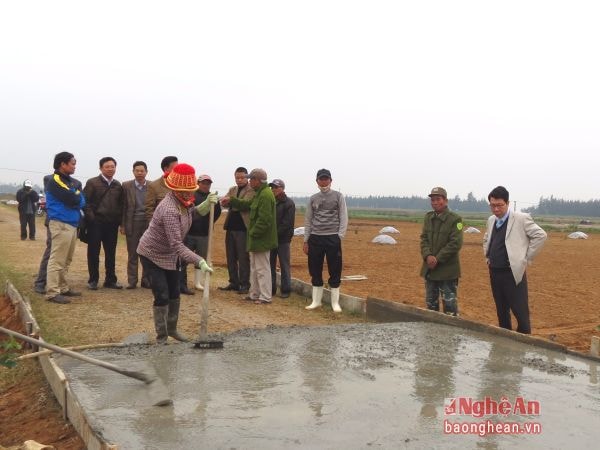 |
| The delegation from the Political School visited and observed the construction of rural roads in Dien Thinh commune (Dien Chau district). |
The duration of field research is determined according to each individual, based on their years of service. Lecturers with 5 years or less of service must undertake 12 months of field research. Male lecturers under 45 and female lecturers under 40 who have not yet worked at a local institution must be assigned to work in various districts, cities, and towns for 3 to 6 months at a time. The locations for field research are relatively diverse, ranging from mountainous districts to lowland cities and towns within the province: Nghia Dan district, Vinh city, Cua Lo town, Hung Nguyen district, Nghi Loc district, etc.
Lecturers receive practical training in Party building departments of district, city, and town Party committees (Mass Mobilization, Propaganda, Organization, etc.), and in various specialized fields (Agriculture, Natural Resources and Environment, Law, etc.); the scope of practical research is also extended to wards and communes. During their practical research period, school staff are assigned work, living arrangements, and duties similar to those of staff in the actual units.
Faculty members undertaking fieldwork receive their full salary, allowances, and other benefits; they are subject to the management and assignment of duties by the agency where they are assigned. They are required to dedicate one day each month (during the first week) to participate in Party branch and professional activities with the school. After the fieldwork period ends, the agency will evaluate and provide feedback on the faculty members' performance.
Overall, the practice of sending lecturers to conduct field research in recent times has achieved the basic objectives set out; the forms of field trips have become increasingly diverse and varied; attracting many lecturers to participate, especially young lecturers; the methods of organizing field trips to local areas are scientific, orderly, and have specific programs and plans; localities and institutions have provided maximum support to lecturers, giving them a good space and environment to work and conduct research.
Therefore, the quality of teaching and scientific research of lecturers, and the quality of personnel planning, have been continuously improved. Most lecturers, after returning from practical training, have been able to apply the practical experience and knowledge gained to their teaching and research, supplementing valuable practical materials and enlivening their lectures. Ms. Pham Thi Tuan, a lecturer in the Department of Marxist-Leninist Theory and Ho Chi Minh Thought, stated: “For young lecturers, accumulating knowledge and connecting with practice through secondment to grassroots levels is extremely necessary and important.”
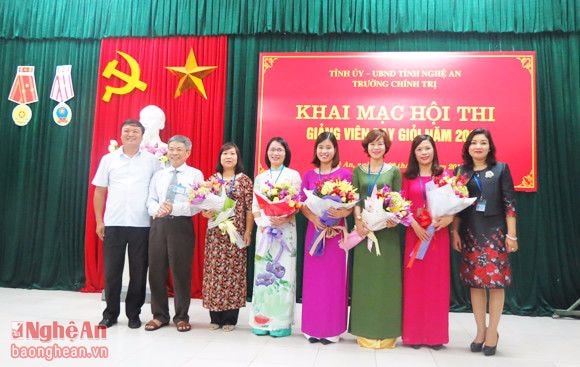 |
| Presenting flowers to the lecturers participating in the 2016 Excellent Lecturer Competition. |
Working with institutions helps me broaden my practical knowledge base, grasp real-life issues, and understand the developments in practice to serve my teaching work."
As for Nguyen Thi Thu Sa, a lecturer in the Department of Mass Mobilization: “More than a year working at the Hung Nguyen District Party Committee has been invaluable. Here, I was able to delve deep into the grassroots, observe, and work with local officials, clearly understanding how the Party's policies and guidelines, and the State's laws are implemented at the grassroots level, what difficulties and shortcomings exist, and what the people expect from the State. I learned how to view issues comprehensively, what should and needs to be done when teaching to convey appropriate knowledge, and how to persuade students, especially those working at the grassroots level.”
However, the effectiveness of the lecturers' practical research has not been fully and comprehensively summarized and evaluated; the majority of lecturers have not clearly understood and correctly identified their responsibilities and obligations to conduct practical research; there are signs of avoiding, shirking, and delaying the task of going to the field for practical research.
Most lecturers choose locations near the university for convenience in commuting and to combine it with additional teaching; some departments and offices assign a relatively large number of teaching duties to lecturers during their field research; the coordination and regular information gathering of lecturers during their field research has not received adequate attention. There is a lack of effective policies and incentives to motivate and encourage long-term field research at institutions. The university and departments lack guidance for lecturers, especially young lecturers, so lecturers assigned to field research are often confused about how to choose research topics, institutions, and related paperwork. The effectiveness of field research also depends heavily on the relationship between the researcher and the head of the institution.
With the goal of building and developing the Provincial Political School into a strong and comprehensive institution, becoming a reputable center for training and fostering cadres, conducting scientific research, and summarizing practical experiences in the North Central region, continuing to send lecturers for practical training must be considered an indispensable part of the school's personnel management. This work needs to be studied, reviewed, summarized, evaluated, and tasks and solutions proposed by the Party Committee, the School Board, and the leaders of departments and faculties.
Comrade Nguyen Ho Canh - Vice Principal of the school - affirmed: "In the near future, the unit will develop a project titled 'Sending lecturers from the Nghe An Provincial Political School to conduct practical fieldwork in the province, 2016-2021,' and simultaneously build a mechanism to create incentives for lecturers to conduct practical research, serving as a basis for implementing training activities, improving the quality of the school's lecturers, and meeting the requirements of the tasks in the new situation. Sending lecturers to conduct practical fieldwork is linked to personnel work, reappointment of leading and managerial cadres, and annual emulation and reward activities."
"We need to establish a coordination mechanism between the school and the agencies and units where practical research is conducted; select diverse locations for lecturers to conduct fieldwork to ensure comprehensive research: urban areas, rural areas, plains, mountainous regions; excellent, average, and weak units to help lecturers fully understand all regions at different levels, so that they can have rich practical materials to serve their teaching work..." - Vice Rector Nguyen Ho Canh said.
Thus, practical research is an important, objective, and urgent task for the Nghe An Provincial Political School, aiming to contribute to building a team of lecturers who are strong in theory, rich in practical knowledge, and proficient in skills, contributing to creating a clear transformation in teaching, improving the quality and effectiveness of training and fostering cadres to meet the requirements of the new period; contributing to consolidating the political system, developing the economy and society, and successfully fulfilling the tasks and goals set by the 18th Provincial Party Congress.
MSc. Tran Duy Ro Nin
(Provincial Political School)


