
Short story: After the storm, the sun comes out.
The flood has just passed. Throughout the countryside, the vegetation is withered, and mud marks remain. The river water is not yet clear, and the reeds in the fields are drooping and faded.
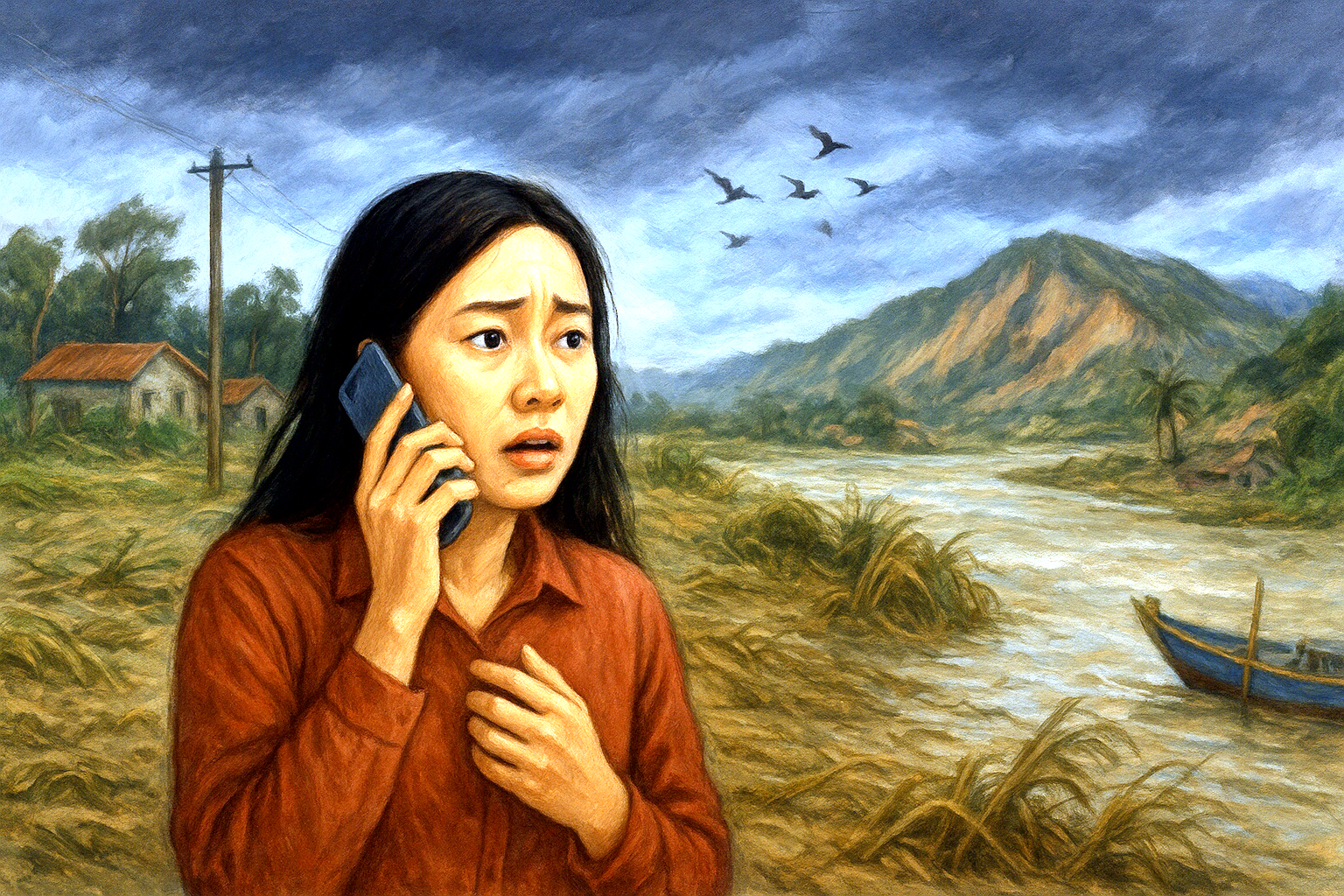
1. The flood had just passed. Throughout the countryside, the vegetation was withered, and mud stains still lingered. The river water was not yet clear, and the reeds were drooping and faded. Every afternoon, flocks of birds, seemingly hesitant to perch against the wind, lingered on the clumps of trees on the cracked, eroded mountain slopes, exposing patches of reddish-brown earth... And yet, Typhoon Kalmaegi had formed in the East Sea, about to move towards the central region of Vietnam, the "backbone of the country." Hoa heard this news just as she finished clearing the broken tree trunks scattered in front of the dormitory. The touchscreen was filled with images of the typhoon. Along the coast, the wind was getting stronger. Fishing boats were anchored at the docks, their hulls rocking against the waves. The loudspeakers blared continuously, advising people to reinforce their houses to withstand the storm. In vulnerable areas, authorities assigned personnel to be on standby, preparing to evacuate residents and move livestock and poultry to higher ground. Before the typhoon, everything was urgent and hurried.
Feeling uneasy, Hoa called her parents. The call didn't go through, making her even more worried. Could the storm be approaching, the power be out, or her parents' phones be out of battery? Hoa hesitated, then called her cousin, a local militia member living next door. She was relieved to receive a response, but her cousin's voice was faint, barely audible amidst the wind and rain. "This year's storm is going to be really big, sister. The forecast says it won't make landfall for over six hours, but the wind is already blowing strongly. In some places, tornadoes have already ripped off the roofs of many houses."
2. It was getting dark. The rain started falling again, the drops getting heavier. And the wind began to howl. Hoa sat sadly by the window, looking out, occasionally glancing at her phone as if waiting for something. This morning, her mother had reassured her, saying that, like every year, the storm would probably deviate from its course and only cause minor damage. Hearing that, Hoa felt somewhat relieved, but little did she know... The storm situation was becoming increasingly complicated. The damage from the recent flood was still there. In one place, a bridge had collapsed, sweeping away people and vehicles. In another, an entire village was submerged up to its roof, and authorities were deploying canoes and motorboats to assist the people. Hoa cried when she watched a video of people taking turns carrying sick people through the night across landslides to the commune's health station to fight for their lives. In the night, the flickering flashlight beams and the weary footsteps of militiamen and soldiers buried deep in the muddy ground as they went from house to house visiting and inquiring. While watching the news, the images of collapsing bridges, washed-away roads, and a pregnant woman being carried on a stretcher across mountains brought Hoa to tears.
Having worked in the mountainous region for many years, Hoa had a good understanding of the local farming practices and feng shui, especially regarding house construction. The indigenous people usually choose flat terrain, facing rivers, streams, or wide, open valleys, with the mountains behind the houses for a sense of peace and stability. However, in recent years, Mother Nature has been increasingly angry. Could it be that humans have done something to displease the heavens? At meetings in the commune, Hoa had heard her superiors warn about the increasingly unpredictable climate, earthquakes in the highlands, deep cracks appearing along the mountain slopes, and successive storms in the last months of the year. Hoa thought to herself, storms happen every year, and the people in storm-prone areas have equipped themselves with knowledge and countermeasures. But then she shook her head, because natural disasters are unpredictable, and humans are small; even with vigilance and proactive measures, damage is still difficult to avoid.
3. All night, alone in her small room with only a few simple belongings, Hoa felt lonely and wanted to cry. The wind howled outside, accompanied by the lashing rain. The gecko's chirping on the porch echoed intermittently in the desolate, chaotic space. Lying awake, Hoa kept looking up at the flickering lamp hanging in the hallway. She felt the cold coming in gusts. Hoa silently tried to hold back her tears. She tossed and turned constantly, glancing at her phone, which was running low on battery, beside her. Hoa stopped at the news about a fishing village being flooded by rising sea levels. She suddenly remembered. The high mountains were just as vulnerable as the plains and islands. There had been years when storms came, with relentless rain and wind. The hills and mountain slopes, saturated with water, suddenly shook and collapsed, burying houses, gardens, and disrupting traffic. Fortunately, the incident happened during the day, and the villagers had already moved deep into the forest and set up tents to take shelter. They spent sleepless nights in safe shelters, but their eyes still wandered towards their village. They wondered if they would be able to salvage anything after the storm. Would the mountains behind their homes, at risk of landslides, withstand the rainy season?
Late at night, Hoa peeked out the window. The dormitory was situated on a high slope, offering a panoramic view of the vast landscape. Across the Dak Pxi River, the village of the Xo Dang people, with its clustered houses nestled beneath the trees, was enveloped in profound silence. The surrounding mountains were a deep, dark expanse. Only the white curtain of rain, carrying the lingering chill of early winter, remained, creating a gloomy atmosphere. Hoa listened intently to the raindrops pounding against the treetops, thatched roofs, and crashing down on the eaves. Thunder and lightning accompanied them. Flashes of lightning streaked across the sky, striking the mountain peaks and riverbanks… Fear gripped her, and she closed the window tightly, huddled in the corner of her bed. She recalled her early days after graduation, when she was assigned to teach at a remote branch of the school there. Day after day, week after week, countless times, her feet followed the rocky, winding mountain path to class after crossing by ferry. Her youthful aspirations had fueled many beautiful dreams. Hoa saw the small, desolate village with its few old classrooms as her home, a place where she could sow the seeds of dreams for the children. She felt as if she were living in the love of the villagers. They treated the teachers like their own children and grandchildren.
4. Hoa was born and raised in a rural area at the end of the river. The ancient village was purely agricultural, the river's alluvial soil enriching the fields and riverbanks. However, during the rainy season, following a storm, the water from the streams rushed in, combined with water flowing down from the mountain slopes, causing the Tra River to writhe and churn, its muddy water carrying debris and large logs. The river gradually swelled, ferociously overflowing its banks, flooding the fields, and leveling the roads. Amidst the gloomy sky, people's hearts were heavy with anxiety. They gathered to listen for news. They hurriedly moved their belongings to higher ground. They moved poultry and livestock to the hills. They stockpiled rice, salt, and oil lamps. The village loudspeaker blared continuously. And the torrential rains, adding to the water from the upstream, caused the river to rise even higher. The whole village was in a panic. Screams of terror filled the air. The sky was pitch black, and gusts of wind howled, sometimes gusting incessantly. The sounds of pouring rain, breaking branches, and flying corrugated iron roofs clashing together were chaotic and frenzied...
Thinking about the floods in her hometown, Hoa suddenly remembered an incident that happened long ago but still haunts her. Back then, Hoa had just started working at a school by the Dak Pxi River. She wasn't familiar with the area or the weather. That day, it was raining heavily, and as she reached the foot of the bridge over the Dak Che stream, the floodwaters were rising, rushing and overflowing the bridge. It was raining heavily, and there were few people around. Hoa thought to herself, "I can't take the risk," but waiting would mean not knowing when the flood would recede. Lost in her thoughts, a man suddenly appeared. He spoke in the local dialect, so Hoa didn't understand anything, but she nodded in the direction he pointed. Hoa bravely took a few more steps over some rocks and found a path. As if guided, she followed the path. The rain intensified, darkness gradually enveloped everything, and all she could see was a hazy black mass. Hoa was truly panicked. She stopped to orient herself. The sound of water was still audible, meaning she was still walking along the stream bank. The strange birds chirped and flew away erratically, making Hoa even more frightened. Just then, a figure stood before her. Hoa screamed and turned to run. But the figure quickly grabbed her hand, muttering incoherently. It turned out to be the man Hoa had met at the foot of the bridge. He was worried about the unfamiliar teacher and had quickly intercepted her to help her cross to the other side of the stream...
5. As the storm moved inland, it gradually weakened, and the wind speed decreased significantly. Everyday life began to return to normal. After several days of isolation due to severe landslides, the mountain pass was repaired. The bridge that collapsed during the flood was also temporarily constructed to facilitate travel for the people. In some areas, landslides caused rocks and soil to slide down into the ravines, forcing people to make their way through the forest. Hundreds of people and authorities also made efforts to deliver supplies to the five isolated villages in Ngoc Linh commune. Good news and joyful updates were quickly shared by the newspapers. Joy shone in everyone's eyes. Loan and Duyen also went to school, saying that only a few sheets of corrugated iron on their porch were blown away by the water. After the storm subsided, the villagers pitched in to clean up; overall, the damage was negligible!
The classroom doors were open for the teachers to clean. Students from nearby schools also came to help pull out the mud and pour out the standing water in the yard. Wiping the sweat from her forehead, Hoa looked up at the clumps of young, green leaves glistening with rainwater. Those leaves had sprouted overnight, looking trembling and weak. But it didn't matter; according to the natural order, those tender leaves would grow. Hoa smiled softly. Just like the old leaves that had been torn from the branches and fallen to the ground during the storm, ending a proud journey...
The playful chatter of the students broke the silence, bringing Hoa back to reality. She followed them up the hill. A green expanse unfolded before her eyes. The rare rays of sunlight after the storm began to spread gently everywhere.


