
Short story: On the crest of the waves
His name was An. But peace never lasted long in his life. The name was like a garment tailored to an ill-fitting body, always loose at the shoulders and too tight at the chest.
His name is An. But peace has never lasted long in his life. The name is like a tailor-made garment for a body that doesn't fit, always loose at the shoulders and tight at the chest. His childhood was devoid of loud arguments, banging tables, or the sound of breaking dishes. His home was so quiet that even sadness had to be carried on barefoot. Family meals were when his father was engrossed in his laptop and his mother was glued to her phone. He sat between them, no one touching anyone, yet he felt weary, as if holding onto an invisible thread to keep the roof from collapsing. Inside the house, everything was always sufficient. Enough chairs, enough dishes, enough clothes drying on the porch. Only affection was lacking.
When he was 19, his parents sat down and announced they were getting a divorce. No tears, no questions, no pleading; his father simply said:
"Mom and Dad tried their best."
Mother looked at the teacup, not at him, and said softly:
"Please understand me, my child."
They moved out on a windy afternoon. The sunlight streaming through the window stretched like a needle slowly sewing up a long-torn tear.
***
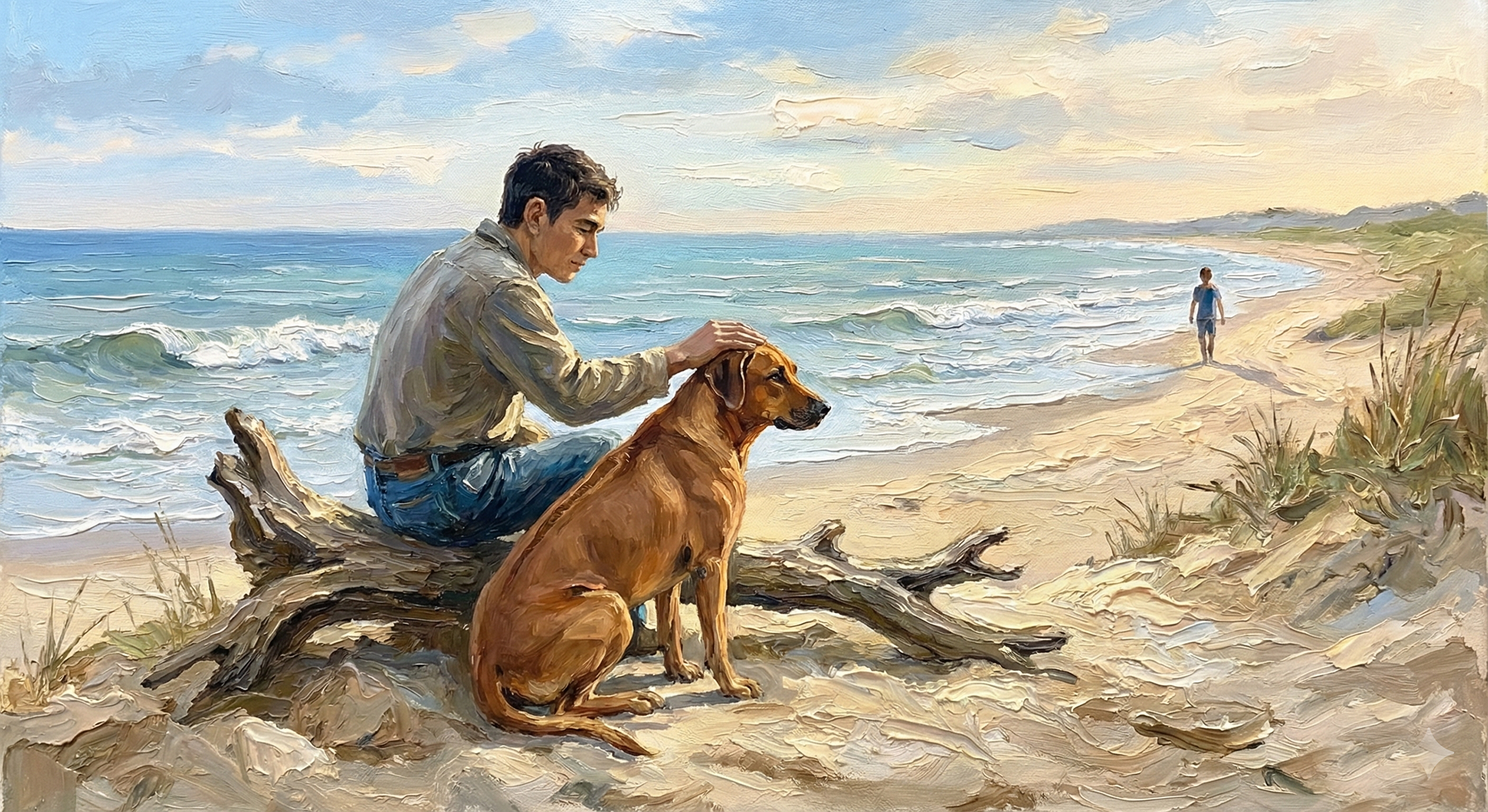
He moved to live alone in a seaside city. The summers there were scorching hot, like a frying pan for drying fish, while the winter sea breeze whistled through the cracks in the door like the whistling of a drunkard. He worked restoring old photographs, a fascinating job. He repaired and brought back lost moments. Meanwhile, his own life offered little to preserve.
That night, it rained. A light but continuous rain. The long coastal road, sparsely lit by yellow streetlights, the dark sea, the waves lapping against the shore with a murmuring sound like an endless conversation. Just as he was about to turn back home, he heard something, a groan. Small, trembling, weak, like someone desperately calling out. He approached the trash can under the coconut tree. There, an old cardboard box, torn in places and tattered in others. The rain had soaked through, making the paper soft and limp. And inside, a tiny, curled-up creature. A puppy.
He stood there for a long time. The rain intensified. All he could hear was the crashing waves, the howling wind, and the pounding of his own heart. He wanted to turn away: “Don’t cause trouble.” He told himself. His life was already exhausting enough. He didn’t even know how to take care of himself. But those eyes… My God. They were like his own eyes at nineteen, standing in front of an empty house, key in hand, unsure what he would find inside. So he picked it up. It was so light he feared it would break if he held it too tightly. He named it Ink.
***
Since Mực arrived, the house has lost its familiar silence. The wooden floor, which used to only hear the footsteps of one person, now echoes with the clacking of claws. Mực is a small dog but full of energy, its tail constantly wagging as if keeping the whole world from falling apart. It runs around the house two or three times before finally lying down, as if afraid that if it stops, the silence will return and engulf the house. The house, therefore, feels warmer.
Once, he caught a cold, his fever so high that his eyelids felt heavy, as if weighed down by stones. His whole body was burning hot, yet his hands and feet were icy cold. He curled up, wrapped tightly in a blanket. Mực lay close to him, so close, as if trying to fill any space between their bodies. Its warmth wasn't the mere heat of their bodies, but the warmth of caring companionship. He remembered the feeling of his fingers gently touching its back—soft, warm, with its steady rise and fall of breath. There were no words, but his chest suddenly felt strangely light, as if someone had opened a window in a room that had been closed for years.
Then came the stormy nights, when thunder rumbled. In this seaside city, thunder didn't just erupt once and then dissipate; it was relentless, dense, and deep. At those times, Mực always sought refuge. It would crawl under the table, its body trembling in small bursts, like a string vibrating incessantly in the whistling wind. Its black eyes were wide open. He reached down, slipping his hand into the darkness under the table, searching for it. His hand touched its warm fur. Mực immediately pressed its head against his hand. He pulled it out, reassuring it softly, "Don't be afraid. I'm here."
The night continued to pass. The storm eventually subsided. The room was once again filled only with the sounds of one person and a dog breathing together. Not everyone is capable of falling in love right away. But sometimes, all it takes is a place to lean on, to begin learning again how to live, how to believe, how to open one's heart. And he knew they had become family without needing to be given names.
***
He developed a new habit. Every month, on the full moon, he takes a picture of Mực (the dog) standing by the sea. No posing. No forcing. Simply letting it stand where it likes to stand, at the water's edge, where the waves just touch it without washing it away. The same camera angle, only time changes. Mực grows, its fur darkening and then gradually turning gray at the corners of its eyes. And he, from a tense expression, now has a more smiling gaze. That photo album sits neatly on his computer. He named it: "Family." Not an art collection, no color correction needed, just ordinary moments.
Time passed, like the silent waves eroding the sand unnoticed. The sea remained blue, the wind still blew, but Mực no longer ran out to greet the waves as before. It walked beside An, still the same small figure, still with its curled tail, but its steps had slowed, shortened, as if it were cautiously feeling each patch of land to make sure it could still stand. At night, it slept more, but its sleep was restless: its breathing was sometimes even, sometimes labored, then it would try to sink deeper. Its eyes, once as black and clear as raindrops, were now veiled with a thin layer of haze, like a window pane left outside on the porch covered in fog, and when he looked closely, he saw his reflection in it, small, distant, and sad, as if he were standing on the other side of the glass, knocking without knowing if anyone would open it.
One afternoon, before the sun had set, it stumbled. Just a slight misstep, but enough to make his heart pound like a boat caught in rough waves. He reached out to support it, his hand touching its back, and realized the skeleton beneath its fur was much lighter than before. Mực struggled to stand, raising its head to look at him, its chest rising and falling rapidly, its breath barely audible. Not a bark. Just a look, weary, and suppressing the last vestiges of pride of a dog that once ran alongside the waves. Both understood that no one could escape time. They could only slow down, walk side by side, until they had to stop.
***
He took Mực to the clinic on a pale gray morning, the kind of weather that made you feel as if the sun was stuck somewhere and couldn't find its way back. As the doctor turned the screen of the scan, the white light shone on his face, and even before he heard a word, he felt his heart constrict. “Bone cancer. It has spread.” The doctor’s voice was neither high nor low, but each word fell so heavily it left an indentation in the air. “If you don’t want it to suffer… euthanasia might be considered.” The words rang out sharply and thinly, like a shard of broken glass cutting into his heart. Cold, clear, leaving no room for blind hope. He didn’t cry. He only felt an invisible hand squeezing his chest, slowly, steadily, relentlessly. Mực lay there, his breaths short and shallow, each inhale like pulling the whole world into its tiny chest.
In the days that followed, time was no longer measured in hours. Only in breaths. Mực tried to stand up each time he stepped out of the room, trying to follow, but then its legs gave way, and it fell onto the carpet. It didn't cry, didn't moan, but the way it tried to hide its pain by turning its face to the corner, not wanting him to see, was what hurt him almost unbearably. Occasionally, at night, when the room was dark and the sea outside was lapping slowly against the shore, Mực let out a faint, very small moan. Each time, he felt as if someone was tearing something inside him. He stroked its head, his fingers trembling so slightly that even he found it strange, as if touching something so fragile that he feared even a strong breath would shatter it.
One night, the sea was unusually calm. The waves only warmed the sand, no longer crashing violently. The wind stopped howling outside the window, only a faint sigh, like someone trying to soothe something about to depart. He and Mực lay side by side on the floor. Only the sound of their uneven breaths mingling could be heard. He placed his hand on its head. His voice was hoarse, as if worn down by the silence: "If it hurts too much… then go. But remember, don't go too far." Mực blinked, very slowly, then used its last ounce of strength to touch its forehead to his palm. In that moment, for him, it was as if the waves had stopped crashing against the shore.
***
He buried Mực near the beach, where it used to bark at the waves, as if it could chase away all the loneliness in its life. The sand swirled in soft curves in the wind, like the hands of heaven and earth caressing the back of the one left behind. The sea that day was unusually gentle, not crashing violently, but softly lulling. On those lulling waves, he found peace in his heart!
As night fell, the room felt strangely vast, as if someone had just drained away some of its warmth. An opened the photo album: pictures of the same corner of the sea, taken month after month, documenting two lives that had silently grown up together. In the last picture, he was still standing there, the sea still blue, the sky still high, everything intact, except for the empty space beside his feet. That space wasn't noisy, it didn't roar, but it was so sharp that a single glance was enough to make his heart constrict.
He still takes walks on the beach every afternoon. The waves still crash, the wind still blows, life goes on. Occasionally, he murmurs to himself: "Squid, look... aren't the waves beautiful today?" The question is as light as a breath, needing no answer, because he speaks as if it were still right beside him. The sea is calm, and his heart is no longer as desolate as before. Squid has come to him, whether for a short or long time, and has fulfilled its mission, transforming a lost soul into someone who knows how to return home.


