
Short story: The Wind Goes Against the Current
In truth, she felt she had died the moment he let his mother lead him across the pigsty, through the kitchen, and into the bedroom, her wedding dress stained with a puddle of murky yellow water, reeking of digested vegetables and bran. She could not smile contentedly beside her groom like other brides on their special day, not even on their wedding night and never afterward.
In truth, she felt she had died the moment he let his mother lead him across the pigsty, through the kitchen, and into the bedroom, her wedding dress stained with a puddle of murky yellow water, reeking of digested vegetables and bran. She could not smile contentedly beside her groom like other brides on their special day, not even on their wedding night and never afterward.
There's nothing to be upset about, it's just a tradition, we're just following the example. Mom isn't making a big deal out of anything. Old people are often meticulous, so we should follow her rules to please her. If we're wrong, we'll take the blame. Hung pulled Ha's hand, urging her to hurry and eat dinner, everyone was waiting. The meal dragged on, and Ha asked to stop early, wondering about the pile of greasy dishes and leftover food. As she rolled up her sleeves, her sister-in-law quickly intervened, "Leave it there, let the others do it. We need to focus on opening the wedding gift envelopes and calculating the costs." Ha didn't know what to calculate anymore; her parents-in-law had announced in front of the wedding hall that they would give everything they had to the two of them.
Hung sprawled on the bed, shirt, shoes, and socks, pulling his wife down with him. Ha struggled to get up, counting the money and calculating other expenses! Her voice sounded unhappy. Hung paused for a moment, glanced at his wife, then at the pile of envelopes, and slowly pushed the door open and went out. Ha remained seated, the pen in her hand slipping and rolling under the bed. She looked at her hands, the stitches and rings, touched the two large handcuffs around her neck, wondering if one was five tenths of a tael or one tenth of a tael, the other one or two tenths of a tael, how many taels of gold in total? "I'll exchange the money for gold, save it all, a house of our own, that's my dream." Hung said his parents only had him as their son, so they didn't have to worry about housing or land…
Hung entered with his sister, who held the position of secretary. Ha was taken aback for a few seconds, then forced a smile, bending down to find a pen to give to her sister. She diligently opened the envelopes, counted, and recorded for hours—over two gold bars and nearly a hundred million dong. Ha smiled inwardly; her dream house would soon take shape. She loved the elegant architecture, the wooden staircase, the flower-filled balcony welcoming the breeze, the wide-open doors overlooking the fruit garden, the swing on the porch under the bougainvillea trellis, the morning glory vines covering the alley, the fish pond next to the house, the fragrant clusters of jasmine blooming, the chickens running around the banana tree searching for worms, the brown sparrows chirping from branch to branch, her little daughter wandering around admiring the flowers, her pretty dress bouncing, her braids swaying with each step…
"One hundred million dong is almost six taels of gold, Mom will make up the difference. Just give it to me to keep, you two are always working, it would be terrible if you lost it." Hung's mother stood at the bedroom door, speaking as she extended her hand. Ha stared at Hung, catching his gaze, two contrasting emotions: joy and shock. Hung squeezed his wife's hand, which was holding the large wad of money, trembling slightly. "Did you hear that? Mom will make up the difference for three taels." Hung kissed his wife's lips with a loud smack, then jumped up, carrying his mother in his arms, cheering. His mother-in-law yelled, "Damn you! Get out of here! Put it down! Get out of here!" The whole family burst into laughter, but Ha was frozen, awkward and embarrassed. She looked down at her hands; this gold, this money—her mother-in-law wanted to keep it all. "Later, when you need anything for business, ask Mom. When you're working, you'll spend it on expenses and the children, you can't look at this," her sister-in-law advised. Ha lowered her head, carefully pulling out each gold ring, her throat tightening with bitterness.
***
"You good-for-nothings! You and your mother are destructive, a jinx!" Hung's mother grumbled, slamming the broom down. The little girl cowered, tears blurring her vision, her face downcast, her lips tightly pressed together, her shoulders trembling. The car clattered over in the yard. Ha rushed into the house, ran to hug her child, "What's wrong, Cún? Be good, tell Mommy! Be good..." Her mother-in-law's voice trailed off with sarcasm. Ha swallowed something, choking back tears. Trying to control her emotions, she gently comforted the little girl, who burst into tears, trembling.
Whether it was due to the pregnancy or something else, Ha never smiled, and her daughter always looked gloomy, her eyes filled with sadness, not to mention she often leaned against the door, waiting for her mother. Her grandmother and aunt scolded her: "You're so unlucky!"
Ha took the broken pieces of her jade bracelet to the jeweler. With money, anything broken could be mended. The jeweler smiled, examining them, and said, "This bracelet isn't rare; a new one might be cheaper." Recalling her mother-in-law's sullen face and bitter words, Ha insisted, "Please wrap it up for me, try your best to do it skillfully. The problem is, my mother-in-law cherishes this bracelet like her life." At this point, Ha remembered her mother-in-law's overly red lips shrieking, "Oh my God, do you know how valuable this is? Someone brought it all the way from China! I begged and pleaded until my teeth fell out just to buy it! Oh my God!" Was it really true that money could mend everything? Ha felt that money had shattered and cracked so many things.
***
The fields were shrouded in smoke in the evening mist. The buffalo herders huddled around fires roasting potatoes, their buffaloes grazed leisurely, occasionally kicking their legs and flicking their tails. A few blood-filled leeches clung to hammocks beneath the buffaloes' feet. A few people, wearing conical hats and raincoats, busily gathered wild vegetables and cut grass. The old people's eyes gazed at the drizzling rain in the gloomy afternoon, their thoughts filled with the impending storm that would sweep everything away. Where would they take their buffaloes to escape the flooding? Where would they store their rice to protect it from the rain? The football field was deserted, grass covering the base of the goalposts. Laughter, hurried breaths, crosses, shots hitting the post, and balls over the fence—the ball leaving the goal and heading straight towards Aunt Tam's window—Sún, the "commentator," cupped his hands like a megaphone. Aunt Tam, with a broom in one hand and her other hand on her hip, watched the children running around excitedly.
Where are they? Where have they all gone?
Ha ran frantically through her memories, stopping at the slope by the drain, from where she could see her house. The whitewashed walls were stained and uneven, the door was covered in moss, the hinges rusted, a wooden plank propped against the courtyard, its end resting against the door. Her parents were in the wood-burning kitchen, the fragrant scent of water infused with the leaves of the fifth day of the fifth lunar month, the smell of boiling rice, and the aroma of fish stewed with turmeric lingering in the air. Tears welled up in Ha's eyes; she wished she could rush back, throw herself into her mother's arms, rest her head on her thin chest, and feel her bony fingers run through her hair. Her father, leaning on his cane, went upstairs, coughed a few times, and took out his cigarette to smoke. Her mother sighed, saying, "Happiness and suffering are predetermined by fate; try to love each other, as long as you have children, don't think of doing anything foolish. A woman who leaves her husband brings shame…"
Ha returned, heartbroken, and desperate. She feared her father's distant gaze, her mother's age-old principles of obedience and virtue, and the guava tree in front of the house—one branch dead and bare, the other laden with fruit, its green and yellow leaves intertwined, still alive, and living, as her mother said. Ultimately, Ha had chosen this marriage, loved, found happiness, and dedicated herself as the essence of those infatuated with love.
Was Ha wrong? She always tried to justify her actions, especially after her husband's shady business dealings. Ha had no voice in the family; her meager salary as an employee didn't give her the right to speak up, let alone the fact that for over a decade after giving birth to little Cun, she had suffered a birthing accident and become indifferent to her husband. Hung's grandson was still somewhere in his bones, and his mother-in-law, with sweet words, insisted that the family couldn't die out, telling them to find a doctor and medicine.
If Ha wouldn't let her husband touch her, what doctor could cure her? After entertaining clients until midnight, Hung would come home and fall asleep, his daughter lying in the middle of the spacious bed. Ha knew from gossip that her husband had another woman, but she wasn't jealous. Since they didn't share a bed, Hung was like a family member to her, a father figure to her daughter. When the wedding gold was mentioned, Hung yelled, "I took it to work! How many taels did your mother give you?" "Two taels? Here you go!" Hung pulled out his wallet and threw the two rings, wrapped in plastic, onto the bed. The force of his hand sent them bouncing to the floor. Ha choked, her eyes welling up with tears.
Picking up the two rings, turning them over and over, bitterly, there was no reason to stay here another day. But a daughter needs a father. Ha always tried to maintain a beautiful image in her daughter's eyes, but why? So that her daughter would see her as complete and happy like other children. Children don't need too much. Hung still came and went like a shadow, with more private meetings with business partners, and money was spent lavishly. Cash envelopes and bank transfers were a thing of the past; the only way to get a bribe was with 9999 gold. Her mother-in-law was proud of her son, showing off the gold bracelets and diamonds he gave her.
An anonymous message reminded her of Hung's business dealings. She deleted and blocked the number, but received a few more messages, this time advising Hung to stop, saying that friends only wanted what was best for the family. Ha was stunned. Since getting married and having a child, she had become less talkative, less confiding in others, and their intimate life had become dull, partly due to Hung. Added to that were changes in their psychology and physiology; they were like two roommates. She knew that if she talked about this, Hung would fly into a rage, yell at her, glare at her, and demand to know if he could afford a fancy house and car for her and their child without illegal business dealings. She told him to shut up!
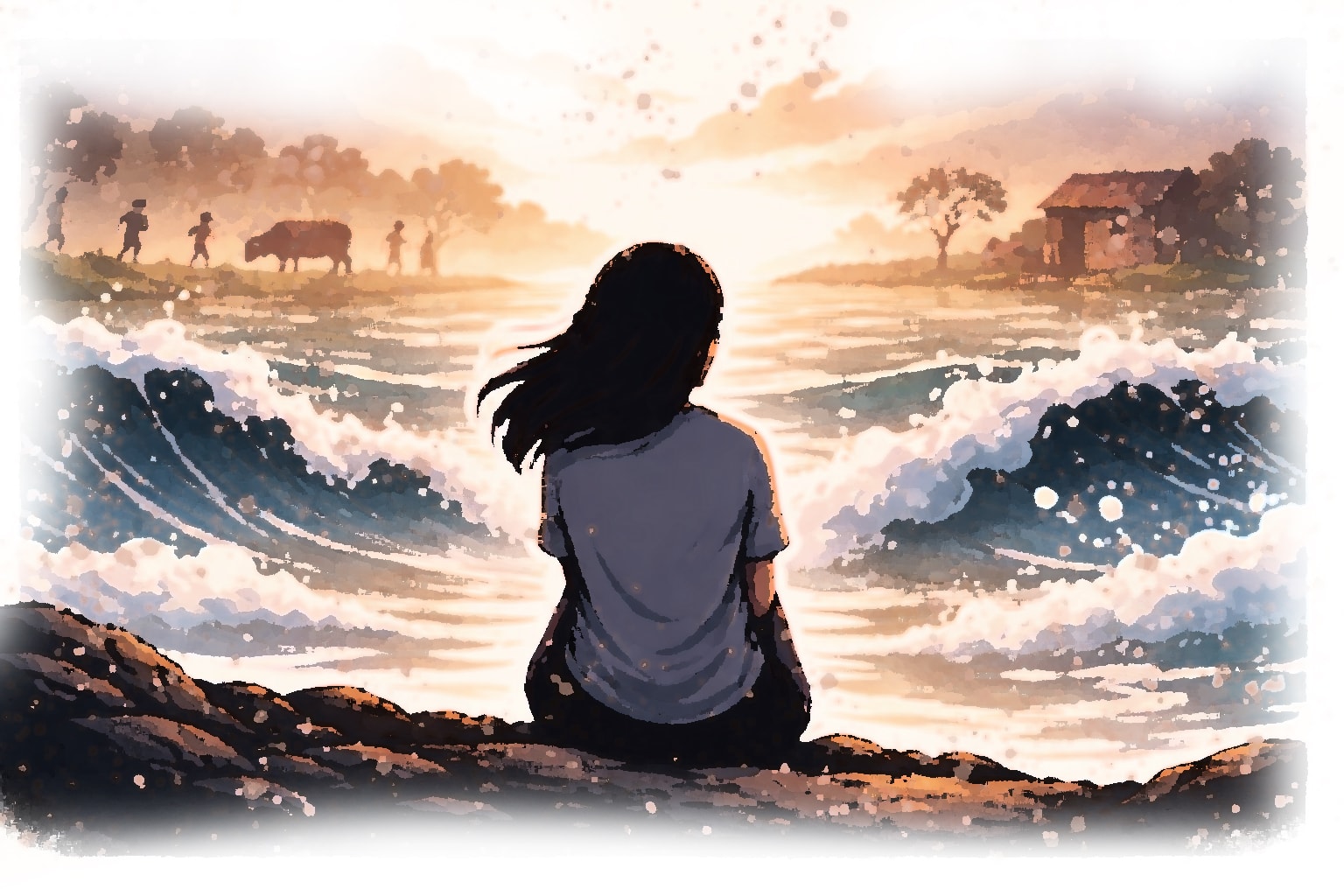
Now, Ha sat there, before the raging waves, each murky surge swirling, the waves crashing against the shore, creating light foam clinging to the sand, then, carried away by the wind, dissolving like soap bubbles. Ha sat there, silent, frozen, thinking about the days gone by, everything like the foam of the waves—all the efforts, the struggles, the dead ends. A fleeting image of the cold granite house, her familiar, trembling back, her child's startled eyes, and Hung trudging along. Was it still not too late? She suddenly shuddered, turning her car around and rushing back, without even thinking about what she would do, but determined to save her husband.
Outside, the waves are still roaring angrily; it seems a storm is coming tonight.


