
6 DIY experiments to help children love science
Guide elementary school children through these six simple experiments, and you'll make them believe in magic and become curious about how the world around them works.
1. The water cycle in the plastic bag
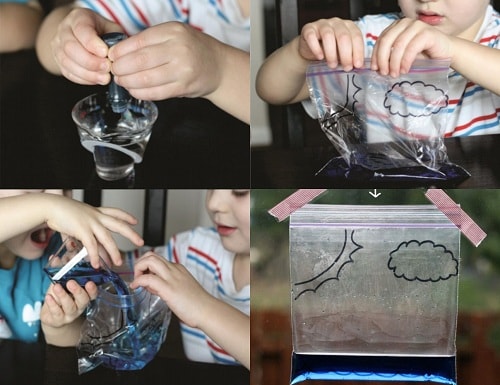 |
| You'll need a compressed plastic bag, some water, blue food coloring, your hands, and your imagination. |
Experiment:Add 4-5 drops of dye to the water. For a more natural look, you can draw clouds and waves on the surface of the bag before pouring in the dyed water. Seal the bag tightly and hang it on the window with some tape. Wait for the results, and you won't be disappointed. You now have a weather machine at home, and the children will enjoy watching the raindrops fall on the sea.
Explain:Earth has a limited amount of water, so our planet has a water cycle. Under the warm sunlight, the water in the bag evaporates and turns into steam. As it cools, it transforms back into liquid and falls as raindrops. This phenomenon can be observed in the bag for a few days, but it happens all the time in the outside world.
2. The "whirlpool in a bottle" phenomenon
 |
| You will need water, a clear glass jar with a lid (the taller the better), dish soap, dye, and sequins. |
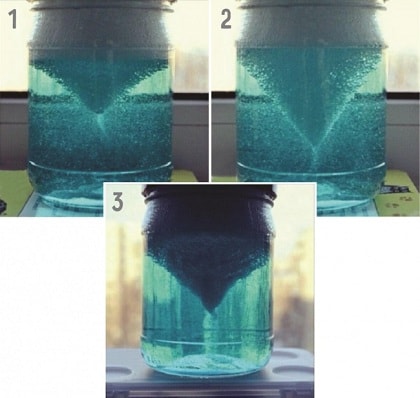
Experiment:Fill the bottle three-quarters full with water and add a few drops of dish soap. After a few seconds, add the dye and sequins. These help to make the waterspout more visible. Close the bottle, shake in a spiral motion, and observe.
Explain:When you shake the bottle in a circular motion, you create a swirling vortex of water, like a tiny tornado. The water moves rapidly around the center of the vortex due to centrifugal force. Tornadoes also occur in nature, but children should definitely only see them in a home experiment bottle.
3. Rainbow Water
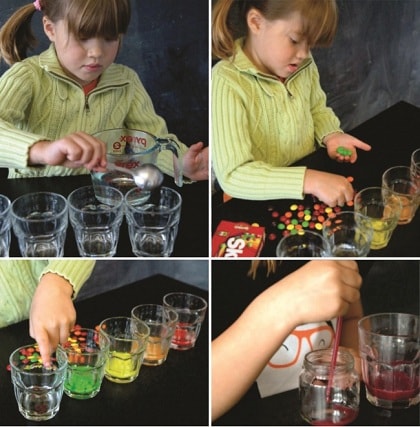 |
| You will need a glass jar, 5 small cups, a cup of hot water, a spoon, a syringe, and a child with a sweet tooth. You will also need some candy: 2 red, 4 orange, 6 yellow, 8 blue, and 10 purple. |
Experiment:Pour 2 tablespoons of water into each cup. Add the correct amount of candy to each cup according to color. Hot water will help the candy dissolve faster. If the candy dissolves slowly, microwave for 30 seconds. Let the liquid cool to room temperature.
Using a syringe, pour the liquid into the glass jars, starting with the cup containing the most liquid (purple) and ending with the cup containing the least (red). It's best to drop the liquid onto the side of the jar so it falls slowly. The result will be a cup of rainbow water.
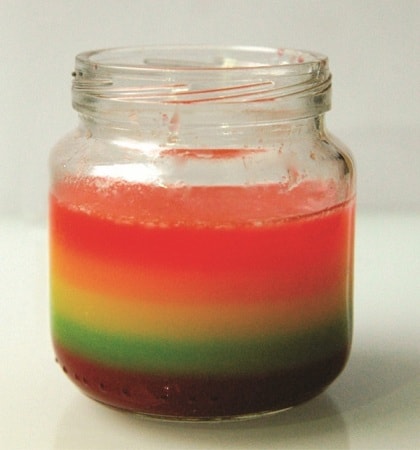 |
Explain:The key to this consistency is fluid density. Thicker, heavier layers move downwards more quickly, while thinner layers float on the surface.
4. Invisible Ink
You'll need a lemon, cotton swabs, a piece of paper, a jar, anything to decorate with (hearts, sequins), and lots of love.
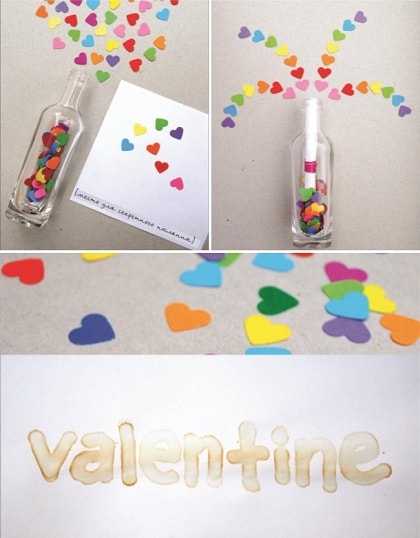 |
Experiment:Squeeze some lemon juice into a cup and dip a cotton swab into it. Use it to write your secret message. To make the message appear, you need to heat the paper (by ironing it or holding it over a flame or other hot object). Be sure not to let children do this alone.
Explain:Lemon juice is an organic substance that can be oxidized (reacts with oxygen). When exposed to high temperatures, it turns brown and burns faster than paper. Orange juice, milk, vinegar, alcohol, honey, and onion juice have a similar effect.
5. Dancing Gummy Candies
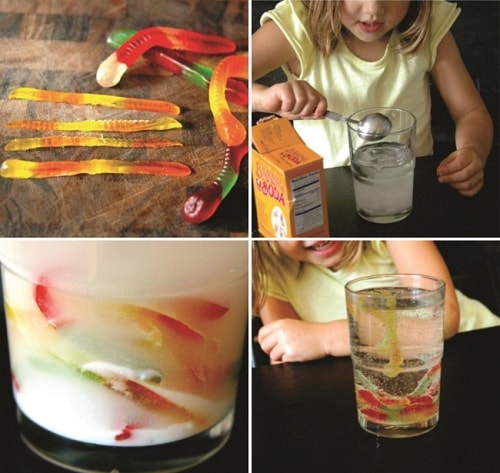 |
| You will need marshmallows, baking soda, vinegar, a cutting board, a knife, and two clean cups. |
Experiment:Cut each marshmallow bar into 4 long strips. Dip the knife in water before cutting to prevent sticking. Then dissolve 3 tablespoons of baking soda in warm water.
Place the marshmallows in a baking soda solution and wait about 15 minutes. Next, take them out and place them in a cup containing vinegar. They will immediately fizz, begin to dance, and float to the surface.
Explain:When you place the marshmallow strands soaked in baking soda into vinegar, the acetic acid reacts with the bicarbonate in the baking soda. Carbon dioxide bubbles form on the strands, pulling them to the surface of the water, making them appear to dance. Once at the surface, the bubbles burst, and the marshmallow strands fall to the bottom, only to produce new bubbles and rise again. For best results, use only four marshmallow strands at a time to allow them ample space to "dance."
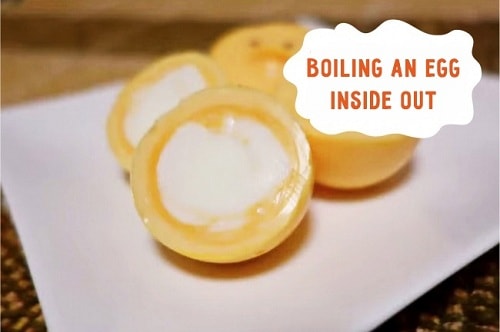
6. Eggs with the white and yolk turned inside out.
You will need 1-2 eggs, tape, a thin stocking, and a pot of water.
 |
Experiment:Before you begin, you should examine the egg with a flashlight. It's very easy to see through. Then wrap the egg tightly with tape. Place the egg in the middle of the sock, twisting both sides. Hold both ends of the sock and rotate the egg around its axis. Shine the flashlight again to see if the egg is ready for the magic.
Boil the egg without removing the tape, flipping it from side to side. Boil for 10 minutes, then let it cool and peel. The result is an egg with the yolk on the outside and the white on the inside!
According to VNE
| RELATED NEWS |
|---|


