
"Wooden Fish Bookcase" spreads and nurtures reading culture.
"The Wooden Fish Bookcase" is one of many groups established with the aim of expanding and further developing the "Rural Book Program" in Nghe An province. Through this program, many bookcases have been donated to school libraries to help students in disadvantaged areas of the province access books and cultivate a reading culture. On the occasion of the 2025 National Book and Reading Culture Day, Nghe An Newspaper had an interview with Mr. Tran Viet Khanh – the founder and project manager of the "Wooden Fish Bookcase" project.

Execution: My Ha - Technical support: Diep Thanh
Publication date: April 21, 2025
"Wooden Fish Bookcase" is one of many groups established with the aim of expanding and further developing the "Rural Book Program" in Nghe An.
Through this program, many bookshelves have been donated to school libraries to help students in many disadvantaged areas of the province access books and foster a reading culture. On the occasion of the 2025 National Book and Reading Culture Day, Nghe An Newspaper had an interview with Mr. Tran Viet Khanh - the founder and project manager of the "Wooden Fish Bookshelf" project.
PV: “The ‘Books for Rural Areas’ program is a meaningful social initiative aimed at promoting reading and bringing knowledge to rural and remote areas in Vietnam. What led you to participate in this program?”

Mr. Tran Viet Khanh:The "Rural Book Program" is a meaningful initiative launched and expanded by Mr. Nguyen Quang Thach to many provinces and cities across the country. The program is currently being extended by a large community of social members, including intellectuals, businesspeople, social activists, and even students. In 2016, the "Rural Book Program" was awarded the Literacy Prize (for literacy) by UNESCO and received an award for knowledge dissemination from the American Library of Literature.

As a book lover, when I learned about Mr. Nguyen Quang Thach and this project, I immediately supported it, even though I was working abroad at the time. Later, around 2016, after returning to Vietnam and settling into my job, I, along with about 10 other friends, mostly from Nghe An, founded the "Wooden Fish Bookcase" group. From the beginning, we didn't aspire to cover as many areas as the "Rural Book Program" had envisioned. Instead, our goal was to donate bookshelves to schools in the mountainous districts of Nghe An, such as Con Cuong, Ky Son, and Tuong Duong... where we grew up and where many people still face difficulties.
PV: One of the models of "Rural Book Project" is the "Classroom Bookcase." This seems to be the direction you have been implementing for many years in many schools in Nghe An province. Why did you name it the "Wooden Fish Bookcase"?

Mr. Tran Viet Khanh:From the beginning, we hoped to donate as many bookshelves as possible to classrooms, especially in ethnic minority boarding schools, where students spend a week at school and don't have many opportunities to read. In fact, during the implementation process, when choosing locations for the bookshelves, we often opted for school libraries, classrooms, or central school spaces where students have ample access to books. I remember our first trips around 2017, when we donated nearly 100 bookshelves to schools in Ky Son district. Wherever parents and schools supported the creation of bookshelves in classrooms, we arranged for individual bookshelves for each class. Additionally, we also donated books to the school libraries.
From the very beginning, we named the program "Wooden Fish Bookcase." The name "Wooden Fish" immediately evokes the people of Nghe An and Ha Tinh provinces, identifying it as a bookcase dedicated to Nghe An and Ha Tinh. However, we also conveyed other meanings, such as "Wooden Fish" symbolizing diligent study. We also hope that the books we donate will help students access diverse sources of knowledge, nurture their love of books, and build a reading culture in schools.

PV: Your program is implemented in a spirit of volunteerism. Could you share more about the implementation process?
Mr. Tran Viet Khanh:To date, our program has been running for almost 8 years, with many bookshelves donated. However, compared to our goals, this is still quite modest. Previously, we organized 5-6 trips per year to donate books to schools. However, since the Covid-19 pandemic, due to changes in work schedules and team members, the number of books donated has decreased significantly. I and the team members always hope and strive to ensure the program continues for the long term...

I also want to share that our program doesn't have a regular funding source. Fundraising only takes place at the beginning of a new trip. We don't accept large sums of money; instead, we raise funds in small installments, depending on the program's requirements. Many people have been with us for years. Although the amount contributed each time isn't much—sometimes just a few tens or hundreds of thousands of dong per person—we all find the program very enjoyable and meaningful. After each trip, all information is publicly and transparently shared so that everyone can see the program's effectiveness.

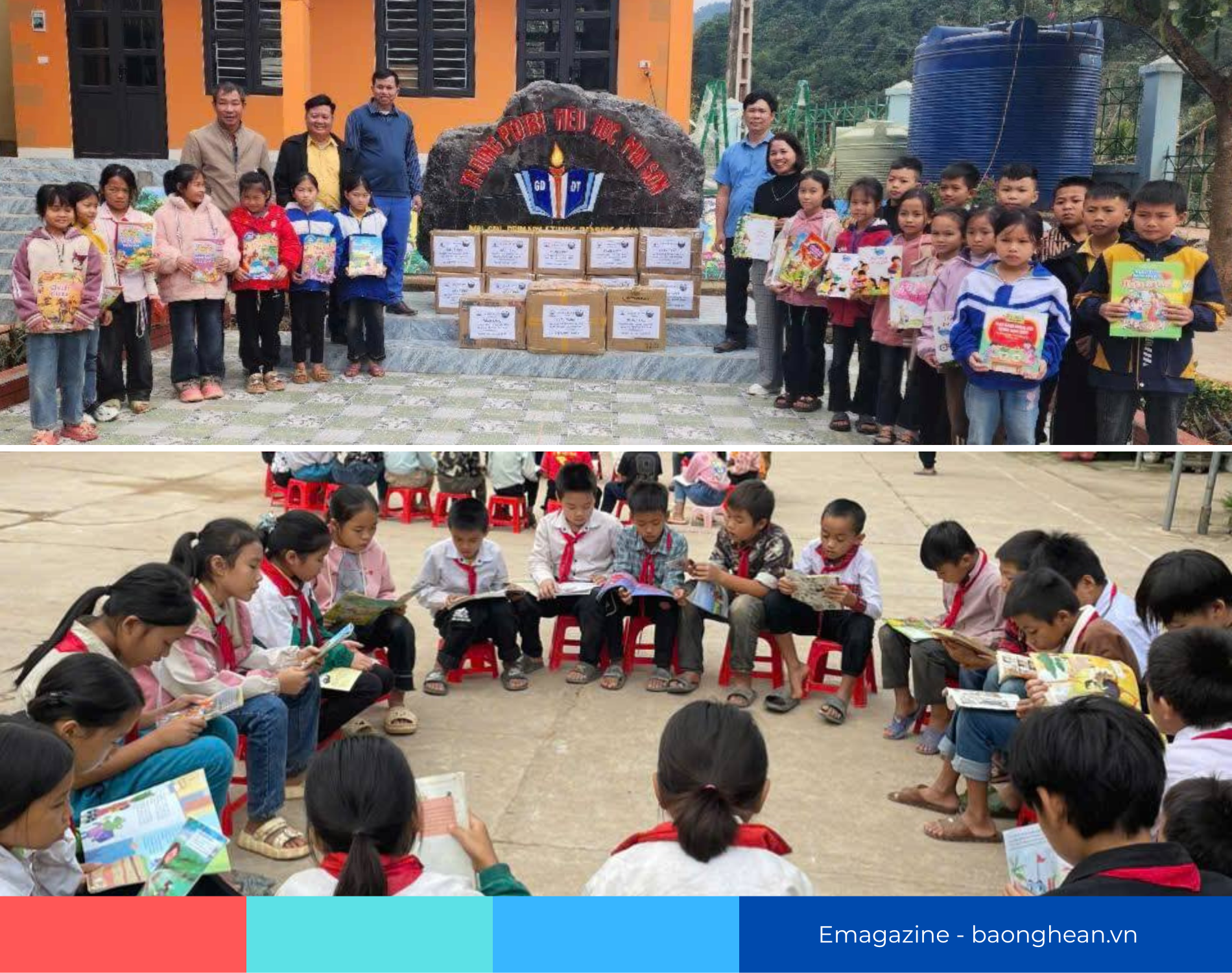
One of the most recent trips of the "Wooden Fish Bookcase" was donating nearly 800 books to Mai Son Ethnic Boarding Primary School (Tuong Duong) at the end of December 2024. Afterwards, we received a thank-you letter from the principal and were delighted that the school's management committed to using the bookcase effectively to best serve the students, staff, and teachers. This also helps the school continue its mission of spreading reading culture, igniting a passion for learning, and developing a reading culture among students.
PV: Having been involved with the program for many years, what is your biggest concern when carrying out the book donation and building classroom libraries for schools?
Mr. Tran Viet Khanh:I grew up in the mountainous district of Con Cuong, but it was thanks to these book donation trips that I learned about the high-altitude mountainous districts like Tuong Duong and Ky Son, and realized how many difficulties and hardships still exist there.

Due to the many hardships of life, books remain a luxury for students in mountainous regions. In fact, even in my birthplace, it's the same. In the district, besides textbooks, there isn't a single large-scale bookstore selling reference books or books for general enjoyment. If there are any, they are very few and far between. My generation, growing up in a poor town, were all avid readers. I myself could sit all day at the district library and only leave when the librarian closed the doors. Personally, I believe that reading has broadened my mind; I've learned so much from the books I've read since I was a child.
When implementing the program, we also put ourselves in the students' shoes and always wanted the books to reach the right students and maximize their value. Typically, when donating books, our target is 20% history books, 20% science books, 20% books about famous people, and 10% novels. For younger age groups, we are also very careful in our selection. For example, we often buy Doraemon books for the libraries, but we choose books that are both entertaining and educational. I hope that these good books will spark the children's interest in reading and gradually cultivate a love for books.
For this reason, when starting the bookshelf project, we had a rather high demand, requiring the school's cooperation. This means we would donate books to the classes, but I wanted both teachers and parents to work together to build the bookshelf for the students. If both sides cooperate, the program will be more effective and meaningful, ensuring that the donated books bring real value to the students.
PV: Recently, there have been many opinions suggesting that young people today no longer love books as much as they used to. Do you personally agree with this opinion, and does it diminish the enthusiasm of the members participating in the "Wooden Fish Bookcase" program?
Mr. Tran Viet Khanh:As I shared, in the past, before phones, the internet, and extra tutoring, books were truly childhood companions for many. There were books we read over and over again, passed down and preserved year after year. Nowadays, perhaps life has changed a lot, so young people live faster and read faster too. Of course, there are still book lovers, but besides books, young people today have many other channels for entertainment.

Despite changes, we still believe that bringing books to disadvantaged areas is essential. In fact, many students currently lack access to books. Therefore, if schools propose it, we will do our best to bring books to the students. Although our contributions may not be substantial—some contribute a little, others a lot—I believe that small contributions add up to a big one. The "reading culture" will "connect the community," and we are happy to share our responsibility with society.
Interviewer: Thank you for joining the conversation!
The leader of the "Wooden Fish Book Collection" - Tran Viet Khanh - was born in 1987 in Con Cuong district. He graduated from the Posts and Telecommunications Institute of Technology and is currently working as an Information Technology engineer at a telecommunications agency of the Army.


