
South Korea U22 lost 0-2 to China, giving Vietnam U22 the advantage.
South Korea U22 suffered a 0-2 defeat against China U22 at the 2025 Panda Cup, their first consecutive loss to this opponent in 21 years; with four teams tied on 3 points, Vietnam U22 has a great opportunity.
The 0-2 defeat of the South Korean U22 team against the Chinese U22 team at the 2025 Panda Cup not only concluded a disappointing evening but also marked a sad record: for the first time in 21 years, a South Korean men's national team at any level has lost consecutively to a Chinese representative. With four teams tied on 3 points after two rounds, the door to the championship is clearly open for the Vietnamese U22 team before the final match.
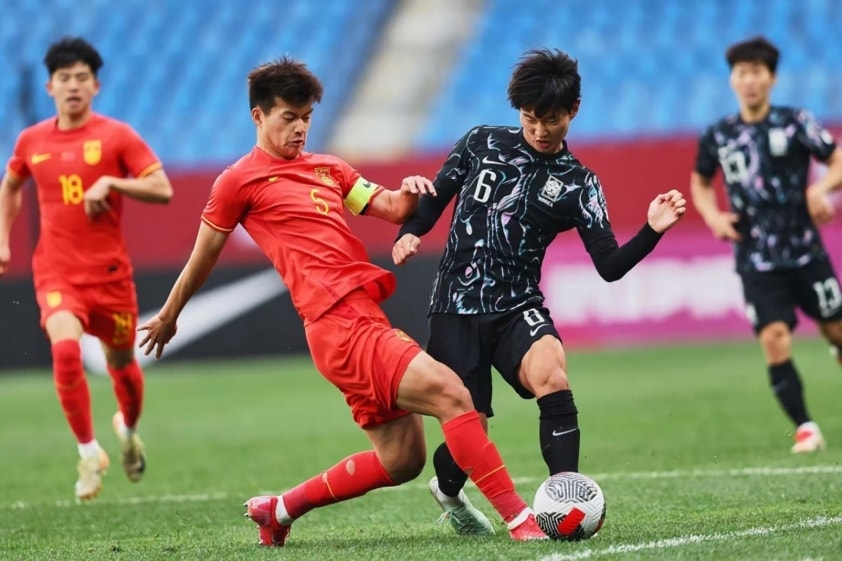
A sad record after 21 years.
Both goals conceded by the South Korean U22 team against the Chinese U22 team came from striker Behram Abduweli, sealing a 0-2 defeat at the 2025 Panda Cup. The poor run of results for South Korean youth football against China began with a 0-1 loss at the CFA Team China friendly tournament in March. Now, with their second consecutive defeat, they have reached an undesirable milestone, the first since 2004.
This development immediately became the focus of South Korean media attention, not only because their opponent was China, but also because of the way the South Korean U22 team performed: disjointed play lacking identity. The overall picture is even more worrying considering their U17 team had previously been eliminated from the World Cup.
The 2025 Panda Cup race is leveling the playing field.
After two rounds of matches, the 2025 Panda Cup has become a "four-team, one-point race." Vietnam U22, China U22, South Korea U22, and Uzbekistan U22 all have 3 points, with one win and one loss each. The gap has narrowed, turning the final round into a true "final": every team still has a chance to lift the trophy.
A championship scenario for Vietnam U22
Coach Dinh Hong Vinh's team will face U22 South Korea on November 18th. Based on the current situation, the chance of winning the championship is entirely within their grasp if they meet the minimum requirement of winning, coupled with the following favorable scenarios:
- Having beaten U22 South Korea and having a better goal difference than the China-Uzbekistan match-up.
- Or: Win against South Korea while the other match ends in a draw.
With their direct rivals having just suffered two consecutive defeats against China in different tournaments, the Vietnam U22 team enters the final match with a psychological advantage. However, the nature of this "decisive match" demands maximum concentration and careful management of goal difference risks.
Pressure from the South Korean U22 team.
With a disappointing record for the first time in 21 years, the South Korean U22 team is under immense pressure to prove their worth. Skepticism from the South Korean media regarding their disjointed and uninspired playing style is pushing the team further into a position where they must react. This could turn the match against Vietnam U22 into a test of both their mental fortitude and tactical organization.
The significance of the Panda Cup transcends boundaries.
For the Vietnam U22 team, this is an opportunity to boost morale before the SEA Games 33 and affirm the progress of youth football. A victory would not only solve the points problem at the Panda Cup 2025 but also reinforce confidence in the competitiveness of the next generation.
The final round is like a "final".
All four teams have 3 points, so goal difference and the results of head-to-head matches in the final 90 minutes will decide the championship. U22 Vietnam will face U22 South Korea, while U22 China will take on U22 Uzbekistan: two parallel matches, one finish line.
With the deadline approaching and the pressure to achieve results mounting, the race at the Panda Cup 2025 awaits a test of character. And there, the Vietnam U22 team has the opportunity to turn their current advantage into a title.


