
Vietnam U22 team struggles in aerial duels, needs to diversify.
More than half of the goals in the U23 Southeast Asian Championship came from aerial balls, but this tactic has been neutralized in recent tournaments; the Vietnam U22 team needs to innovate for the SEA Games 33.
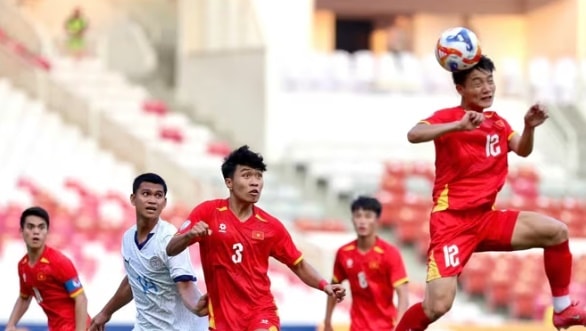
The Vietnam U22 team once excelled with long balls, but signs of being figured out are becoming apparent. At the U23 Southeast Asian Championship in Indonesia, 4 out of 7 goals came from set pieces and crosses. However, in the U23 Asian Cup qualifiers, the Panda Cup, and the closed-door matches against Qatar U22 in the UAE, opponents blocked wing play and tightened marking within the 16.5-meter box, making this tactic less effective even against Singapore U22.
From key weapons to bottlenecks
Improved physical fitness and well-organized tactics have transformed aerial balls into a key attacking weapon for the Vietnam U22 team. The fact that they scored 4 out of 7 goals in Indonesia is proof of this effectiveness: corner kicks, free kicks, and crosses into the penalty area all yielded positive conversion rates.
But football is a constant movement. When an advantage is exposed, the opponent adapts. Teams with equal or superior physical stature significantly reduce their advantage in challenges. Intense man-marking in the 16.5-meter area, coupled with aggressive pressing from both flanks to cut off ball supplies, neutralized the familiar strengths of the Vietnam U22 team.
When the opponent reads your strategy
Recent tournaments have shown that the "magic" of aerial play is no longer absolutely effective. Although specific details of closed-door matches haven't been fully released, the general trend is clear: wing play and long balls are being neutralized, and their effectiveness has decreased. Notably, even against regional rivals like U22 Singapore, wing attacks and set pieces no longer make a difference.
Common countermeasures
- Closely mark opponents and occupy space within 16.5 meters, limiting their jumping momentum and landing point.
- Press early on both flanks, intercept passes, and cross the ball directly from the source.
- Utilize equal or superior physical strength to break up aerial duel pairings.
The challenge for coach Kim Sang Sik
The core issue is dependence. When option A is neutralized, the Vietnam U22 team needs sharp options B and C to unlock the game. Long balls remain an option, but they cannot be the only one if the goal is to compete for the gold medal at the SEA Games 33.
Based on the team's performance and the need for diversification, the following approaches could be considered:
- Central attacking: increase short passing combinations, release the ball to the second line, and take long-range shots to force the opponent to narrow their defensive block.
- Exploiting the inner corridor: penetrating from the "gap" of the defense to create reverse passes that cut across the face of the goal, reducing reliance on aerial balls.
- Fixed variations: changing the landing point, running distance to the near/far post, and covering to create space to optimize the situation have proven effective in the past.
- Rapid transition: launching an attack immediately after winning possession to take advantage of the moment when the opponent has not yet settled their defensive block.
Looking ahead to the 33rd SEA Games
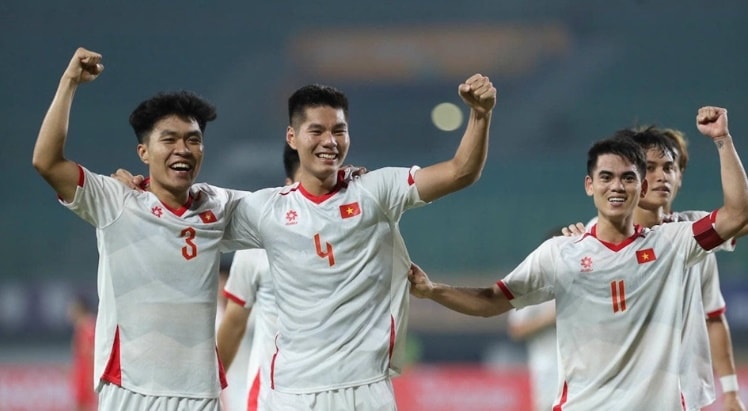
Against highly competitive regional rivals like Thailand or Indonesia, flexibility is paramount. When the Vietnam U22 team can no longer make a difference solely through crosses and set pieces, their ability to combine in small groups, organize attacks through the center, and employ a variety of offensive strategies will determine their unpredictability—thus opening up more winning scenarios.
Therefore, the test for the Vietnam U22 team is no longer about "who is taller" in the 16.5-meter box, but rather about the speed of tactical adaptation. Retaining proven strengths while expanding the attacking toolkit will help the team avoid being confined to a playing style that opponents have already figured out.


