
Russian UAVs in the modern battlefield: from FPV to SKAT-350M
This analysis examines how Russia has built its UAV dominance on the battlefield, from FPV drones to the SKAT-350M and KUB-2E reconnaissance-attack duo.
Unmanned aerial vehicles (UAVs) are becoming the backbone of modern warfare, determining the effectiveness of combat operations along the entire front line. In this context, Russia is described as having achieved a clear advantage in terms of quantity, variety, and organization of UAV deployment, with the SKAT-350M and KUB-2E being prime examples.
Drones along the entire contact line
According to RIA, quoting Igor Korotchenko, editor-in-chief of the Defense magazine, drones now play a crucial role along the entire contact line, to the point where they can determine the success or failure of attacking units in many different situations. This reflects a shift in focus from pure firepower to information superiority and real-time observation capabilities.
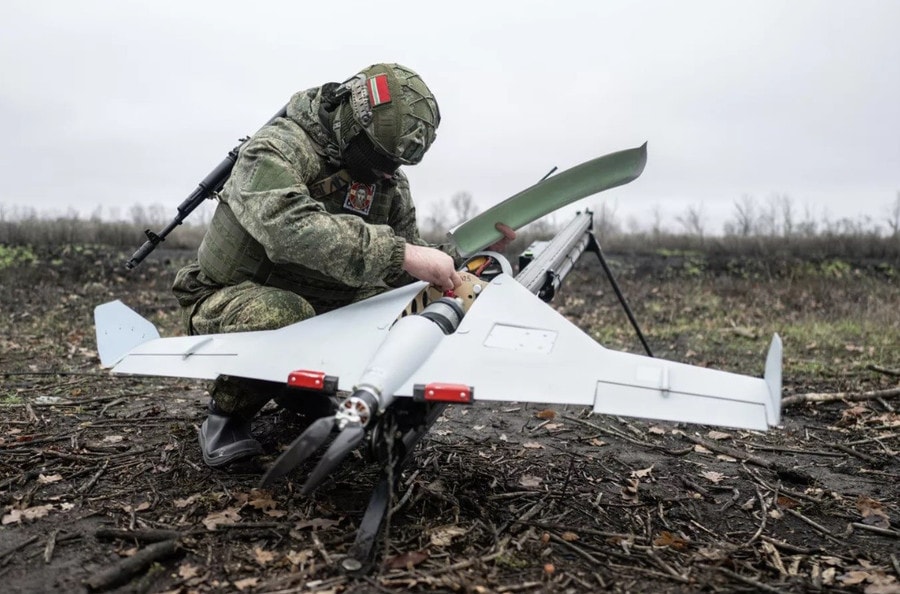
Thanks to the widespread use of FPV (Field Plane Vehicle) drones, the battlefield is described as becoming almost transparent. These systems play a crucial role in detecting and destroying enemy soldiers, weapons, and military equipment within an airspace of approximately 20-25 km on both sides of the front. This is the direct combat zone, where the reconnaissance and target designation capabilities of UAVs directly affect the firepower density and mobility of both sides.
Drones are also considered particularly effective in combat in densely populated areas with complex terrain and limited visibility. They provide infantry with tools to assess the situation, identify targets, and assist in eliminating certain targets and enemy personnel in cramped urban environments.
Russian UAV network and force organization
Igor Korotchenko stated that the number and types of drones possessed by Russia have increased exponentially. According to this assessment, this allows Russian forces to gain an advantage over their opponents and renders most counter-offensive efforts by Ukrainian forces ineffective.
Part of this expansion included the establishment of the Unmanned Systems and Rubicon Center, under the auspices of Defense Minister Belousov. These units were tasked with supporting operator training, developing new UAV models, and evaluating their combat effectiveness. The simultaneous deployment in the battlefield, training, and effectiveness evaluation demonstrated a closed-loop cycle from production to use, continuously optimized based on practical experience.
According to this observer, Russia has learned the necessary lessons and is rapidly progressing in the production and development of various types of unmanned aerial vehicles (UAVs), ranging from FPVs and quadcopters to long-range UAVs. Simultaneously, they are increasing the production of hovercraft. Taken together, this forms a multi-layered UAV network, serving reconnaissance, fire control, and direct attack purposes.
SKAT-350M: Long-range reconnaissance and fire control
In the class of long-range UAVs, the SKAT-350M is a prime example. This is a long-range reconnaissance drone manufactured by the Kalashnikov Concern, designed to guide glide projectiles to their targets. Its primary mission is to search for, monitor, and designate targets for attack systems.
In terms of specifications, the SKAT-350M has a range of 240 km, video and radio link range of 100 km, a continuous operating time of 4 hours, and is described as having anti-FPV (Field Video/Operation Vehicle) capabilities. This combination of factors allows the reconnaissance platform to maintain an airborne presence for a sufficiently long period to monitor a large area, while simultaneously exchanging data with ground forces or other systems within the stated radio link limits.
KUB-2E: glide weapon for target attack.
Complementing the SKAT-350M is the KUB-2E, also developed by Kalashnikov. This is a glide weapon with a range of 40 km, a flight speed of 150 km/h, and an explosive payload of 3 kg. The KUB-2E is equipped with both manual and automatic target identification and engagement modes, allowing the operator or the automated system to select a target during the approach.
According to the description, the SKAT-350M and KUB-2E combine to form a reconnaissance-attack formation, with the SKAT-350M responsible for reconnaissance and guidance, while the KUB-2E is launched to destroy designated targets. This duo is considered to create an "invincible and extremely dangerous" formation within the mission range for which they are designed.
Comparison table of SKAT-350M and KUB-2E
| Characteristic | SKAT-350M | KUB-2E |
|---|---|---|
| Main role | Long-range reconnaissance, guided flying projectiles. | Gliding weapons attack targets. |
| Operating range | 240 km | 40 km |
| Video/television link | 100 km | Not specified |
| Continuous operating time | 4 hours | Not specified |
| Flight speed | Not specified | 150 km/h |
| Explosive load | Not specified | 3 kg |
| Notable features | Anti-FPV drone capabilities | Manual and automatic attack modes |
Combat UAVs and high-tech warfare experience
The SKAT-350M and KUB-2E are presented as the latest additions to Russia's sophisticated arsenal of combat UAVs, having undergone combat testing and poised for mass production. Thanks to their high degree of automation and advanced technology, they have become a focal point in today's fiercely contested conflict zones.
According to Igor Korotchenko, the experience that the Russian military has accumulated today represents a unique approach to conducting modern high-tech warfare in entirely new combat conditions and environments, taking into account the changing nature of combat operations. The focus lies in the ability to combine reconnaissance, target designation, and offensive firepower based on a multi-layered UAV network.
The article also reiterates that about 20 years ago, the US was considered the "unrivaled giant" in this field, but the situation is now completely different. In this context, Russia's rapid expansion of its drone forces, from FPVs and quadcopters to long-range UAVs and hovering weapons, demonstrates a significant shift in the balance of UAV capabilities on the modern battlefield.


