
Iran's Hadid-110 stealth UAV: specifications and deployment
The IRGC deployed the Hadid-110 (Dalaho) stealth UAV, which uses a solid-fuel rocket engine; it has a top speed of 510 km/h, a range of 350 km, and a 30 kg warhead; it appeared at Sahand-2025.
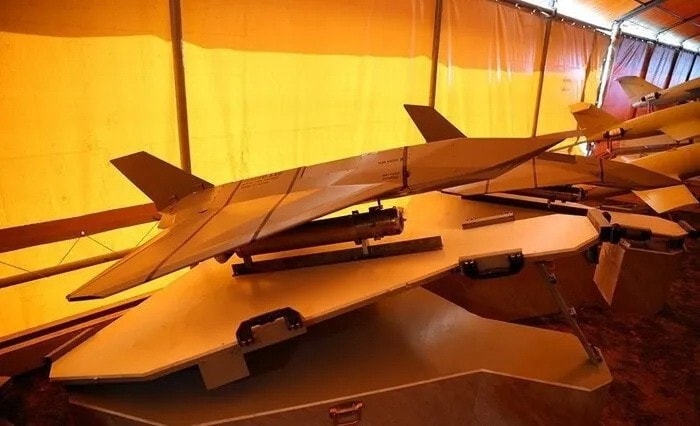
The ground forces of Iran's Islamic Revolutionary Guard Corps (IRGC) have deployed the Hadid-110 stealth drone, also known as the Dalaho. According to the Tehran Times and US Armed Forces ODIN data, this is a jet-powered suicide attack drone, launched with solid-fuel propulsion, reaching a maximum speed of 510 km/h, a range of 350 km, a ceiling of 30,000 feet (9,144 m), carrying a 30 kg warhead, and a maximum operating time of 1 hour. The system was showcased in the Shanghai Cooperation Organization (SCO) Sahand-2025 counter-terrorism exercise in Iran's East Azerbaijan province.

Design and technology
The Tehran Times reported that the Hadid-110 airframe is optimized to reduce its effective radar cross-section (RCS), evident in its stealthy shape with distinctive angles. This configuration aims to limit its radar detectability. The UAV uses a jet engine for the flight phase, allowing it to achieve higher speeds than many propeller-driven UAVs in its class. Launch is assisted by a solid-fuel propulsion system, enabling rapid takeoff and reducing reliance on runways.
Time of announcement and implementation
The Hadid-110 was first unveiled in February 2025 during a meeting between the Islamic Revolutionary Guard Corps leader and scientists, officials, and defense industry experts. This UAV was used in the five-day counter-terrorism exercise "Sahand-2025" of the SCO in East Azerbaijan province (Iran), which involved 10 member states: Belarus, Iran, India, China, Pakistan, Kazakhstan, Kyrgyzstan, Russia, Tajikistan, and Uzbekistan.
The specifications have been stated.
According to the US Armed Forces' open database ODIN and information cited by the Tehran Times:
| Parameter | Value | Source |
|---|---|---|
| Role | Suicide attack UAVs | Video/Tehran Times |
| Type of motivation | Jet engine (cruise); solid-fuel launch | Tehran Times |
| Maximum speed | 510 km/h | Odin |
| range | 350 km | Odin |
| Flying ceiling | 30,000 feet (9,144 m) | Odin |
| Warhead | 30 kg | Odin |
| Operating hours | Maximum 1 hour | Odin |
| Geometric properties | RCS-reducing design, angular | Tehran Times |
Combat capabilities and how to use them
With its suicide attack configuration, the Hadid-110 is designed for unidirectional strikes against a defined target. Its high jet speed (up to 510 km/h) combined with its radar-reflection-reducing shape can shorten the enemy's warning time. A range of 350 km and an altitude of 30,000 feet allow for target engagement at extended tactical ranges. The 30 kg explosive charge is suitable for destroying medium-surface targets such as radar stations, logistics facilities, vehicles, or light fortifications, depending on deployment conditions.
Launching with a solid-fuel propulsion system offers flexibility in launch points, supporting rapid deployment by ground forces. However, a maximum operating time of one hour also means limited time for reconnaissance and target acquisition; the appropriate scenario is to strike a pre-reconnaissance target or a predetermined coordinate.
The significance of the Sahand-2025 initiative.
The appearance of the Hadid-110 in Sahand-2025 indicates that this platform has entered the field deployment phase within the framework of multinational training. In the context of counter-terrorism, high-speed kamikaze UAVs can play a role in rapid precision strikes against specific targets. However, their actual effectiveness depends on the command and control methods, the combat environment, and the countermeasures of the enemy's air defense and electronic warfare capabilities.
Initial assessment
Based on published data, the Hadid-110 combines three notable elements: a reduced RCS (Reduced Coverage System) shape, a jet engine, and solid-fuel launch. This configuration is consistent with the requirement for high-speed strike capability at tactical-operational ranges. However, there is no independent data on its survivability against modern air defense systems or its effectiveness in real combat. The parameters mentioned above mainly come from ODIN and Tehran Times; further verification data is needed to conclude on the extent to which it alters the balance of combat operations.
Conclusion: The Hadid-110 demonstrates Iran's investment focus on high-speed, stealthy kamikaze attack UAVs. In the short term, its applicability depends on the coordination of sensor-command-firepower by the forces using it. In the long term, its effectiveness will be assessed through subsequent field deployments.


