
Is the UAV developed by Viettel comparable to the US MQ-9 Reaper?
At the Indo Defence 2018 exhibition, Viettel, the Military Telecommunications Industry Group, attracted international media attention with its UAV product.
According to information published by the British defense magazine Jane's, at the Indo Defence Exhibition, Viettel Group only displayed a small unmanned aerial vehicle (UAV) called Shikra, weighing 26 kg and with a wingspan of 3.5 m.
However, according to British reports, Viettel plans to manufacture larger UAV models in the future, initially a version with a wingspan of 5-6 meters and an flight time of 10 hours (five times longer than the Shikra).
Most notably, Viettel has announced its long-term plan to research and produce a large UAV with a 20-meter wingspan, which will likely be a variant with a range of 150 km and a flight time of 20 hours.
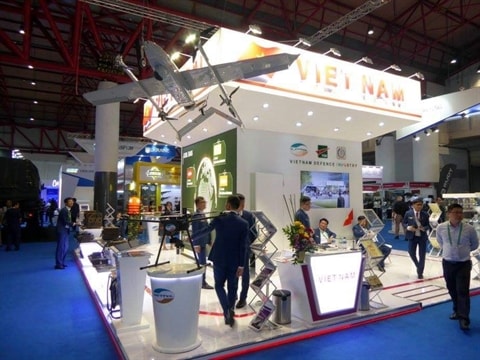 |
| Viettel Group's product display booth at Indo Defence 2018 Exhibition. |
The type of UAV that Viettel is developing is similar in size to the American MQ-9 Reaper, the US's flagship unmanned aerial vehicle, which is 11 meters long, has a wingspan of 20 meters, and a maximum takeoff weight of 4,760 kg.
It is currently unclear what the payload capacity of the UAV that Viettel is researching will be, but it is very likely that it will not be much less than the 1,400 kg that the MQ-9 Reaper can carry.
Another noteworthy detail is that the MQ-9 Reaper can only fly continuously for 14 hours when fully loaded, while the Viettel UAV model will be able to fly for 20 hours.
However, thanks to its advanced guidance system, the MQ-9 can operate independently with a range of 1,852 km, while the Viettel UAV can only be deployed 150 km from its control station.
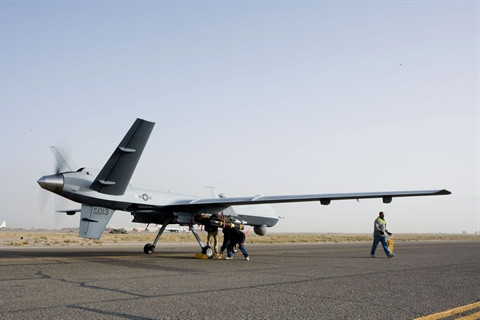 |
| The MQ-9 Reaper armed drone of the US Air Force. |
However, in the future, the limitations in the operational range of UAVs researched and manufactured domestically in Vietnam are expected to change qualitatively when our telecommunications and remote sensing satellite networks are fully deployed in orbit.
With the synchronization of satellite communication networks and advancements in drone programming and control technology, the "Made in Vietnam" UAV will be fully capable of autonomous operation and transmitting data back to command center.


