
Ukraine used UAVs to attack Russian An-26 aircraft and radar in Crimea.
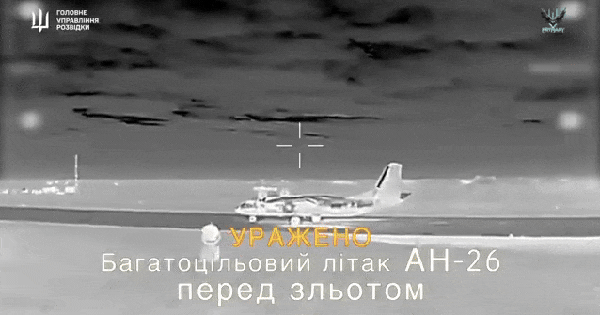
DIU stated that the UAV struck the An-26 at Kacha during takeoff; it also attacked the Nebo-M and 64N6E radars, impairing early warning capabilities in Crimea.
The Ukrainian Defense Intelligence Agency (DIU) reported that the Prymary special forces unit carried out drone strikes against Russian military targets in Crimea. According to the DIU, the drones struck an An-26 aircraft at Kacha airfield just as its engines were starting, destroying the left wing and engine. Simultaneously, the drones also attacked two radar stations, 55Zh6M Nebo-M and 64N6E, which were concealed under protective domes. The DIU assessed that disabling these assets inflicted damage on Russia's multi-layered defense system in Crimea.
Overview of the target of the attack
The An-26 is a Soviet-era military transport aircraft, first test-flown in 1969 and entering service in 1975. It has a crew of 5–6, a maximum payload of 5.5 tons, a top speed of 540 km/h, and a range of 2,500 km. The DIU stated that the attack on the An-26 occurred just as the engines were starting, resulting in damage to the left wing and engine.
Regarding surveillance sensors, the Nebo-M is a new generation radar designed and manufactured by the Nizhny Novgorod Radio Engineering Research Institute (NNIIRT) of Almaz-Antey. The system is designed to detect and track airborne targets, including ballistic missiles, stealth aircraft, UAVs, and hypersonic targets. The 64N6E radar is described by Ukrainian intelligence as the "eyes" that provide target data for the S-300 and S-400 systems.
Technical analysis
An-26
The parameters mentioned above indicate that the An-26 was designed for tactical transport with a medium payload. The attack at engine start-up – according to DIU information – reduced its maneuverability at Kacha airfield. The extent of the damage was described by DIU as the destruction of the left wing and engine.
Nebo-M (55Zh6M)
Nebo-M is designed for autonomous, multi-target tracking. In area-by-area scanning mode, the radar can track up to 20 ballistic targets at distances up to 1,800 km and altitudes up to 1,200 km. The system operates in temperatures from -50 to 50°C, humidity up to 98%, wind speeds up to 45 m/s (level 6), and at altitudes up to 1,000 m above sea level. These data indicate that Nebo-M plays a long-range surveillance role within a multi-layered air defense network.
64N6E
The 64N6E is a long-range surveillance/reconnaissance radar that provides target data for the S-300 and S-400 systems. According to the data, the system can detect ballistic missiles at a range of up to 1,000 km and cruise missiles at 300 km. The attack on this radar, according to DIU, creates a significant gap in the early warning and target designation chain.
Tactical aspect
DIU noted UAV attacks targeting both transport capabilities (An-26 at Kacha) and sensor links (Nebo-M, 64N6E). The simultaneous targeting of airborne targets (aircraft at the airfield) and ground radar indicates an intention to reduce the mobility of forces and weaken the target identification and surveillance layer. DIU assessed these UAV attacks as increasingly effective and difficult to prevent.
For multi-layered air defense networks, long-range radars like the Nebo-M and reconnaissance radars that provide data to the S-300/S-400, such as the 64N6E, are key nodes. When one or more nodes are disrupted, the early warning coverage and the effectiveness of combined firepower can be reduced, forcing the defending side to redeploy sensors or accept a surveillance gap for a certain period.
Main specifications table (based on the data provided)
| System | Role | Key features |
|---|---|---|
| An-26 | Military transport | Crew 5–6; payload 5.5 tons; maximum speed 540 km/h; range 2,500 km |
| Nebo-M (55Zh6M) | Surveillance radar | Tracks up to 20 ballistic targets; range 1,800 km; altitude 1,200 km; operating temperature -50 to 50°C; humidity 98%; wind speed 45 m/s; altitude 1,000 m |
| 64N6E | Surveillance/Reconnaissance radar | Detects ballistic missiles at a range of 1,000 km; cruise missiles at 300 km; provides data for S-300 and S-400 systems. |
Short-term impact
According to DIU's assessment, disabling the An-26 reduces local military transport capabilities, while losses to the Nebo-M and 64N6E directly impact early warning and target designation capabilities. At the tactical level, this could force the defending side to adjust its radar network to restore coverage.
The information above is sourced from DIU. This article focuses solely on describing the facts and technical specifications mentioned, without inferring anything outside the scope of the source.


