
Ukraine attacks Su-30, US conducts further air-launched artillery tests.
Ukraine releases video of attack on Russian Su-30 base, US Army tests resupply of artillery shells by helicopter, Su-57 enters testing phase for new engine.
The Main Intelligence Directorate of the Ukrainian Ministry of Defense released a video showing a Russian air base near the city of Lipetsk being attacked on December 21, claiming that two Su-30 fighter jets suffered temporary damage. At the same time, the US Army tested resupplying 155mm artillery rounds from helicopters during gun raid training, while Russia announced that the Su-57 had completed test flights with the new Product 177 engine, marking the next stage of development for this fighter jet.
Ukraine claims to have damaged two Su-30 fighter jets in Lipetsk.
According to information released by the Main Intelligence Directorate of the Ukrainian Ministry of Defense, a targeted attack on a Russian air base near the city of Lipetsk took place on December 21. Ukraine claims the attack resulted in damage to two Su-30 multirole fighter jets, rendering them temporarily inoperable. A video posted by Ukraine shows footage of the attack on the base.
The Sukhoi Su-30 is a two-seat, twin-engine, multirole fighter developed by Sukhoi Corporation. The aircraft boasts exceptional maneuverability, a top speed of approximately Mach 2 (approximately 2,120 km/h) at high altitude, and the ability to maintain supersonic flight in certain modes without afterburner. Its range is approximately 3,000 km without refueling and can be extended to over 5,000 km with in-flight refueling.
| Key specifications | Su-30 |
|---|---|
| Maximum speed | Approximately Mach 2 (≈ 2,120 km/h) |
| Non-refueled flight range | Approximately 3,000 km |
| Flight range during aerial refueling | Over 5,000 km |
| Number of weapon hanging points | 12 |
| Maximum weapon payload | Approximately 8,000 kg |
In terms of firepower, the Su-30 is equipped with a 30 mm GSh-30-1 cannon and 12 hardpoints allowing it to carry a weapon payload of approximately 8,000 kg. Its arsenal may include R-27, R-73, R-77, and R-37M air-to-air missiles; Kh-29 and Kh-59 air-to-ground missiles; Kh-31A anti-ship missiles; Kh-31P anti-radar missiles; and rockets and precision-guided bombs such as the KAB-500.
Thanks to its diverse weaponry and advanced sensor systems, the Su-30 can perform a variety of roles, from air superiority and ground fire support to long-range precision strike. In the context of the current conflict, Russia is believed to be using the Su-30 primarily for patrol missions, escorting bombers, and launching missiles from outside Ukraine's air defense zone.
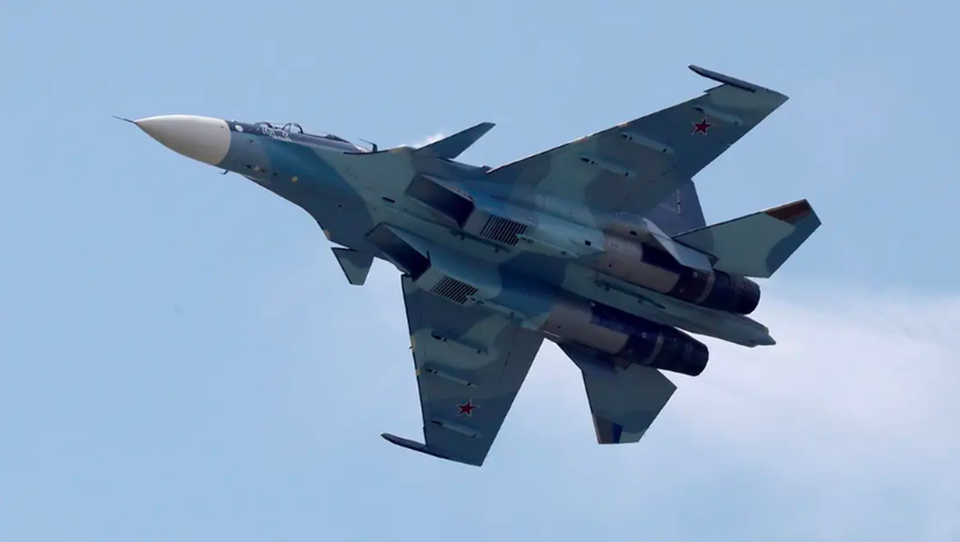
Public estimates suggest that each Su-30 fighter jet is worth tens of millions of dollars. However, the actual impact of the attack – if the claims are confirmed – lies not only in the financial aspect, but also in the temporary reduction of the number of combat-ready aircraft at the targeted base. This could affect the pace and scale of air operations originating from the region, especially if repairs are lengthy or the aircraft cannot be restored.
In addition to long-range attacks, Ukraine also emphasized the role of ground-based UAVs. According to related reports, Ukrainian UAV units are believed to have attacked Russian armored vehicles and engineering equipment in several combat zones, aiming to disrupt ground offensive efforts.
US artillery forces test a helicopter-based ammunition resupply model in a gun raid exercise.
U.S. Army artillery crews recently conducted gun raid training at Fort Riley. Notably, 155 mm artillery rounds were transported directly to the firing positions by helicopter, instead of relying on the usual ground supply convoys.
Gun raids are a form of artillery warfare that emphasizes speed and mobility. Artillery units quickly occupy positions, open fire, and withdraw before the enemy can detect them and retaliate. In high-intensity conflicts, where the enemy possesses effective reconnaissance, counter-fire, and long-range attack capabilities, minimizing the time artillery has to remain stationary becomes crucial to reducing losses.
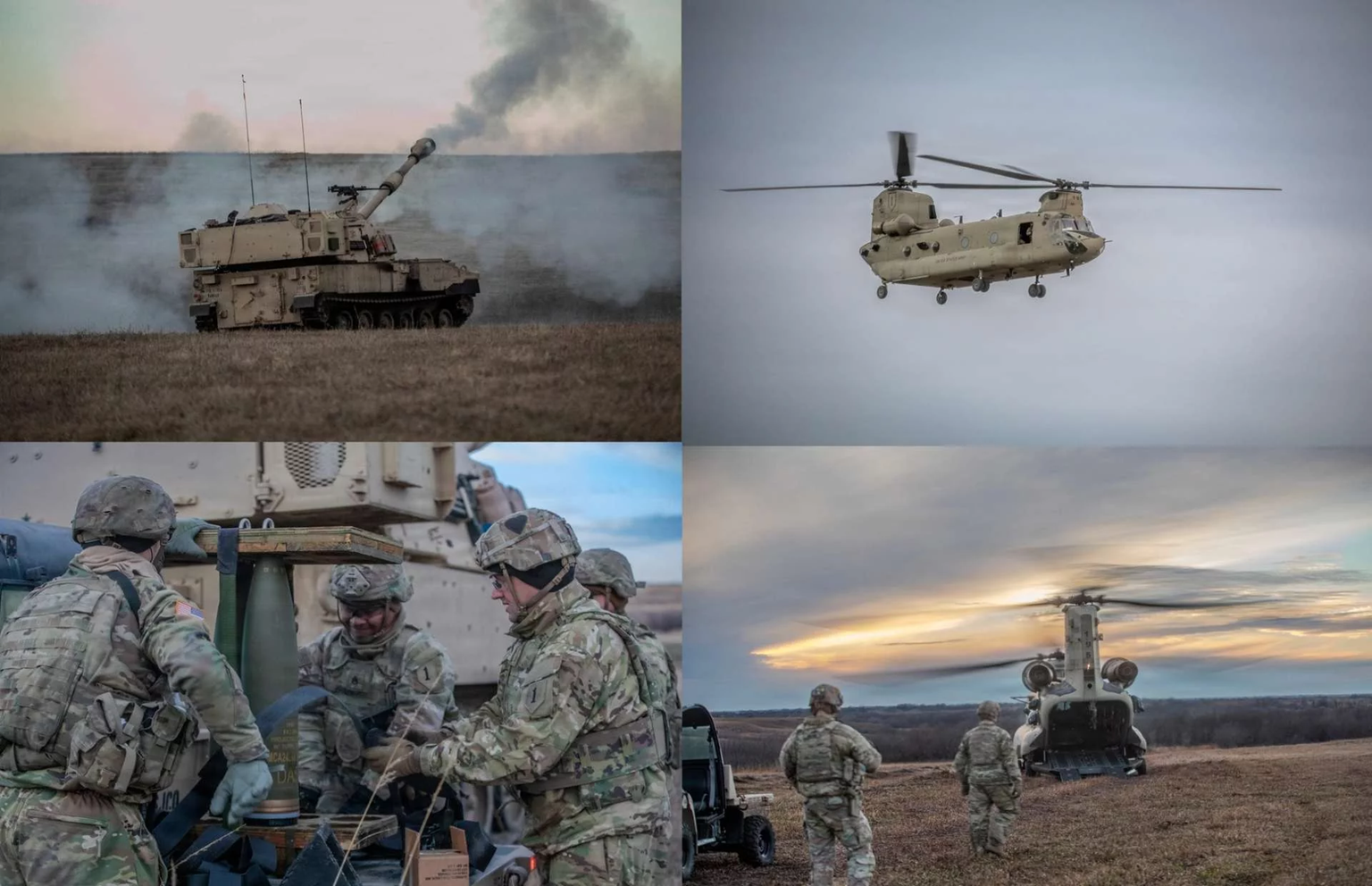
According to the description, the training at Fort Riley aimed to test the ability to maintain artillery fire when ground supply lines were disrupted or became too risky. Airborne ammunition resupply allows artillery units to maintain combat operations even when logistics convoys cannot safely access the area due to enemy fire or complex battlefield conditions.
The centerpiece of the course is the M109A7 Paladin self-propelled howitzer, the main 155 mm artillery piece of the US armored brigades. The M109A7 is designed for mobility within tank and mechanized infantry formations, providing continuous indirect fire. The howitzer has a range of approximately 22 km with standard ammunition and can reach about 30 km with extended-range ammunition powered by an auxiliary engine.
Each 155 mm artillery shell weighs over 45 kg, placing significant demands on resupply organization and transportation. In this training exercise, CH-47 Chinook helicopters were used to deliver the shells to the artillery positions. With an external payload capacity of over 11 tons, the CH-47 can transport large quantities of ammunition and supplies in a single flight.
From an operational perspective, this resupply method reduces reliance on the road network, complicates enemy reconnaissance and attack operations, and increases commander flexibility in firepower deployment. The exercise at Fort Riley demonstrated that the U.S. Army considers logistical support an integral part of artillery operations, especially in high-intensity warfare scenarios against peer adversaries.
The Su-57 has entered the flight testing phase with the Product 177 engine.
On December 22, Rostec announced that Russia had reached another milestone in the Su-57 stealth fighter program with the first flight test of the aircraft using the new Product 177 engine. This event marks the transition from ground testing to specialized flight testing for the engine designed for this fifth-generation aircraft.
According to Rostec, the test flight conducted by test pilot Roman Kondratyev went smoothly, with the engine operating within its specified parameters. Product 177 is presented as a new generation jet engine, achieving a maximum thrust of approximately 16 tons with afterburner engaged, while also improving fuel consumption and lifespan compared to its predecessor. Representatives from United Engine Corporation (UEC) stated that the application of new materials and improved design solutions are key factors in enhancing the engine's overall performance.
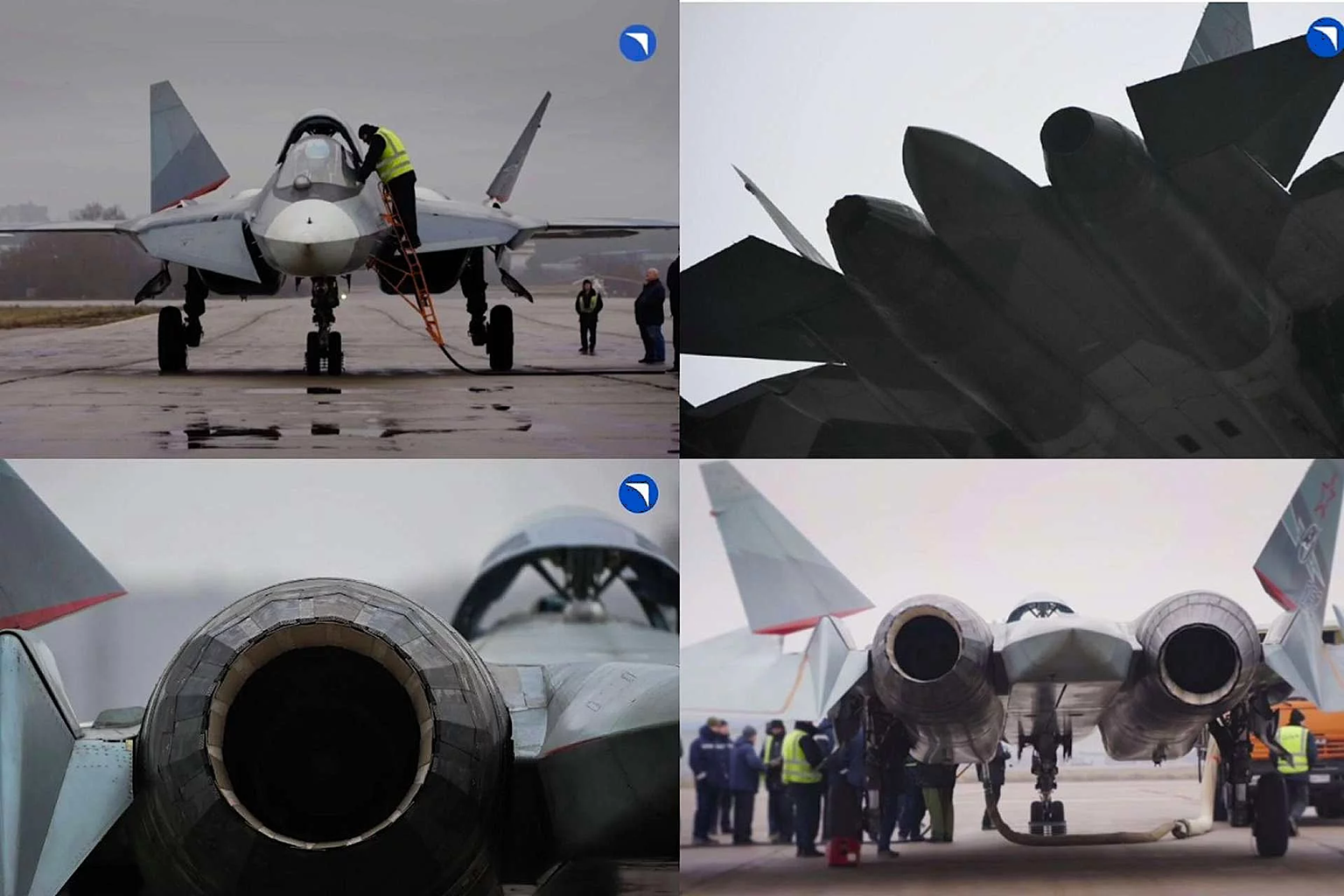
Rostec is placing this event in the context of the Su-57 still being perfected and modernized. According to official descriptions, the Su-57 is a multirole fighter capable of air, land, and sea combat, operating in all weather conditions and complex electronic warfare environments. Experience gained from recent military operations, according to the Russian side, is being used to adjust and upgrade the aircraft's weapon systems and equipment.
From a technical standpoint, the new engine is expected to provide greater performance potential for the Su-57, including improved acceleration, climb rate, carrying weapons payloads in the internal bay with minimal impact on flight performance, and extended operating time. If claims of fuel efficiency and durability are confirmed in real-world operation, the Su-57 could significantly improve its ability to sustain missions in densely air-defense environments.
For comparison, the thrust of the Product 177 is said to be equivalent to the F119 engine on the American F-22, but still lower than the F135 on the F-35. However, with a twin-engine configuration, the Su-57 has a significant total thrust, partially compensating for the difference in individual engine performance. The successful testing of the Product 177 demonstrates Russia's efforts to maintain its domestic military aircraft engine development capabilities. The progress of testing and the ability to bring this engine into mass production will be crucial factors in assessing the actual level of completion of the Su-57, as well as the program's position in the next-generation fighter market.


