
Ukraine integrates interceptor UAVs onto Sea King helicopters to counter Geran UAVs.
The Ukrainian military has converted Westland Sea King helicopters into platforms for carrying small interceptor UAVs, overcoming limitations in battery capacity and altitude when pursuing suicide drones.
The Ukrainian Navy has begun deploying the Cold War-era Westland Sea King naval helicopters as a platform for launching and delivering small interceptor unmanned aerial vehicles (UAVs). This technical solution aims to expand the operational radius and improve the effectiveness of destroying the Geran suicide attack UAVs of the Russian Federation.
The option is to convert a Sea King helicopter into a launch platform.
A new operational strategy was discovered when a Sea King helicopter appeared at the Farnborough Airshow in the UK with a unique configuration. Underneath the helicopter's fuselage, dedicated pylons were installed for small interceptor UAVs, while the crew operated the equipment directly from inside the cockpit.
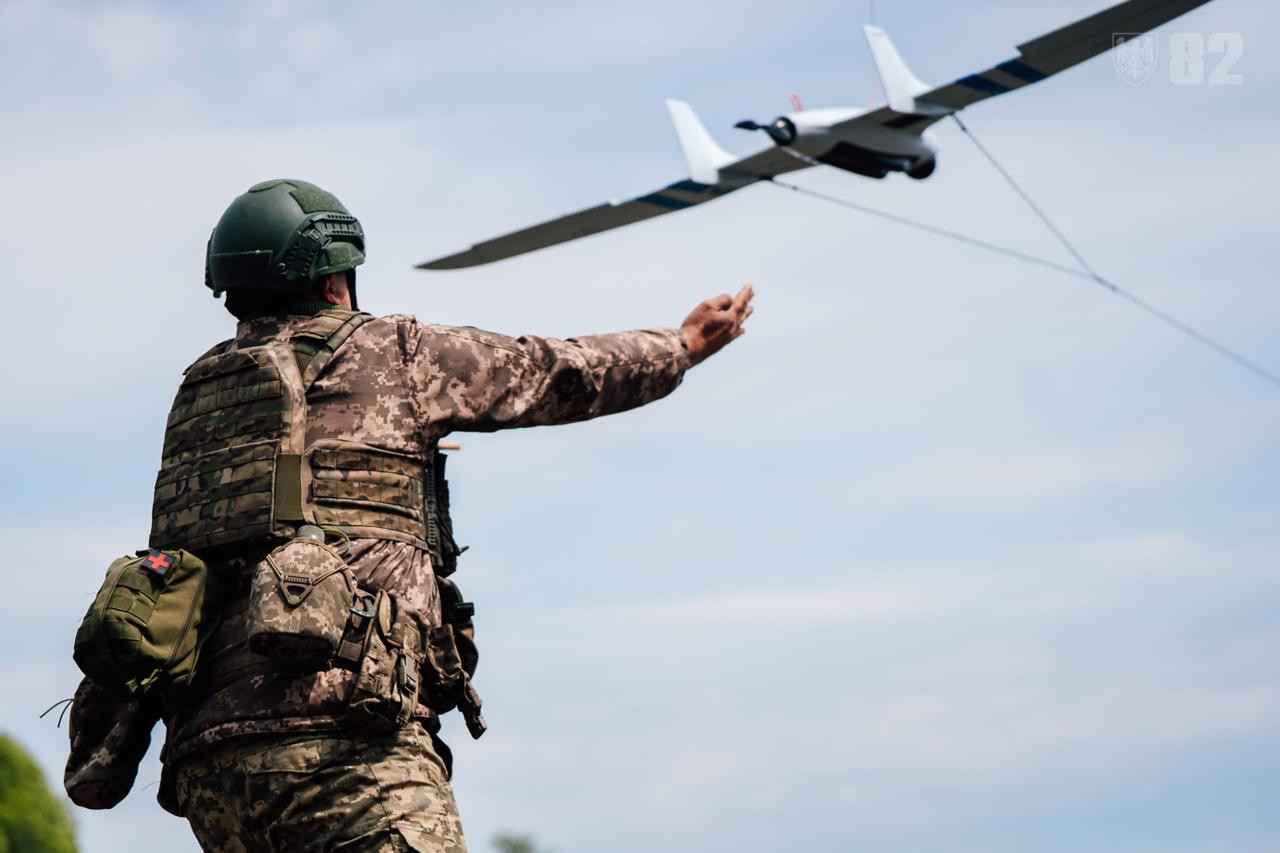
The interceptor UAVs used by Ukraine are low-cost to produce, costing only a few thousand dollars each. Some versions are equipped with AI-integrated automatic targeting systems and carry small explosive charges, while others operate entirely manually and destroy targets using kinetic energy from direct impact.
Overcome battery life limitations and weather conditions.
Although Ukrainian air defense forces achieved a relatively high interception rate against Geran-series UAVs, these small interceptor UAVs faced significant limitations in terms of power. Due to their low-capacity batteries, their flight time was typically limited to just a few minutes. Furthermore, weather conditions such as low clouds or heavy rain significantly reduced the sensors' observational capabilities.
Using the Sea King helicopter as a carrier allows interceptor UAVs to reach an optimal altitude of approximately 1,000 meters, passing through low clouds without consuming battery power during the climb. This enables the UAVs to maintain full battery capacity during the acceleration and target pursuit phases.
Combat capabilities and deployment units
In terms of specifications, the interceptor UAVs have a maximum speed of approximately 350 km/h. This speed is not sufficient to intercept cruise missiles flying at speeds of around 900 km/h, but it is capable of catching up with most versions of Geran UAVs that use conventional propeller engines.
Currently, these helicopters are operated by the 10th Naval Aviation Brigade of the Ukrainian Navy. The unit operates approximately nine Sea King helicopters donated by the United Kingdom and Germany. Previously, this helicopter type was primarily used for search and rescue and light transport missions. Thanks to its spacious cargo bay and reasonable operating costs, the Sea King has been repurposed to support low-altitude air defense networks along the coastal region.


