
'VI Lenin - the creator of a new life'
(Baonghean) - Under the Tsarist regime, the working people of Russia lived extremely difficult lives. In his essay "To the Poor Peasants," written in 1903, V.I. Lenin (1870-1924) affirmed: "The only way to free the working people from their misery is to change the current regime throughout the country from the bottom up and establish a socialist regime."
A Russia of the Dark Ages
At the beginning of the 20th century, Russia had transitioned to the imperialist stage but still retained many remnants of the feudal system.
In agriculture, 30,000 landowners owned 70 million decibels (1 decibel = 1.09 hectares), and the Tsar himself and his family and relatives owned up to 7 million decibels. Meanwhile, Russian peasants made up four-fifths of the population, but 65% of rural households were landless. They were heavily and brutally exploited by the Tsar and the landowners.
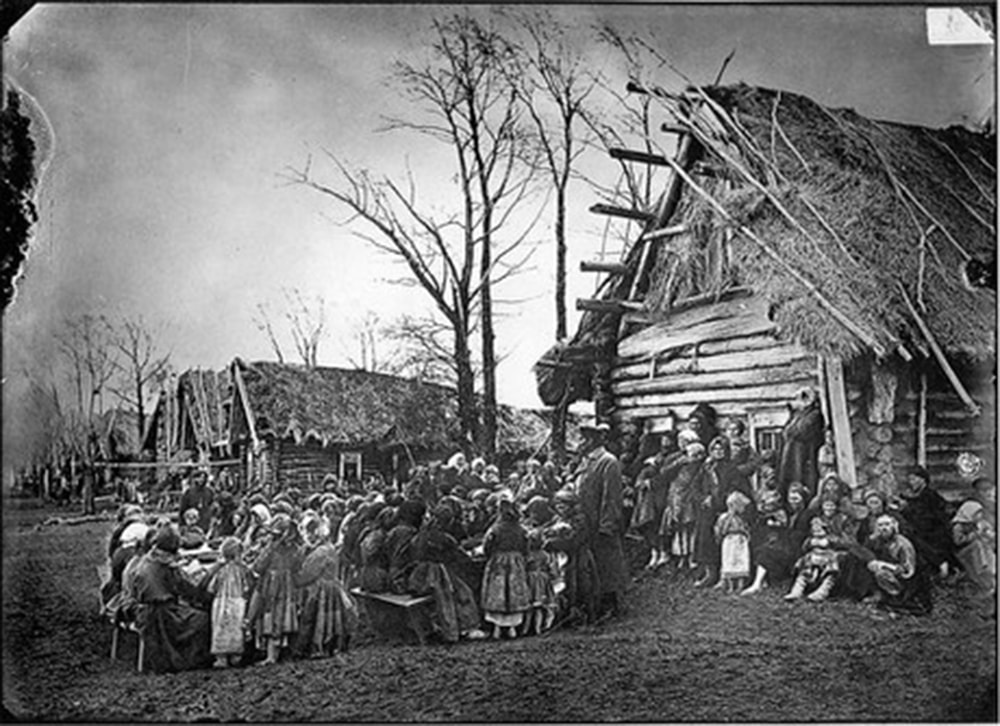 |
| Images depicting the famine years in Nizhny Novgorod, Tsarist Russia, 1891-1892. The photo shows a communal meal of the villagers of Pralevke in the Lukoyanovskoye district. (Historical archive photo) |
In terms of industry, in 1914, Russia's total industrial output ranked fifth in the world, after the United States, Great Britain, France, and Germany, but only accounted for 4% of the world's total industrial output. Almost all of Russia's major industries were in the hands of foreign capital. Workers in Russia made up 10% of the population but were heavily exploited by their employers, resulting in very difficult living conditions.
Lenin observed the situation in Russia as “on one side, the most backward system of land ownership along with the most ignorant rural conditions, and on the other side, the most advanced industrial and financial capitalism.” Lenin recognized the worker-peasant alliance as the core force for the revolution. He stated: “The social content of the revolution about to break out in Russia can only be the revolutionary democratic dictatorship of the proletariat and peasants. The revolution cannot succeed in Russia without overthrowing the monarchy and the feudal landlords. But the proletariat cannot overthrow them without the help of the peasants.”
Opening a new era in world history.
On April 4, 1917, before the Central Committee of the Russian Social Democratic Workers' Party meeting in Petrograd, VI Lenin read "The Tasks of the Proletariat in the Present Revolution." In it, he emphasized the need to resolve the land issue for the peasants and the bread issue for the poor.
On November 7, 1917, the Russian October Revolution triumphed. On November 8, 1917, V.I. Lenin was elected Chairman of the Council of People's Commissars of the Soviet Russian Federation by the Russian Congress of Soviets. He emphasized: “We are proud to have had the honor of beginning the construction of the Soviet State and thus, ushering in a new era in world history, the era of the domination of a new class, the oppressed class in all capitalist countries and everywhere is moving towards a new life, towards the victory of the bourgeoisie, towards the establishment of the dictatorship of the proletariat, towards the liberation of humanity from the yoke of capitalism, from imperialist wars.” On January 10, 1918, the Third All-Russian Congress of Soviets adopted the “Declaration on the Rights of the Working and Exploited People,” affirming Russia as a Soviet state with the goal of abolishing the system of exploitation of man by man and the abolition of class.
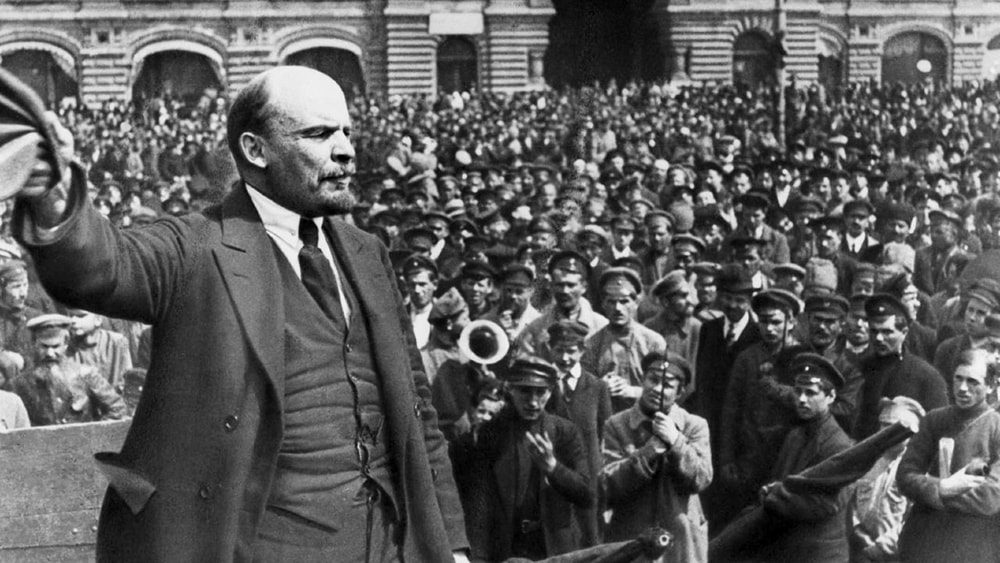 |
| VI. Lenin was the leader who helped Soviet Russia and the Soviet Union develop remarkably from a backward Tsarist Russia. Photo: historical archives. |
To realize these declarations, V.I. Lenin and the Russian Bolsheviks immediately took measures. Regarding agriculture, from the spring of 1918, the "Decree on Land" began to be implemented to satisfy the long-held aspirations of the Russian peasantry. Peasants received (free of charge) more than 150 million hectares of land from the Tsarist family and the landlord class, and had 3 billion rubles of bank debt forgiven. In June 1918, the Soviet authorities established Poor Peasant Committees in the countryside. These committees confiscated and handed over 50 million hectares of land to the poor peasants.
In the industrial sector, on November 14, 1917, V.I. Lenin signed the "Regulations on the Control of Workers." According to this, workers had the right to control the entire production process in all sectors, from industry, agriculture, commerce, and transportation to enterprises and cooperatives. On June 28, 1918, V.I. Lenin issued a decree nationalizing all large-scale industry. By the beginning of September 1918, more than 3,000 industrial enterprises had been nationalized.
To improve the lives of the working people, V.I. Lenin believed that it was necessary to: "Raise the educational and cultural level of the masses," and "Improve the discipline of the workers, their labor skills, and their dexterity." In his "Great Initiative" written in 1919, V.I. Lenin stated: "Only when workers voluntarily and consciously cooperate with each other and use modern technology" can they achieve higher labor productivity. In addition, V.I. Lenin also emphasized the importance of competition in labor and production.
In March 1919, in Moscow, V.I. Lenin met with socialist revolutionaries from around the world and founded the Communist International. According to V.I. Lenin, this was necessary to protect the socialist regime in Soviet Russia internationally, to make the Soviet state a model and inspiration for the world revolutionary movement, primarily the international communist and workers' movement in the West and the national liberation movements in the East.
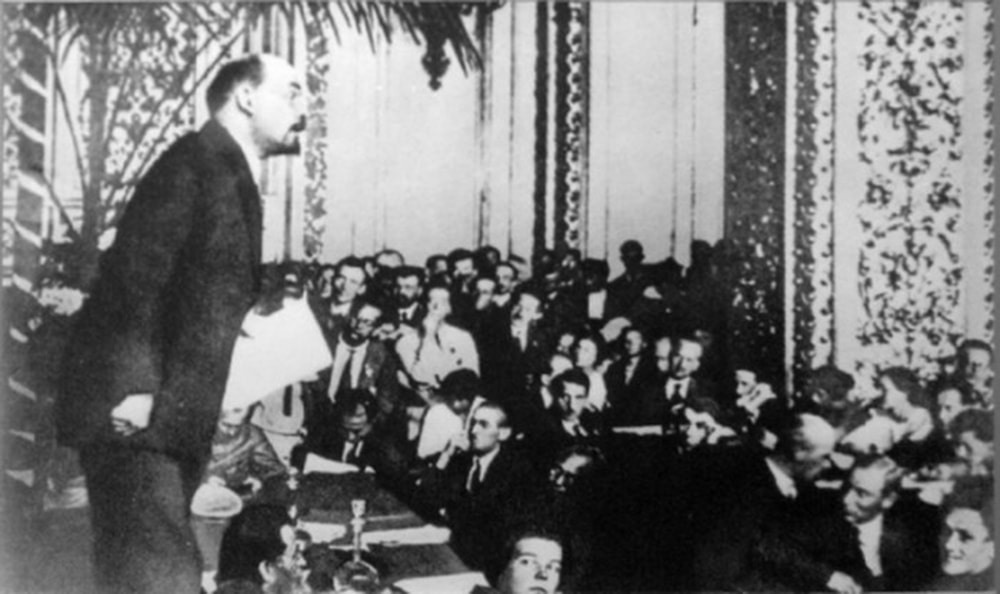 |
| Lenin speaking at the 3rd Congress of the Communist International in 1921. (Historical photo) |
In 1920, with the approval of VI Lenin, Soviet Russia was the first country to allow its citizens to take a day off on International Workers' Day, May 1st. Soviet Russia also established an eight-hour workday and provided various social benefits for its working population.
The Ninth Congress of the Russian Communist Party (Bolsheviks) on March 29, 1920, outlined a plan to restore the national economy. To quickly restore the economy after the civil war and the intervention of 14 capitalist countries, V.I. Lenin proposed the New Economic Policy (NEP) to replace the "War Communism Policy." In agriculture, the state replaced food requisition with a food tax. After paying the tax, farmers had the full right to exchange surplus food on the market. In industry, small enterprises previously confiscated by the state were returned to their former owners. Domestic and foreign capitalists were allowed to open factories and enterprises. In commerce, private individuals were free to trade and exchange goods…
The New Economic Policy (NEP) quickly yielded positive results. In 1921 alone, the first food tax collection reached 90%. By 1922, cities had sufficient food supplies. Labor productivity increased by 33% since September 1925. The lives of farmers and workers improved. The distribution of national income in 1925-1926 showed that 82% of national income belonged to workers and farmers.
On December 30, 1922, the Union of Soviet Socialist Republics was established. The Congress elected V.I. Lenin as Chairman of the Council of People's Commissars of the Soviet Union. This was a great victory resulting from V.I. Lenin's nationalist policy.
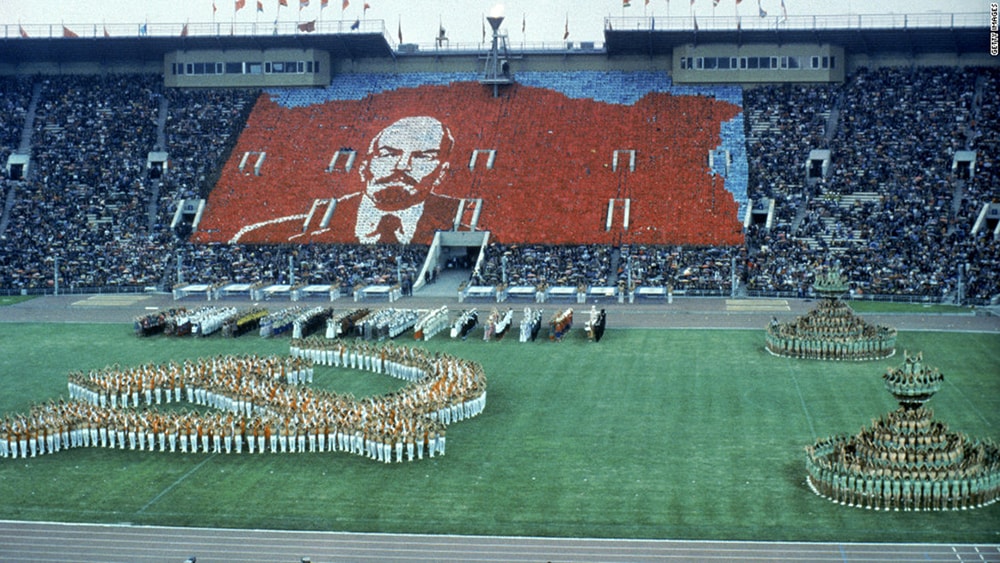 |
| The 1980 Moscow Summer Olympics showed the world an image of peace and development in the Soviet Union. (Historical photo) |
"Lenin was the creator of a new life."
President Ho Chi Minh affirmed: "Lenin is the brilliant successor to the great work of Marx and Engels in new historical conditions." He also affirmed: "In the eyes of colonial peoples, in the history of the suffering and deprivation of colonial peoples, Lenin is the creator of a new life, a lighthouse guiding the path to liberation for all oppressed humanity."
Regarding the path of economic development, President Ho Chi Minh emphasized: "The experience of the October Revolution is a guiding star for us in the cause of building a happy life for the Vietnamese people." In the light of the October Revolution outlined by VI Lenin, President Ho Chi Minh stated: "To put it simply and concisely, socialism is first and foremost about freeing the working people from poverty, ensuring everyone has a job, is well-fed, and lives a happy life." That is precisely the socialist society our people are building: a prosperous people, a strong nation, democracy, justice, and civilization.
After more than 30 years of reform (1986-2020), Vietnam has achieved significant accomplishments in the industrialization and modernization of the country. From a backward agricultural economy with 90% of the population engaged in agriculture, Vietnam has built a material and technical foundation and socio-economic infrastructure that gradually meets the needs of industrialization and modernization, creating an environment to attract social resources for development.
______________________
References:
- VI Lenin, Complete Works, Progress Publishers, Moscow, 1978.
- Ho Chi Minh: Complete Works, National Political Publishing House, Hanoi, 2000


