
The role of trade unions in relation to workers remains unclear.
(Baonghean.vn) - Many grassroots trade unions still do not pay attention to the legitimate interests of workers, and have not grasped the wishes and thoughts of the workers.
On the morning of August 24th, the People's Committee of Nghe An province organized a scientific seminar on reforming the organization and operation of trade unions in the context of international economic integration.
Attending the workshop were members of the Provincial Party Committee: Huynh Thanh Dien - Vice Chairman of the Provincial People's Committee; Vo Thi Minh Sinh - Deputy Head of the Provincial Party Committee's Organization Department; Tran Quoc Thanh - Director of the Department of Science and Technology; Nguyen Tu Phuong - Chairman of the Provincial Federation of Labor; representatives from the Vietnam General Confederation of Labor and a number of relevant departments and agencies.
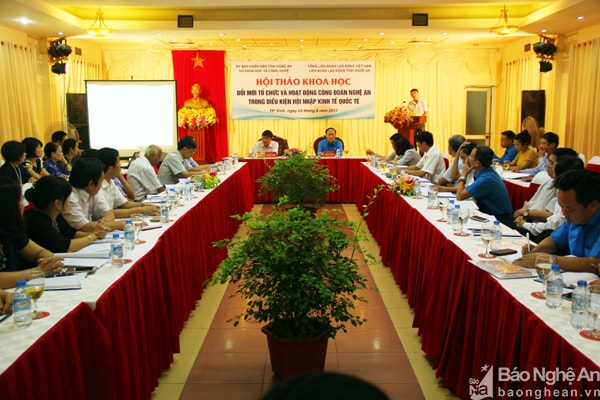 |
| Overview of the workshop. Photo: Tien Hung. |
According to Mr. Nguyen Tu Phuong, the province currently has nearly 16,000 businesses with approximately 70,000 workers. However, only 453 businesses have trade unions. “In the first six months of this year, there were no collective labor disputes or strikes. But in the period from 2010 to 2016, the province experienced 21 strikes,” Mr. Phuong said, adding that this data shows a trend of increasing strikes in recent years.
Some strikes have been prolonged and difficult to resolve, such as the one at Matrix Vinh Company in 2016, which involved approximately 3,000 workers. This strike lasted from October 3rd to October 12th, forcing the company to close down. “Most of the strikes in recent times have not followed the procedures and regulations of the law,” Mr. Phuong said, adding that strikes in Nghe An in recent years have negatively impacted the province's economy and society. Mr. Phuong expressed concern that if strikes continue to occur frequently, investors will hesitate and reconsider investing in Nghe An.
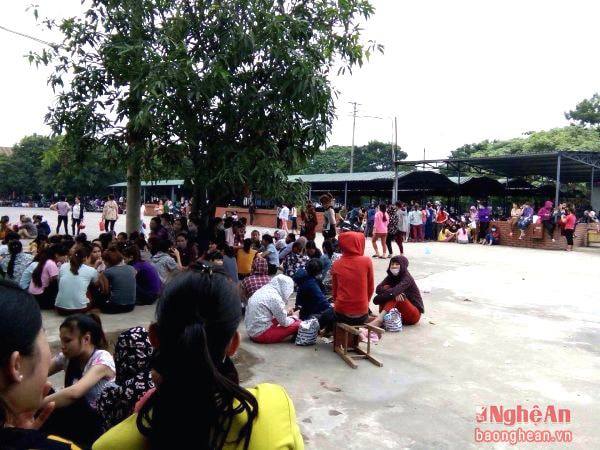 |
| The strike at Matrix Vinh Company. (Photo courtesy of the company.) |
Mr. Nguyen Chi Cong, Head of the Policy and Legal Affairs Department (Nghe An Provincial Labor Union), stated that many workers still do not receive adequate attention and protection of their rights from the labor union. “The lives of workers are still very difficult. Wages are low. Working conditions are unsatisfactory, hot, dusty, and uncomfortable. Working hours are long, and there is excessive overtime…,” Mr. Cong pointed out.
Meanwhile, according to this person, the grassroots trade unions have not grasped the desires and thoughts of the workers in order to convey them to the business owners. They have not truly cared about the interests of the workers. The strikes that occur are not led by the trade union. The trade union doesn't even know when a strike will happen…
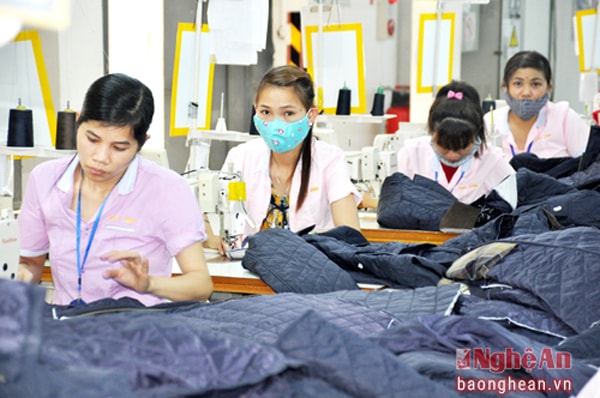 |
| Workers in Nghe An still face many difficulties in their lives. (Photo: Archival image) |
To address these shortcomings, some delegates pointed out several causes, including the fact that many current grassroots trade union leaders are transferred from commune-level civil servants. Many of them even lack a clear understanding of labor relations, leading to poor management.
At the workshop, delegates suggested that Nghe An needs to strengthen the establishment of trade union organizations, ensuring that grassroots trade unions are present and perform their functions in all businesses, especially small businesses; promote dialogue to resolve difficulties and build harmonious and stable labor relations; and minimize labor disputes.
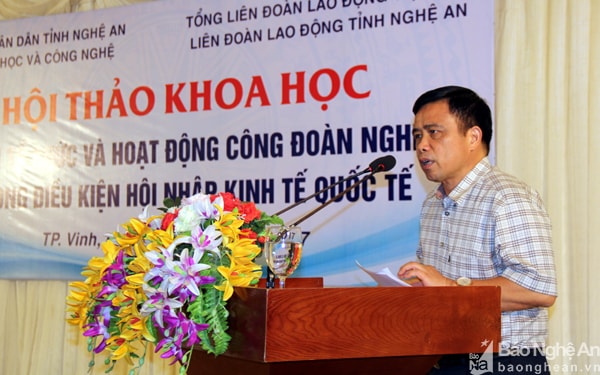 |
| Vice Chairman of the Provincial People's Committee Huynh Thanh Dien speaks at the workshop. Photo: Tien Hung |
“In reality, the effectiveness of trade unions remains unclear and inadequate. While many large foreign-owned businesses have invested in Nghe An, reforming the organization and operation of trade unions is essential,” emphasized Huynh Thanh Dien, Vice Chairman of the Provincial People's Committee. He also suggested that relevant agencies and organizations should propose specific solutions; reforms should be implemented within the framework of the law and in accordance with the Party and State's policies. If there are regulatory obstacles, proposals can be submitted to the Central Government for resolution.
Tien Hung


