Culture illuminates the path for a new era.
Resolution No. 80-NQ/TW of the Politburo on the development of Vietnamese culture was issued at a particularly important time, just before the 14th National Congress of the Party – a Congress that opened a new era of national development, with the goal of rapid, sustainable, and high-quality development, building a strong and civilized nation. In that context, culture was not only a field requiring attention, but was established as a resolution with a "guiding mission".
Phuong Chi(Perform) /Technique:Hong Toai• January 19, 2026
------------o0o------------
Resolution No. 80-NQ/TW of the Politburo on the development of Vietnamese culture was issued at a particularly important time, just before the 14th National Congress of the Party – a Congress that opened a new era of national development, with the goal of rapid, sustainable, and high-quality development, building a strong and civilized nation. In this context, culture is not only a field of concern, but is established as a resolution with a "guiding mission." Reporters from Nghe An Newspaper and Radio and Television interviewed Associate Professor Dr. Bui Hoai Son – a full-time member of the National Assembly's Committee on Culture and Society – about the fundamental shifts in thinking about cultural development, from the foundation and endogenous resources to national soft power.

PV: Resolution 80 of the Politburo re-establishes priorities, clearly demonstrating the view that "cultural and human development is the foundation, an important endogenous resource, and a great driving force." In your opinion, what is the fundamental difference between this thinking and how we have approached culture in many previous periods?
Assoc. Prof. Dr. Bui Hoai Son:The fundamental difference in thinking in Resolution 80 lies in the fact that, for the first time, culture and people are no longer seen as a "parallel field" or "supporting software" for development, but are affirmed as the structural foundation, an endogenous resource, and a driving force for development in the truest sense of the word—a decisive force. Previously, in many periods, we often approached culture in a "compensatory" way—when the economy had advanced and social problems had arisen, culture was called upon to correct behavior, reinforce morality, and smooth out the cracks in life. Culture was then often considered a "beautiful garment" draped over achievements, or an important content that was not truly placed at the center of strategic thinking.
Resolution 80 is different. Here, culture is viewed as a regulatory system – a very new and profound concept. "Regulatory system" means that culture not only creates spiritual values but also guides development, regulates growth, balances economic interests with social progress, speed with depth, openness with resilience. And people are placed at the center not as a slogan, but as a "creative subject" – the creator of growth, national competitiveness, and social trust.
In short: While culture was previously understood as a goal, it is now also a driving force and a method of development. This represents a shift from a "cultural management" mindset to a cultural creation mindset, from "making culture" to "developing through culture."
PV:For the first time, there is an official national Vietnamese Culture Day (November 24th). However, if Vietnamese Culture Day is only understood as a holiday for shopping or tourism, it could easily become merely a formality. What mechanisms and cultural activities do you think are needed to ensure that November 24th truly "permeates" the lives of the people?
Assoc. Prof. Dr. Bui Hoai Son:I completely agree that the greatest value of Vietnamese Culture Day lies not in the form of celebration, but in how it is lived out among the people. A truly meaningful culture day cannot be merely a ceremony, nor can it become a day of consumption where people wait for promotions, tourism, festivals, and then forget about it. If so, culture would be reduced to an event, and events pass quickly; whereas culture must be something that endures, becoming a way of thinking and living.

To make November 24th truly impactful, I believe three groups of mechanisms and activities are needed.The firstThis is a community mechanism. Vietnamese Culture Day should be returned to the community as a "cultural right," allowing villages, hamlets, neighborhoods, schools, factories, etc., to design activities that reflect their own unique identity. Culture only truly permeates when people are not mere spectators but become active participants.
.png)
Monday,This is an educational and communication mechanism. November 24th needs programs that spread core values: respect, honesty, compassion, loyalty, responsibility, and creativity. Stories about love for one's homeland and country, about family, and about proper conduct should become the "main content" of this day, not just a stage performance.
Tuesday,It is a mechanism for creating and enjoying culture. I want to see November 24th as an “open door day” for culture: museums open for free, libraries open all night, art spaces serving the community, programs for children, for workers, for the underprivileged… Only when culture reaches the most ordinary people can we have a truly meaningful Vietnamese Culture Day.

PV:A highlight of Resolution 80 is the commitment to allocate at least 2% of the annual state budget to culture. Setting aside concerns about funding shortages, what other challenges remain in transforming investment in culture into a genuine driving force for development?
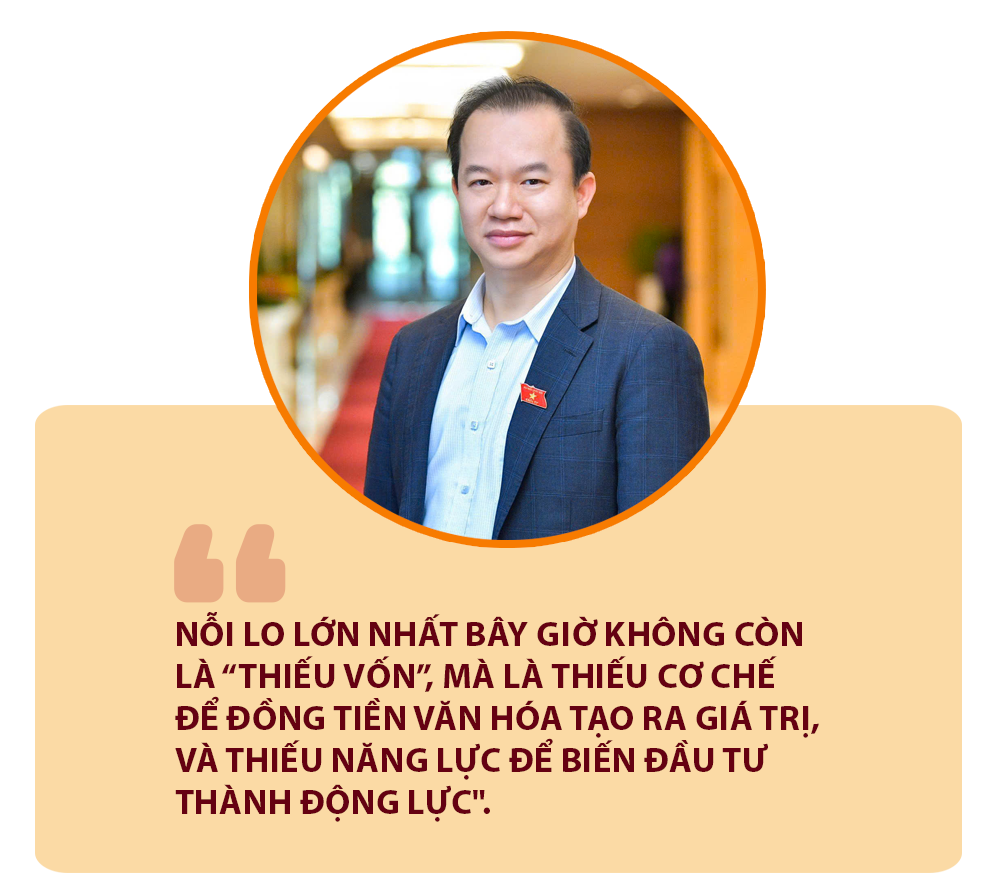
Assoc. Prof. Dr. Bui Hoai Son:I believe that Resolution 80's commitment to allocating at least 2% of the annual budget to culture is historically significant: Culture is seen as an investment in the future, not just an auxiliary expense. However, as the question arises, having money isn't enough. The biggest concern now is no longer a lack of capital, but rather a lack of mechanisms for cultural funds to generate value, and a lack of capacity to transform investment into driving force.
First,The concern is about scattered and superficial investment. If budget allocation continues with the mindset of "a little bit for each place," and "wanting to have a project for every project," then that 2% will be quickly eroded. Culture needs targeted investment: institutions, people, cultural industries, digital transformation, heritage protection… – areas that create a ripple effect.
Monday,The concern lies in governance. Many places still view culture as a difficult-to-measure area, leading to laxity and a tendency to "spend according to custom." While Resolution 80 places culture in the role of a "driving force," governance must reflect this driving force, meaning it must have objectives, indicators, evaluations, and accountability.





Tuesday,The main concern is human resources. If cultural officials do not innovate their thinking, do not understand the market, do not grasp technology, and do not have the ability to organize large-scale cultural projects, then investment will be difficult to be effective. Ultimately, investing in culture is investing in the people who create culture.
And finally,The main concern is the mechanism for mobilizing social resources. 2% of the annual budget should act as "seed capital," drawing in businesses, communities, and innovators. If the State continues to do everything, culture will struggle to become a value-creating industry. In short, the biggest challenge is shifting from "spending money on culture" to investing in culture to generate value.

PV: The development of cultural industries is often accompanied by markets, competition, and profit. Where is the boundary that needs to be maintained so that building national soft power does not diminish cultural identity, but instead highlights Vietnamese values?
Assoc. Prof. Dr. Bui Hoai Son:The cultural industry is indeed linked to the market, competition, and profit. But I want to emphasize that the market is not opposed to identity; the issue is how we set the "rules of the game" and how we choose to enter the market. The boundary that needs to be maintained is that commercialization must not make culture cheap, and integration must not turn identity into a hybrid version.
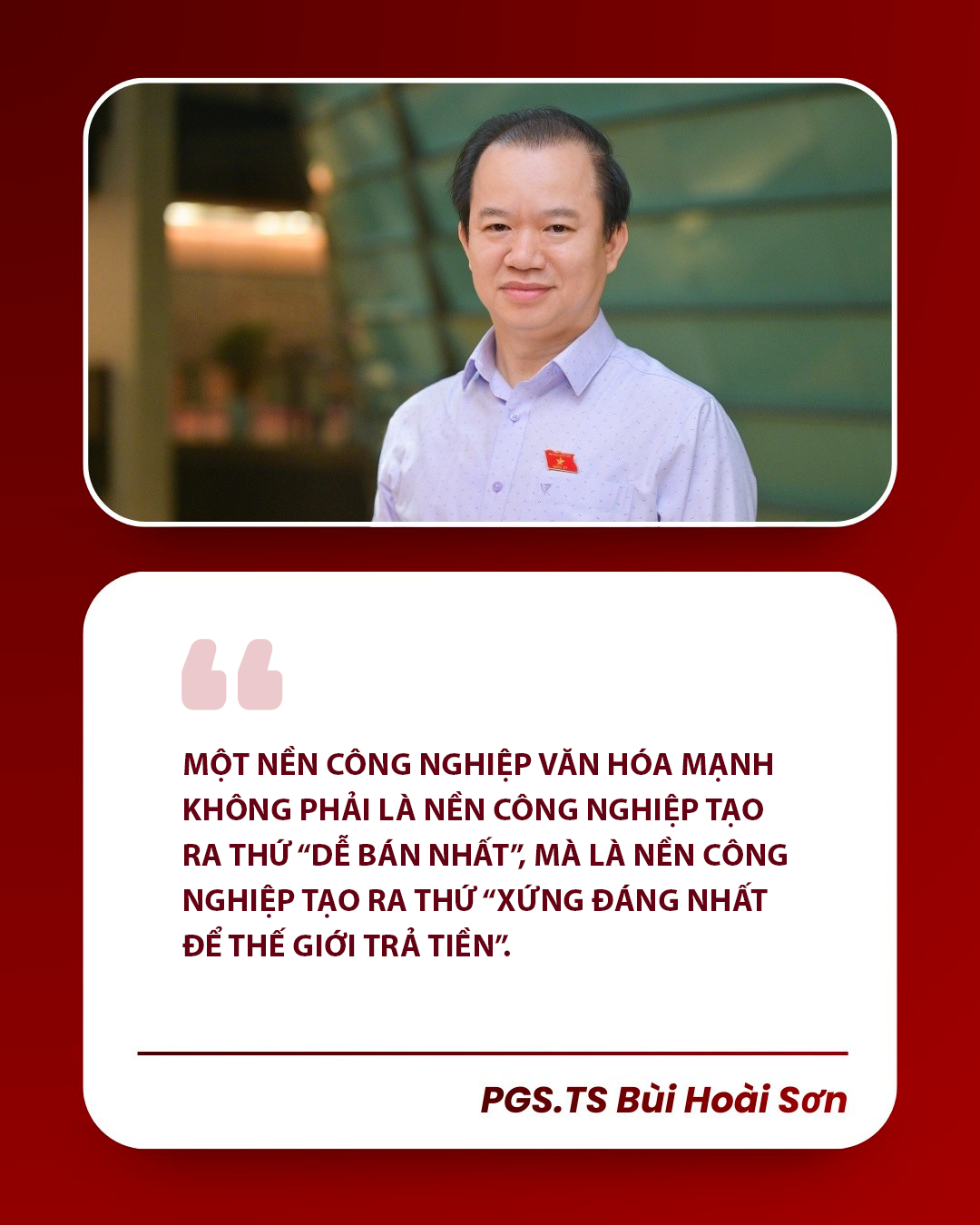
The first boundary is upholding core values. Cultural industry products may be modern and global, but they cannot compromise core values such as compassion, loyalty, community spirit, respect for history, and national pride. A strong cultural industry is not one that produces the "easiest to sell," but one that produces the "most worthwhile for the world to pay for."
The second boundary is maintaining aesthetic standards and cultural dignity. Chasing after views, sensationalism, offensive content, or inciting base instincts might yield short-term gains, but it will erode morality and damage the foundations of society. Soft power cannot be built on content that weakens society.
The third boundary is the proactive role in telling the Vietnamese story. The cultural industry is not just about producing films, music, games, performances, etc., but a competition of "who tells whose story." If we don't tell the Vietnamese story ourselves with confidence, we will have it told for us, or even distorted.
Therefore, I believe that for the cultural industry to develop sustainably, it must always be supported by two pillars: cultural governance through laws and standards; and fostering Vietnamese cultural identity in each artist and each creative enterprise. Only then will profit not obscure identity but become a means for Vietnamese identity to reach further and deeper.
PV:One of the major challenges today is ensuring that cultural policies do not become mere formalities or trends. In your opinion, what are the important criteria for evaluating whether a cultural policy "reaches real life" or remains only on paper?
Assoc. Prof. Dr. Bui Hoai Son:This is a very apt and timely question, because the cultural sector has long suffered from the "disease" of having good policies that are implemented as short-term movements or campaigns, initially boisterous, then gradually fading away. In my opinion, to avoid formalism, we need very specific evaluation criteria, meaning that cultural policies must be measured by the "pulse of life," not by written documents.
The first criterion is the level of public participation. If a policy only creates activities organized by the governing body while the people stand aside and watch, it will be difficult to implement effectively. A good policy must empower the people: they participate, they create, they take pride in it, and they sustain it.

The second criterion is the degree of change in behavior and the cultural environment. Cultural policy is not just for show, but to improve lives: families treat each other better, communities are more united, public spaces are more civilized, violence and offensive behavior decrease, and young people have clearer aspirations and ideals.
The third criterion is sustainability. A cultural model is considered successful when it can operate for many years, spread to other localities, and is not dependent on a few individuals or a few budget allocations.
The fourth criterion is the efficient use of resources, which must be transparent, avoid waste, and prevent projects from being built merely for the sake of reporting. If the cultural budget increases without creating commensurate social value, it represents a failure in governance.
The final criterion is the ability to create new capacities for society: the capacity for creativity, the capacity for appreciation, the capacity to protect heritage, and the capacity to build a cultural industry. Policies become effective when they create new people – truly cultured citizens.
PV:From the perspective of a National Assembly representative specializing in the cultural sector, what do you expect to see the most significant changes after a few years of implementing Resolution 80 if it is executed correctly?
Assoc. Prof. Dr. Bui Hoai Son:I expect culture to become a natural part of national governance capacity and social quality of life, rather than a "conditional" area.
First,I expect a major shift in the cultural environment: kindness will be elevated to a norm; the rule of law will be integrated into cultural conduct; public spaces will be managed more civilly; and school violence, online deviance, and anti-cultural behaviors will gradually be reduced thanks to educational and community mechanisms.
.jpeg)
Monday,I expect the policy to bring about a significant shift in the institutional system and accessibility to culture. Culture cannot be concentrated only in urban centers while remote areas, industrial zones, and migrant workers are lacking. Culture must reach where people live, work, and study. When people see culture present in their daily lives, trust and social cohesion will be strongly restored.
Tuesday,I expect that Vietnam's cultural industry will have "breakthrough points" that are strong enough to inspire confidence: There will be works, brands, events, and digital platforms that embody Vietnamese identity but meet international standards; there will be cultural businesses that are competitive; and there will be artists who are not only famous but also inspiring.
And more profoundly, I expect to see the emergence of a new generation of citizens – Vietnamese people who are knowledgeable, digitally savvy, culturally profound, and deeply proud of their nation. At that point, Resolution 80 will not only transform the cultural sector but will also contribute to fundamentally changing the country's development in the new era.
PV: We sincerely thank Associate Professor Bui Hoai Son!