
The song "Hello, my girl from Lam Hong" will forever resonate.
(Baonghean.vn) - Musician Ánh Dương, whose birth name was Lê Ánh Dương, was a member of the Music Committee of the Nghe An Union of Literature and Arts Associations and a member of the Vietnam Musicians Association. He was the author of many famous songs, most notably "Chào em cô gái Lam Hồng" (Hello, my girl from Lam Hong), which was loved by music listeners nationwide. He passed away on November 8, 2022 (October 15, Year of the Tiger), at the age of 88.
Composer Ánh Dương, whose real name is Lê Ánh Dương, was born in 1935 in Sơn Hải commune, Quỳnh Lưu district, Nghệ An province. He graduated from the Hanoi Conservatory of Music and was later assigned to the Military Arts Troupe of Military Region 4, where he served as its leader.
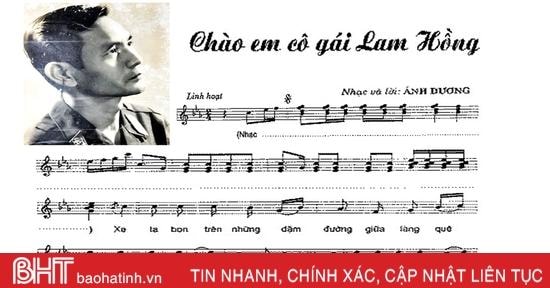 |
The song "Hello, my girl from Lam Hong" by composer Anh Duong. Photo: Ha Tinh Newspaper. |
He was honored with the Third-Class Military Merit Medal, the First-Class Resistance Medal, and the First-Class Glorious Soldier Medal. He also received the State Prize for Literature and Arts, Second Round, in 2007, for his collection of works: "Greetings, My Girl from Lam Hong", "Devoting Our Hearts and Strengths to Liberating the South", "Peach Blossoms Blooming on the Border", "Phu Cham Xy", and the symphony "Monument to Victory". He received the Ho Xuan Huong Literature and Arts Award from Nghe An province twice: the third time (2000-2005) and the fourth time (2005-2010).
 |
Composer Ánh Dương during his lifetime. Archival photo. |
With his famous song "Greetings, My Girl from Lam Hong," composer Anh Duong once recounted: In the summer of 1967, he attended the Emulation and Victory Congress held in Huong Son district (Ha Tinh province). After the Congress, he was invited to help the Provincial Military Arts Troupe stationed in Nhan Loc commune, Can Loc district. The journey back wasn't far, but the enemy's attacks were fierce, so they had to travel at night. Comrade Hao, the Political Commissar, escorted him, reminding him: "Don't worry, comrade, the villagers have built many shelters along the way, and there are volunteer youth protecting every place."
That night, the moon was dim, it was drizzling, and enemy planes were shelling, illuminating the sky. Along the road, young female volunteers constantly came out to greet and inquire about our well-being in a very friendly and cheerful manner. Mr. Hao said he really wanted to write a work about these courageous and brave young female volunteers. They even forgot about themselves to keep the road open. The musician said: "Indeed, the young female volunteers of Ha Tinh are truly brave. The Highway 15A was ravaged by bombs and bullets, leaving no green on either side, life and death hanging in the balance, yet these girls, only eighteen or twenty years old, persevered day and night. The car was suddenly forced to stop. A bomb exploded right in front of us. Despite the roaring planes, the girls hurriedly filled the bomb craters so our car could pass. They treated death as lightly as a feather." With each car passing through the critical point, we were met with voices, laughter, and friendly greetings. Occasionally, a melodious folk song from Nghe Tinh would soar, stirring the hearts of the listeners: "Oh, soldier driver / When you return victorious, please celebrate with us…!" Witnessing these touching scenes, the composer was deeply moved. That night, he completed the song "Greetings, my girl from Lam Hong."
Before returning to his unit, composer Ánh Dương reported to the then Provincial Party Secretary, Nguyễn Văn Linh, who praised the song and requested a copy for him. The song likely gained its popularity from these first listeners. In early 1968, at the Emulation and Victory Congress of Military Region 4, the performing arts troupe staged a trio performance of this song to celebrate the Congress. Unexpectedly, the song captivated listeners. Soon, the song spread throughout the Military Region; those on stage sang, and the audience below clapped and sang along. When composer Đỗ Nhuận went to Nghệ An for work, he heard the song "Chào em cô gái Lam Hồng" (Greetings, my girl from Lam Hồng), and he liked it so much that he took it to Hanoi to record and broadcast it on the radio.
Composer Do Nhuan was a prolific and innovative composer, writing many unique works. He quickly recognized the rare uniqueness of "Chào em cô gái Lam Hồng" (Greetings, My Girl from Lam Hong): "First of all, the rhythm of this song is very fast and unusual. The rhythm is captivating; it can be said that no other work has music as powerful and captivating as this one. The fast tempo from the beginning, combined with the concise and tight musical structure, easily evokes the inspiration of an endless army overcoming difficulties to support the battlefield. From there, the song became popular with audiences and listeners nationwide through the music programs of the Voice of Vietnam Radio."
Composer Ánh Dương has shared many times that"Every time I hear the lyrics again: 'Our vehicle speeds along the road, through our villages, crossing streams, hills and fields, as our vehicle heads to the battlefield'..."I kept imagining that driver on his way south, passing through the Nghe Tinh region, his homeland. The rough, rocky road of war couldn't stop the wheels from rolling smoothly under the hands of that soldier driver. He happily sang, happily drove, oblivious to the dangers lurking around him, and how touching it must have been to be by his side."The girl from Lam Hong, amidst the roar of bombs and bullets, still hears the resounding folk songs on the road"...And it's also full of love, faith, and optimism."Even if my vehicle travels day and night, it's still not as precious as your love for the South..."
With a passionate and fervent heart, not only in art, musician Ánh Dương silently dedicated his life like a warm flame, so that his heroic songs still resonate here, like a call to arms.
The musician's heart has stopped beating, but generations of music lovers will forever sing the song about the girl from Lam Hong, about the love for his homeland and country that he left behind…


