
The world's blackest material can absorb 99.9% of light.
The light-absorbing material developed by British scientists is so dark that it can absorb almost all visible light.
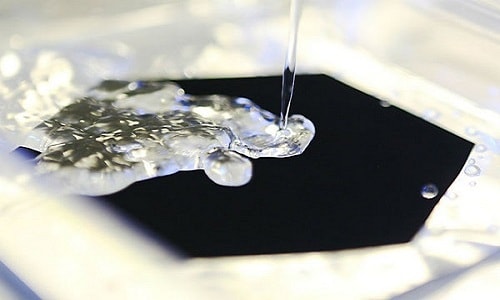 |
A real-life example of the Vantablack. Photo: Surrey NanoSystems. |
According to The Christian Science Monitor, Vantablack, a material developed by Surrey NanoSystems in the UK, is considered the blackest material ever created on Earth. Initially, Vantablack was developed for use on satellites, but its ability to absorb most light and convert it into heat has since opened up many interesting applications in various fields of life.
The blackness of Vantablack is disorienting and cannot be quantified by any spectrometer. "Vantablack is so black that viewers can't understand what they're looking at. All shapes and lines disappear, leaving nothing but an abyss of blackness," Ian Johnston of The Independent described Vantablack in 2014.
According to Surrey Nanosystems, researchers fabricated Vantablack from ultra-small carbon nanotubes arranged in a highly dense, linear fashion in space. When light photons encounter this forest of carbon nanotubes, they become trapped and reflect continuously within the tubes. Eventually, the photons lose energy and convert into heat before dissipating permanently.
The carbon nanotubes are completely hollow inside, making Vantablack extremely lightweight, flexible, and highly durable. However, strong impacts or collisions on the surface can damage the nanostructure and color of Vantablack.
To produce Vantablack, scientists use a low-temperature chemical vapor deposition technique, or through the newly developed Vantablack S-VIS atomization device. Surrey Nanosystems says that current spectrometers cannot accurately determine the blackness of Vantablack, but the material is capable of absorbing up to 99.965% of visible light.
Ben Jensen, CTO of Surrey NanoSystems, shared that Vantablack's reflectivity reduction capabilities far surpass those of materials used in the Hubble Space Telescope. Besides satellites, Vantablack can be used in telescopes like Hubble to eliminate turbulence and produce clearer images of space. Additionally, Vantablack is useful in a range of applications such as solar power, spectrometers, optical sensors, calibration equipment, and even in the arts and architecture.
The search for a truly black material began in the 19th century, when scientists hypothesized about a substance that could completely absorb all incident light while simultaneously being non-reflective and non-transmitting. While Vantablack hasn't yet achieved the perfection it hoped for, it still meets the expectations of those interested in non-reflective coatings. Vantablack is still being improved to enhance its absolute reflectivity reduction and absorption.
According to VnE
| RELATED NEWS |
|---|


