
Why choose to build highways instead of high-speed rail?
Immediately after the Ministry of Transport submitted to the Government the investment plan for the 1,372 km long North-South East Expressway, with a total investment of 229,829 billion VND, there were opinions evaluating the plan, including the question of why the expressway was chosen to be built first instead of a high-speed railway.
Regarding this issue, our reporter had a discussion with Mr. Pham Huu Son, General Director of the Transport Design and Consulting Company (TEDI) - the unit assigned by the Ministry of Transport to lead the research and development of this project.
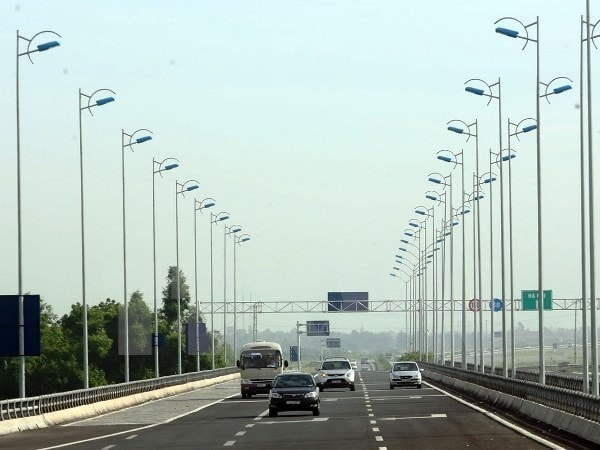 |
| Vehicles traveling on the Cau Gie-Ninh Binh expressway. (Photo: Huy Hung/TTXVN) |
Could you explain the reasons for choosing to build the North-South highway first instead of the North-South high-speed railway?
Mr. Pham Huu SonAccording to the detailed plan developed by TEDI and submitted to the Ministry of Transport, it includes analyses and explanations as to why the North-South expressway should be built first instead of the North-South high-speed railway. In its explanation, TEDI comprehensively addresses the main modes of transport involved in the North-South route: sea, inland waterway, road, rail, and air, taking into account the current transport structure of National Highway 1.
Specifically, regarding traffic flow forecasting, the plan addresses the consideration of the proportion of passengers and goods currently handled by National Highway 1, followed by the completed coastal ring roads to determine the allocation between road and rail transport. It also considers how traffic flow will be distributed between the newly expanded National Highway 1 and the North-South Expressway once it opens. Furthermore, it examines how toll collection will be implemented to attract vehicles to the expressway.
Here, I want to emphasize that there is absolutely no intention of simply allocating a certain percentage of traffic to this highway. Instead, we already have a calculation comparing traffic volume once the highway is completed and put into operation, and how the load will be distributed.
Regarding traffic distribution based on calculations of traffic volume between road, rail, and sea routes, the current proportion of rail transport, as well as the current state of the railway system (including both freight and passenger transport), is very low with a 1-meter gauge. Therefore, even if a North-South railway line were to be built to increase capacity, it would not be feasible. Furthermore, attracting people to use this mode of transport would be difficult because the "door-to-door" speed (delivery of goods directly from sender to recipient) is inferior to other modes of transport. If a North-South line were to operate, passengers would choose air travel, especially low-cost airlines.
Furthermore, if traveling by road, passengers will choose segments of about 200-300 km, or even under 500 km, while the demand for continuous North-South travel is not high. Therefore, the advantage of expressways is that they meet the demand for traveling on specific segments. This is also the goal of expressway construction.
Highways will connect economic centers, urban centers, industrial zones, and economic zones. Especially in our country, due to its S-shaped geographical features, the construction of highways will have the potential to connect these economic centers.
According to assessments, the sections including Hanoi-Vinh-Da Nang-Nha Trang-Ho Chi Minh City are the four main routes for the flow of goods and people, from which the advantages of connecting this expressway to the South must be considered. From the economic efficiency perspective of all 20 cities along National Highway 1, which currently account for 45% of the population, 57% of GDP, and 67% of the country's economic zones, connecting the North-South expressway is extremely important in creating momentum for the socio-economic development of the country.
So, in the current context, the question is: between building expressways and high-speed railways, which project has more advantages, sir?
Mr. Pham Huu Son:In terms of freight and passenger volume, rail transport has an advantage over road transport. However, if only considering traffic volume, Vietnam's railways still primarily carry passengers, while the proportion of freight transported by rail is still relatively small. Furthermore, when comparing the proportion of freight transported by rail, we need to compare it with maritime transport, a mode of transport in which we have a significant advantage.
On the other hand, when calculating the proportion of passenger transport, we must also consider the competition from air and road transport, not just rail. In this respect, this is also a disadvantage for the railway industry.
The second disadvantage of railways is the enormous initial investment required. A quick calculation shows that if investing in high-speed rail costs around $10 billion, then investing in high-speed rail would cost five times that amount. Furthermore, investing in high-speed rail allows us to be almost entirely self-sufficient in raw materials, fuel, machinery, equipment, and especially human resources.
As for high-speed rail, we are still dependent on technology, and this factor currently accounts for a very large proportion. This is because, in terms of railway infrastructure, related to the mechanical engineering and supporting industries for railways, we are still unable to meet the requirements. Everything from train tracks to operating machinery and even the signaling and communication systems must be imported, thus making us very vulnerable. Conversely, in the current context, building high-speed roads would allow us to utilize all domestic resources.
In terms of timeline, the North-South expressway project could be completed in about 5 years, but this is impossible for the railway project within that timeframe.
Therefore, according to TEDI's macroeconomic assessment, the North-South expressway should be built first instead of the high-speed railway.
So, if we compare the amount of money the government can invest in building expressways with that of high-speed rail, how would that compare, and where would the funding for this project likely come from, sir?
Mr. Pham Huu SonI can say that, at the present time, the likelihood of attracting private investment in railways is very low. Therefore, if a railway is built, the state budget will still have to account for a large proportion. The state's contribution to the North-South expressway project is projected to be 40.7%. The remainder can be mobilized from non-budgetary investment sources. However, if a railway is built, the state's contribution, according to calculations, must account for the majority of the capital.
Economic experts have analyzed that the capital for highway investment includes state funds, investor funds, bank funds, and finally, funds from the people. The people's contribution here is understood not simply as people depositing money in banks and then the banks lending it out, but also taking into account the economic benefits that the people will receive when the project is built.
On the other hand, if we look at other countries, some have issued bonds specifically for a road project, not just general bonds. Therefore, we must demonstrate the effectiveness of building this road. The experience of other countries shows that issuing bonds for a specific project (project bonds) is also a very promising channel for attracting capital.
Furthermore, it has the potential to attract foreign investment as investors see the project's profitability and gain confidence in Vietnamese partners. This is also an important source of capital for the project.
It's very difficult to calculate funding when the project hasn't even started. Investors will only participate if each section or segment of the route proves beneficial.
We have calculated that in sections with high traffic volume, the state's capital contribution is low, possibly as low as 30%. In other sections, the state may have to participate up to 60-62% because traffic volume is low. In such cases, the principle is that the state must invest in areas where the private sector is not allowed to operate or cannot attract investment due to low profit margins, and even in areas solely for public and social purposes, the state must invest...
Thank you, sir!
According to Vietnam+
| RELATED NEWS |
|---|


