
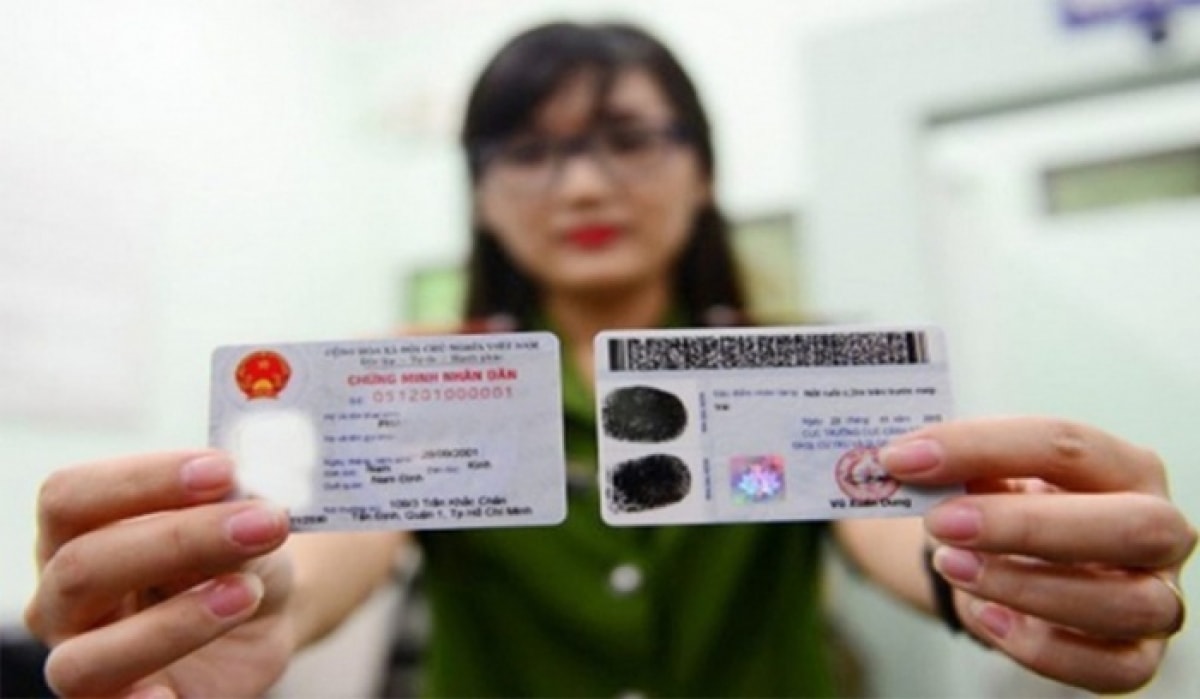
Why haven't I received my national identity card after 3-4 months?
The Department of Administrative Management and Social Order Police (QLHC về TTXH) stated that the reason for the disruption in the import of electronic chips from abroad to Vietnam stems from the impact of the Covid-19 pandemic.
According to the Department of Administrative Management of Social Order (QLHC về TTXH) of the Ministry of Public Security, as of October 19th, the Ministry of Public Security had issued 49.8 million chip-embedded citizen identity cards (CCCD). According to the Department's leadership, there have been many public concerns regarding population management and chip-embedded CCCDs. To address these concerns, the Department created a Facebook page called "National Population Data Center" (facebook.com/ttdldct). After more than a month of operation, the page has received over 3,000 suggestions, feedback, and questions regarding the procedures and regulations for issuing CCCDs, especially the issue of delayed card issuance that has persisted for months.
Regarding this issue, Lieutenant Colonel Vu Van Tan, Director of the National Population Data Center, Department of Administrative Management of Social Order, Ministry of Public Security, has the following comments:
 |
| Lieutenant Colonel Vu Van Tan, Director of the National Population Data Center, Department of Administrative Management of Public Order and Security. |
Population data is the foundation and basis for shared use by ministries, departments, and agencies.
PV:Currently, there is much public interest in the Ministry of Public Security's integration of information fields into the electronic chip-embedded citizen identification card. Could you please tell us about the progress of this information integration?
Lieutenant Colonel Vu Van Tan:As we know, the Government has invested in two systems: the national population data system and the citizen identification card data system, and assigned the Ministry of Public Security to implement them. To date, the Ministry has also implemented them at a rapid pace and achieved certain results.
Regarding the population system, the Ministry has completed the system for approximately 100 million people. The Ministry has issued national citizen identification cards, ensuring accurate and complete population data. As for identity cards, as of October 19th, 49.8 million citizen identification cards have been issued.
When deploying the two systems, we determined that population data is the foundation, the basis for shared use by ministries and agencies. Therefore, in integrating these features onto the Citizen Identification Card, the Department of Administrative Management of Social Order (Ministry of Public Security) has implemented many solutions. Currently, we have integrated the entire subsystem, which we call "Subsystem 68," regarding the Prime Minister's Resolution on implementing social security policies during the Covid period.
This integration first and foremost provides convenience for the relevant units. For example, the People's Committee of a ward can significantly reduce manpower and minimize the amount of verification, record-keeping, and authentication required. For instance, when a citizen's information is integrated into the Citizen Identification Card system, the ward's People's Committee only needs to read the QR code to determine if the person has received the money. If they have, there's no need to create a list for verification anymore.
Furthermore, we integrate all vaccination records compiled by local police forces during screenings at the grassroots level for citizens who have already received vaccinations and have obtained confirmation from health authorities.
Recently, the Ministry of Information and Communications, the Ministry of Health, and the Ministry of Public Security have agreed and clearly determined that integration into the Citizen Identification Card (CCCD) is a long-term and sustainable solution.
Thirdly, we continue to integrate content, for example, onto the existing data platform of the Ministry of Public Security, such as motorcycle registration. This integration means citizens only need to carry one document, the chip-based citizen identification card, and not other documents. Similarly, state management agencies only need to check one document, thus avoiding the complexity of checking multiple documents for verification.
PV:Integrating information fields into chip-embedded national identity cards offers numerous benefits to citizens and administrative agencies. So, Lieutenant Colonel, could you share what benefits we have achieved in this process?
Lieutenant Colonel Vu Van Tan:This integration addresses three issues. Firstly, government agencies do not need to invest in any tools to read the QR code on the card; they can simply use the QR code reading function on the VNID app.
Government agencies, businesses, or other entities, when checking citizens' documents and procedures, simply need to download the VNID app online. Then, they can use the QR code scanning function on the Citizen Identification Card to read the information.
Secondly, it ensures the complete security of citizens' data. That is, if we use other QR code reading functions, they could access all of a citizen's information. This would lead to a high risk of data loss for citizens. However, when using this function on the VNID app and the system, which is essentially a system built by the Ministry of Public Security, this data is completely secure.
Thirdly, with Resolution 68, the date and amount of money received will not be displayed in the personal information fields. Therefore, it will be completely confidential for citizens.
 |
The system built by the Ministry of Public Security ensures complete data security.
PV:As the Lieutenant Colonel just mentioned, the Citizen Identification Card will contribute to reducing administrative procedures for state administrative units. However, based on our observations at various agencies, scanning the data is still proving difficult.
Lieutenant Colonel Vu Van Tan:That's only true for a certain period. Based on the established Citizen Identification Card (CCCD), Phase 1 of this CCCD design is the basic structure built upon the CCCD platform.
When creating QR codes, the Ministry of Public Security initially focused on integrating citizen information fields to facilitate transactions. Notably, previously, citizens had to re-verify their old ID card number each time they applied for a new Citizen Identification Card (CCCD). This process has now been integrated, eliminating the need for re-verification, but this was on the original platform. As applications are developed, the Ministry of Public Security continues to create verification environments on the current platform.
Therefore, when citizens use their Citizen Identification Card (CCCD) on the original platform, scanning the QR code will display their full name and ID number, facilitating their transactions during their participation.
The new integrated platform is an independent system designed for development and integration with the national ID card system.
PV:How will the data we integrate into the information fields stored on the citizen identity card be reviewed and verified to prevent citizens from having to fill out forms multiple times or from having inconsistent information, Colonel?
Lieutenant Colonel Vu Van TanAccording to government regulations, citizens are only allowed to provide their personal information once, and only when it is done using the citizen data (also known as the original data). This original data is guaranteed and established on a constantly updated data platform, as it is based on the functions and duties of the local police force. Therefore, through daily activities related to residency, this citizen data is continuously maintained.
All citizen activities are carried out through their residence functions, such as permanent residence or temporary residence. Therefore, we can affirm that population data is the original data; citizens only need to declare it once on the residence registration platform of the local police force.
Therefore, all information such as driver's licenses, vaccination registrations, and insurance cards will later be integrated into the chip-embedded citizen identification card through a single process: "Citizens can declare this data on the VNID app, and then the system will verify it and integrate it into the citizen and identity system." Alternatively, local police can directly integrate this information into the citizen platform using software, which is then integrated through the citizen identification card.
Therefore, if we say that the process of that data is clean, then it has met three criteria:
Firstly, it utilizes original resident data, resident records, and citizen identification cards. Secondly, it is verified by the local police force. Thirdly, the responsibility for final approval by the head of the ward/commune police before uploading it to the system rests with the individual.
PV:As the Lieutenant Colonel just mentioned, security is very well implemented. Could you please explain how this security is achieved? And some citizens have questioned whether the chip-embedded citizen ID card can track the user's location.
Lieutenant Colonel Vu Van Tan:Regarding security systems, both the citizen identification system and the citizen identification card system implement numerous security measures. Of particular note is the fact that the citizen identification card itself is completely secured by leading solutions from the Government Cipher Committee.
Regarding whether using a Citizen Identification Card (CCCD) can be tracked, I'll just say this: Anything that wants to live needs food. The chip on the CCCD card is the same; it needs power to function. Therefore, without power, how can the CCCD card survive and track your location? It's like using a phone; if you use up the battery and turn it off, you can never use it again.
 |
The delay in issuing chip-embedded citizen identification cards is due to many objective factors.
PV:People are also wondering why those who lost their ID cards 3 or 4 months ago haven't been able to get them. How does the Lieutenant Colonel explain this to the people?
Lieutenant Colonel Vu Van Tan:Firstly, the recent period has been due to a shortage in the chip market, a shortage that all chip festivals around the world are aware of.
Secondly, due to the Covid-19 pandemic, trade has been restricted. Furthermore, when issuing citizen identification cards, during the process, people sometimes declared that they were issuing a replacement instead of a new one. Therefore, upon verification and checking the database system, it was determined that the card was a replacement, not a new one. This caused delays in the process. Recently, to minimize this, we have implemented several public measures to inform citizens, allowing them to report any delays directly on the "National Population Data" website for clarification.
PV:Colonel, how will it be more convenient for citizens to carry out procedures and transactions when they use only one electronic chip-embedded citizen identification card??
Lieutenant Colonel Vu Van Tan:Currently, such integration is a convenient and optimal solution that benefits both citizens and government agencies. The question is whether it has been implemented yet?
It can be said that depending on the specific integration, we can deploy it immediately, such as the integration of the injection system, which can be deployed right away.
As for other aspects, data sharing between ministries is necessary. For example, integrating insurance requires data sharing from the insurance company, and integrating driver's licenses requires data sharing from the Ministry of Transport, etc. Only then can we achieve integration.
Secondly, for widespread implementation, there must be a legal basis, and many legal bases need adjustment. For example, many of our legal documents stipulate that traffic participants must have a driver's license, vehicle registration certificate, vehicle insurance, etc., which are the legal basis for these regulations. Therefore, now that we have integrated them here, we need to adjust the legal basis to be most favorable to the people.
PV:TLooking ahead, what solutions or plans does the data center have to further promote the application and utility of these services in practice?
Lieutenant Colonel Vu Van Tan:Integrating one piece of content will integrate multiple pieces of content. This is also one of the solutions.
Now, it's possible to integrate various documents once the Ministry of Public Security has data sources or conducts surveys to update and incorporate them. Secondly, we can integrate all dependents onto the citizen card, for example, children under 14 years old or other dependents.
Thirdly, we are researching solutions such as replacing the citizen identification card with the ATM card for withdrawing money,….
The question arises: if there is no citizen identification card at this time, can the first two vaccinations be integrated? Essentially, it's a system. Therefore, when citizens don't yet have a citizen identification card, they can go to the local police station where we are providing them with their complete citizen identification number. This form contains a QR code, and citizens can use this document as a substitute for their citizen identification card during the period before the card is issued.
PV:Thank you very much, Lieutenant Colonel./.


