
Will Vietnam receive its first batch of four Su-35s?
Information from the Russian side indicates that they are actively offering the 4.5th generation Su-35S fighter jet to Vietnam, and the prospects are considered very bright.
Following the full commissioning of 36 Su-30MK2 multirole fighter jets, it has been suggested that Vietnam will soon proceed to order a more advanced Flanker variant, with the two most promising candidates being the Su-30SM and Su-35S.
Initially, it seemed as though the Su-30SM had a clear advantage, especially after Vietnam sent pilots to India to learn to fly the Su-30MKI – the predecessor of the Su-30SM. However, recent developments suggest that Vietnam is highly likely to invest directly in the most advanced Flanker version, the Su-35S.
At this point, all attention is focused on how many Su-35s Vietnam will order if it decides to do so. To answer that question, let's look back at Vietnam's history of ordering Flanker fighter jets.
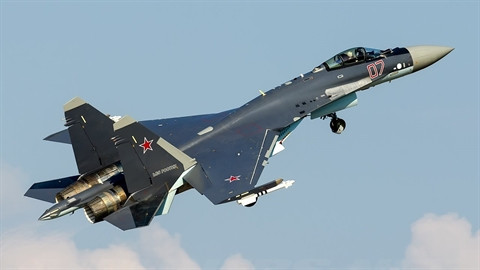 |
| The Su-35S multirole fighter aircraft of the Russian Air Force. |
Vietnam began acquiring fourth-generation fighter jets in 1995, when we received the first six Su-27SK/UBK aircraft. In 1996, we received another six Su-27s under a second contract.
Ordering six aircraft at a time was a significant effort by Vietnam given the circumstances at the time, when the need to modernize its air force to protect its maritime sovereignty was extremely urgent.
After mastering the Su-27 fighter jet, Vietnam commissioned its first squadron of four Su-30MK2 aircraft in 2004. Following a thorough performance evaluation, it wasn't until 2010 that Vietnam decided to order another eight aircraft.
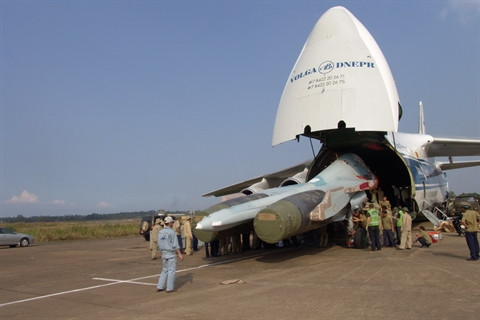 |
| The first Su-30MK2 fighter jet of the Vietnamese Air Force was unloaded from the cargo bay of an An-124-100 transport aircraft. |
Based on "purchasing habits" and a careful assessment of the features and capabilities, along with the country's financial situation and Sukhoi Corporation's production capacity, many believe that if Vietnam orders Su-35S, the initial quantity is unlikely to exceed 4.
The number of Su-35S as mentioned above can be considered temporarily sufficient for immediate needs; this squadron will play a key role in coordinating combat operations for the older generation Su-22, Su-27, and Su-30 units.
Hopefully, after a period of operation, the number of Su-35S aircraft in Vietnam will increase rapidly, as was the case with the Su-30MK2 previously.
According to Baodatviet


