
Vietnam will have a surplus of over 70,000 teacher training students.
Vietnam will have a surplus of approximately 70,100 teacher training students, prompting us to find solutions for effective investment in what is considered the noblest profession.
By 2020, Vietnam is projected to have a surplus of approximately 70,100 graduating teacher training students (41,000 for primary school, 12,200 for lower secondary school, and 16,900 for upper secondary school). This means they will have limited opportunities to work in the teaching profession.
This information was presented at the National Scientific Conference on Teacher Training at Multidisciplinary Universities, meeting the requirements of current educational reform, which was recently held in Hanoi.
Nearly 20 years ago, schools across the country faced a severe shortage of both the quantity and quality of teachers. During some teacher recruitment seasons for primary school teachers, Ho Chi Minh City had to set the passing score at 6.5/20 for candidates from the inner city and 3.5/20 for those from the suburbs, with less than 20% of the exam papers achieving a perfect score of 10/20.
Faced with that crisis, in implementing the "National Program for Building a Team of Teachers and Teacher Training Schools 1995-2000," the Ministry of Education and Training decided to waive tuition fees for students studying in teacher training programs.
The years 1996-1997 are considered the "golden age" of teacher training, when the Ministry of Education and Training introduced a regulation waiving tuition fees for students enrolling in this field. This encouragement led many bright and talented students to enroll in teacher training schools whenever the university and college entrance exams approached.
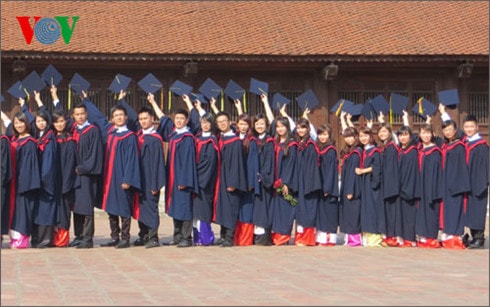 |
| Students at a teacher training college (illustrative photo) |
The competition to enter the teaching profession reached its peak when, in some years, candidates had to achieve 27 or 28 points across three subjects to get into the Mathematics department of Hanoi Pedagogical University.
However, in recent years, the entrance scores for teacher training programs have not been as high and are trending downwards. The recruitment and compensation mechanisms still have many shortcomings and limitations, which have led many excellent graduates to choose not to pursue a career in teaching.
Meanwhile, many localities have not paid special attention to training teacher-students to meet the needs of society, and the mismatch between the supply and demand for human resources is also a reason why tens of thousands of graduates from teacher training colleges are unemployed or switch to other jobs each year.
In reality, the funding required to implement the policy of waiving tuition fees for teacher training students is considerable. Currently, in addition to a number of multidisciplinary universities that offer teacher training programs, there are 13 teacher training universities, 1 university of education, and 33 teacher training colleges nationwide.
Although in recent years the Ministry of Education and Training has acknowledged the surplus of teachers and set regulations to gradually reduce teacher training quotas, in reality, the amount of budget funds used to subsidize tuition fees for teacher training schools continues to increase steadily every year.
According to reports from the Ministry of Education and Training's budget planning conferences, in 2011, out of more than 4,000 billion VND in the education budget, nearly 250 billion VND was allocated specifically to subsidize tuition fees for teacher training colleges under the Ministry of Education and Training, based on the tuition fee framework stipulated in Decree 49.
By 2012, the total actual expenditure from the state budget for tuition fee subsidies for teacher training colleges under the Ministry of Education and Training had increased to over 354 billion VND. In 2013, the Ministry of Education and Training's budget estimate for tuition fee subsidies for teacher training students at universities and colleges, and for tuition fee exemptions and reductions, increased to over 440 billion VND, and in 2014, the budget allocated for this task further increased to over 484 billion VND.
Should the government's investment in the teacher training sector change?
The projected figure of approximately 70,100 surplus teacher training students in Vietnam by 2020 raises concerns about the wasteful use of state budget funds in tuition fee exemptions for students studying this field.
According to Mr. Nguyen Van Tuyen, Rector of Hanoi Pedagogical University II, the government's tuition waiver for pedagogical students in 1996-1997 attracted a large number of talented students to apply. The graduates of this cohort all possessed good qualifications and skills.
However, nowadays, with people's living standards improving, it is entirely possible for them to afford a few hundred thousand dong for their children's tuition.
Currently, tuition waiver is no longer a major incentive to attract students to teacher training colleges. A more "powerful" solution is needed, such as: tuition waivers, scholarships, free accommodation, and immediate job placement upon graduation, similar to graduates from police and military academies.
Meanwhile, Professor Dinh Quang Bao, former senior research fellow at the Institute of Pedagogical Research (Hanoi University of Education), stated that if the country wants to train high-quality human resources, it must have excellent teachers. Therefore, we still need policies to attract talented students to enroll in teacher training colleges.
As it stands now, the practice of providing free tuition to all students will not attract talented individuals, nor will it create an incentive to improve the quality of teacher training at teacher education institutions.
Therefore, the total budget investment for each teacher training college should not decrease, but rather the investment per student should be increased, rather than spreading the funds too thinly.
"Assuming the current budget for Hanoi Pedagogical University is 100 billion VND per year for 2,000 full-time undergraduate students, we should consider increasing the investment per student. This way, the total investment wouldn't decrease, but that funding would only be allocated to 1,000 students," Mr. Dinh Quang Bao shared.
This solution also helps improve the quality of training, attract talented students, and genuinely reduce enrollment quotas. Because, although the Ministry of Education and Training has a policy of reducing teacher training quotas due to a surplus of teachers, some schools still resist this trend because funding is still being channeled through student enrollment.
According to VOV


