
Has Vietnam unveiled a new domestically produced missile?
The People's Army Newspaper has just published surprising images of a rather unusual type of missile manufactured by Vietnam's defense industry.
Images of this new type of missile appeared during a Ministry of Defense inspection of scientific and technological research products at the Military Technical Academy in 2017.
Although the exact designation of this missile is unclear, observations from the images suggest that it is very likely a new type of missile manufactured domestically in Vietnam.
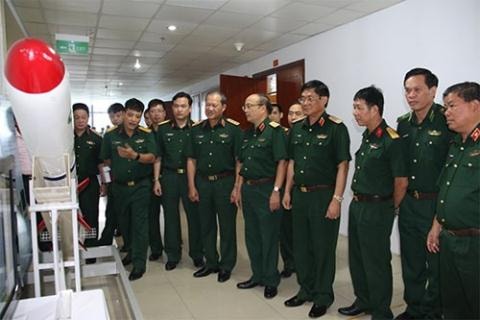 |
| This is an image of a new type of missile manufactured domestically in Vietnam. |
Prior to the appearance of this new type of missile, the Vietnamese defense industry had successfully produced the KCT 15 anti-ship cruise missile based on the Russian Kh-35 Uran-E design, and the TL-01 short-range air defense missile - an Igla variant.
Thus, after a period of implementation, the "TL-01 Short-Range Air Defense Missile Manufacturing" project has achieved astonishing results and is truly a significant step forward in gradually achieving self-sufficiency in the supply of modern weapons for the Vietnam People's Army.
Reportedly, as early as the beginning of 2015, Vietnam successfully researched and manufactured a key electronic component of the 9P516 type Igla missile system.
To successfully manufacture the system, the research team mastered the technology and produced six electronic modules that met international technical standards; these modules were then transferred to domestic factories for assembly into launch mechanisms.
The authors have also completed the design documentation and the manufacturing technology documentation for the electronic modules, tailored to the skill level of Vietnamese technical staff and workers.
Based on their mastery of the technology, scientists have also researched and improved the 9P516 type electronic module, localizing its production.
As a result, 2 out of 4 electronic boards have been completely localized (manufactured from domestic materials and components), and have been tested for compatibility and functionality with the prototype boards in the launch mechanism; the remaining 2 boards are being researched with a view to using a combination of domestic and foreign components, with initial promising results.
The successful research, design, and manufacturing of the 9P516 electronic module has high practical significance, helping to master the technology, proactively secure components and materials, reduce dependence on foreign experts, and contribute to improving the quality of technical support and combat readiness.


