
Vietnam has risen to second place in Southeast Asia in terms of the number of naturalized players.
Statistics from Seasia Goal show that the wave of naturalized and foreign-born players is helping regional football to break through, with Vietnam possessing world-class Brazilian players.
Southeast Asian football is undergoing a significant strategic shift as nations actively optimize resources from naturalized players and those of overseas origin. According to the latest report from Seasia Goal, this trend not only helps narrow the skill gap between teams but also becomes a crucial leverage point for regional representatives to compete on the international stage, especially in continental competitions.
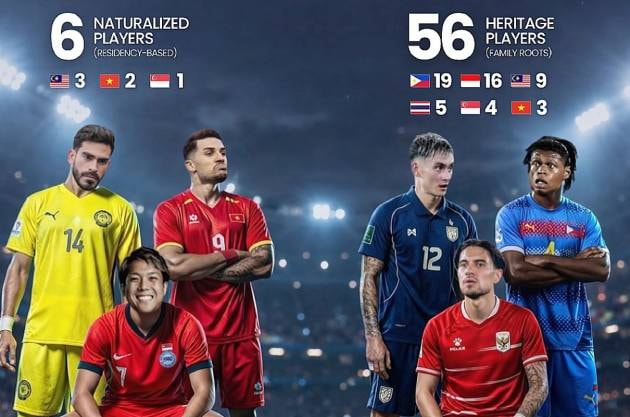
Group of players with 100% foreign origin: Vietnam closely trails Malaysia.
In the segment of fully naturalized players (those without native blood), the region currently has 6 players competing. The Malaysian national team currently leads this list with 3 names: Sergio Aguero, Endrick, and Paulo Josue. However, Malaysian football has also recently faced a major setback when the Asian Football Confederation (AFC) handed Malaysia a 0-3 defeat in two matches against Vietnam and Nepal due to serious irregularities related to the naturalization records of another group of players, directly leading to their loss of a spot in the 2027 Asian Cup.
Following closely behind Malaysia is the Vietnamese national team, featuring two outstanding players from Brazil: Xuan Son and Hoang Hen. This duo quickly proved their professional value by making significant contributions to the 3-1 victory against Malaysia on March 31st. Their impressive performance also earned them a place in Sofascore's Team of the Year. The remaining player in the group of 100% naturalized players in the region is Kyoga Nakamura of Singapore.
The strength of mixed-race players.
Besides the purely naturalized players, the segment of mixed-race players (heritage players) is seeing a dominance by the Philippines and Indonesia. The Philippines currently holds the top position in the region with 19 players of overseas origin in their squad. Indonesia ranks second with 16, mostly players of Dutch descent.
The strategy of leveraging "brainpower" from Europe has helped Indonesia undergo a spectacular transformation, advancing straight to the fourth round of the 2026 World Cup qualifiers – an unprecedented milestone in regional football history. On the Vietnamese side, this force currently contributes three quality players: two goalkeepers, Nguyen Filip and Dang Van Lam, and defender Cao Pendant Quang Vinh.
An inevitable trend to elevate standards.
Combining domestic resources with foreign-born players has yielded significant results in terms of achievements. Notably, for the first time, Southeast Asia has had four representatives participating in two consecutive Asian Cup finals. Other countries such as Thailand (5 mixed-race players) and Singapore (4) are also actively promoting this trend.
Overall, calling up players of overseas origin is no longer a temporary solution but has become an essential part of the long-term football development strategy. For Vietnam, the emergence of players like Xuan Son or Nguyen Filip not only improves the team's strength but also creates positive competition, encouraging domestic players to reach international standards.


