
VinFast leads ASEAN electric vehicle market as gasoline-powered vehicles stagnate.
PwC noted a 62% increase in ASEAN electric vehicle sales after the first three quarters of the year. VinFast sold 110,362 vehicles by September, 94% of which were in Vietnam; V-Green operates approximately 3,000 charging stations, sparking debate about the level of concentration.
ASEAN electric vehicle sales are growing rapidly while gasoline sales are stagnating, but the pace of electrification varies across markets. Vietnam stands out, where VinFast leads with 110,362 electric vehicles sold as of September, according to PwC data, surpassing BYD's more than 70,000 electric vehicles. The majority of VinFast's sales (94%) took place in Vietnam; in the third quarter, related parties purchased 26% of the vehicles, according to VinFast's financial report.
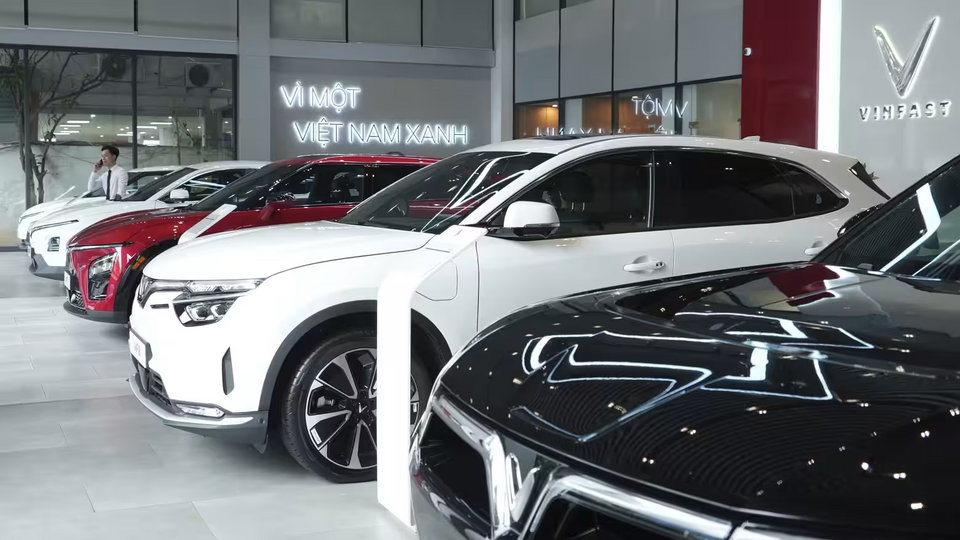
Vietnam accelerates unexpectedly, regional markets become polarized.
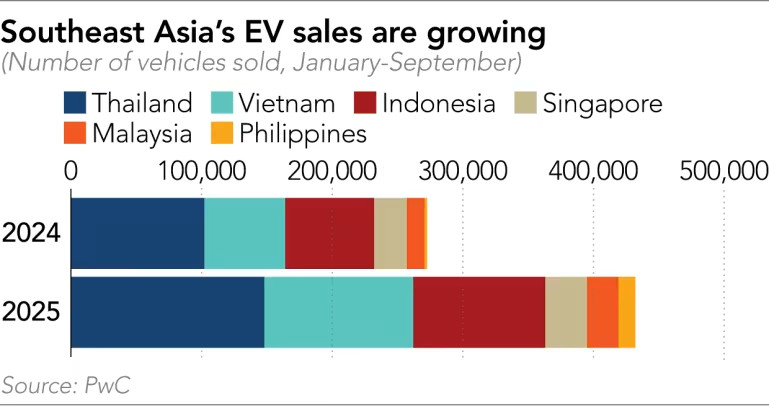
“Vietnam’s growth is certainly a big surprise,” Akshay Prasad, director of consulting firm Arthur D. Little, told Nikkei Asia. Total car sales in Vietnam (commercial and passenger vehicles, both electric and petrol) increased 18% in the January–September period compared to the same period in 2024; electric vehicle sales increased 84%, according to PwC.
Across ASEAN, PwC reports that electric vehicle sales in the first three quarters of the year increased 62% year-on-year, but penetration is uneven. Malaysia and the Philippines lag behind among the bloc's six largest economies. According to government data, as of October, electric vehicles accounted for 4.5% of new registrations in Malaysia, while the regional average reached 17% according to PwC.
Charging infrastructure: local advantages and concentration risks.
A lack of synchronized charging infrastructure is a bottleneck in many places. According to the Electric Vehicle Association of Thailand, the country leads with 21 companies operating more than 4,000 public charging points. Vietnam is highly rated by PwC in the ASEAN Electric Vehicle Readiness Index and has exceeded its target this year, according to Yossapong Laoonual from Thonburi University of Technology.
Conversely, Vietnam is the only market with a single main operator: V-Green (a subsidiary of VinFast) manages approximately 3,000 charging stations. This concentration raises concerns about the risk of a monopoly, which could stifle market expansion. In the US, Tesla's network only expanded its reach after the White House mandated the opening of several stations "to expand freedom of movement for all electric vehicles." "That was government intervention," Yossapong said, while also suggesting adherence to international technical standards for global network access.
From a different perspective, according to Mohammad Mudasser, Director of Transactions at PwC Vietnam: users primarily charge at home or at work, so the lack of public charging stations is not a decisive barrier. "Convenience is key to the future," he said.
Fragmented supply chains and the challenge of an "ASEAN single hub"
Regarding manufacturing, fragmented supply chains are a weakness when ASEAN wants to expand localization. “If each market remains isolated, some companies will have to withdraw or cease operations,” Akshay Prasad noted. Patrick Ziechmann (PwC) argues that ASEAN should operate as a single automotive hub, despite currently low intra-regional trade barriers. According to him, countries all want to create local jobs and receive technology transfer, so the trend towards “closed” markets persists.
Yossapong proposed assigning roles based on strengths: Indonesia (nickel) for batteries, Thailand for mechanical components, and Malaysia leveraging its electronics supply chain. "ASEAN can cooperate with each other," he said.
China's increasing influence; joint ventures with Vietnamese businesses.
While VinFast dominates in Vietnam, Chinese brands hold a dominant position in many other ASEAN markets. Several companies are partnering with Vietnamese companies: Chery (Anhui) collaborates with Geleximco; Wuling (Guangxi) partners with TMT Motors. Mohammad Mudasser predicts that in about five years, the market will become less concentrated with the entry of more Chinese brands.
In Thailand, once dubbed the "Detroit of Asia," the rapid expansion of Chinese brands is posing a challenge to the competitiveness of domestic businesses. "Many Chinese companies haven't collaborated with Thai companies," Yossapong said, recommending that domestic businesses increase their R&D capabilities.
Market trends: Malaysia, Indonesia, Thailand
PwC reports that the ASEAN automotive market contracted by 1.5% in the first three quarters of the year, largely due to a decline in petrol vehicles. While Malaysia surpassed Indonesia in size in the second quarter, the proportion of EVs remains low; by October, EVs accounted for 4.5% of new registrations, up 44% year-on-year, with sales led by BYD, Proton, Tesla, Zeekr, and BMW. Proton reports that electric vehicles will account for 22% of its market share this year; Perodua (42% of total vehicle deliveries) is expected to enter the EV market in December, potentially boosting mass demand.
Indonesia, formerly the largest market, is being impacted by a shrinking middle class and tighter financial conditions; electric motorcycle ownership is booming. According to the International Energy Agency, from around 2% of two-wheelers being electric last year, current trends suggest it could reach 30% by 2030. In Thailand, despite a challenging economy and cautious credit (banks remain hesitant about EVs), electric vehicle registrations by October were already 8% higher than the total for 2024, according to the industry association.
Key figures
| Target | Data | Source |
|---|---|---|
| VinFast EV sales figures up to September. | 110,362 vehicles | PwC reports on VinFast. |
| Sales share in Vietnam | 94% | VinFast Report |
| Related party sales ratio (Q3) | 26% | VinFast Report |
| BYD EV Sales | Over 70,000 vehicles | PwC |
| ASEAN EV Growth (3 quarters) | +62% compared to the same period | PwC |
| Vietnam: Electric Vehicle Growth (1–9) | +84% | PwC |
| Vietnam: Total Automotive Market (1–9) | +18% | PwC |
| Malaysia: EV share (up to 10) | 4.5% new registrations | Malaysian Government, PwC |
| Regional EV average | 17% | PwC |
| ASEAN: Automotive Market (3 Quarters) | -1.5% | PwC |
| Thailand: Public charging stations | >4,000, 21 businesses | Thai Electric Vehicle Association |
| Vietnam: V-Green charging station | Approximately 3,000 | Yossapong Laoonual |
| Indonesia: electric two-wheelers | ~2% (last year) → 30% (2030, forecast) | IEA |
Conclude
VinFast is leading the ASEAN electric vehicle market thanks to its domestic advantages and extensive charging infrastructure, amidst a growing but fragmented demand for EVs across the region. The challenge for the next phase is to standardize infrastructure, reduce network concentration to encourage competition, and coordinate supply chains within the bloc to expand production scale.


