
VinUni and UPenn: From receiving technical support to reciprocal cooperation
Starting from a challenging journey to seek support from Ivy League universities to build an internationally recognized academic foundation, after 8 years, VinUni University has risen to become an equal partner with the University of Pennsylvania (UPenn).
VinUni University and the University of Pennsylvania have officially signed a new cooperation agreement, promoting student and faculty exchanges and research collaboration between VinUni and the entire University of Pennsylvania system of schools, not just limited to the Perelman School of Medicine. In particular, VinUni and the University of Pennsylvania aim to jointly design and teach master's programs and short-term training courses in the fields of medical education, healthcare system leadership, and hospital management, expanding their influence regionally..
“The number of Vietnamese universities that collaborate on an equal footing with leading universities worldwide is currently very small, and VinUni is the first private university to do so. This is very encouraging for Vietnamese higher education, especially as Resolution 71 of the Politburo sets the goal of bringing Vietnamese universities into the top 100 in the world,” said Professor Nguyen Dinh Duc, University of Technology, Vietnam National University, Hanoi.
According to Professor Nguyen Dinh Duc, reciprocal cooperation is very difficult because it requires universities to have a faculty of outstanding researchers comparable to top universities in order to be able to cooperate with them.
From receiptsupportassistancetechniquearrive... reciprocal cooperation
Eight years ago, VinUni was just an ambitious idea for a world-class, elite university right here in Vietnam, conceived by Vingroup. That idea, written on a single A4 sheet of paper, was taken to the United States by Dr. Le Mai Lan, who approached Ivy League universities – the group of the most prestigious private universities – seeking their expertise to build a new university from scratch.
"Many schools politely refused, saying they didn't know who we were, but we didn't give up," Dr. Le Mai Lan recalled.
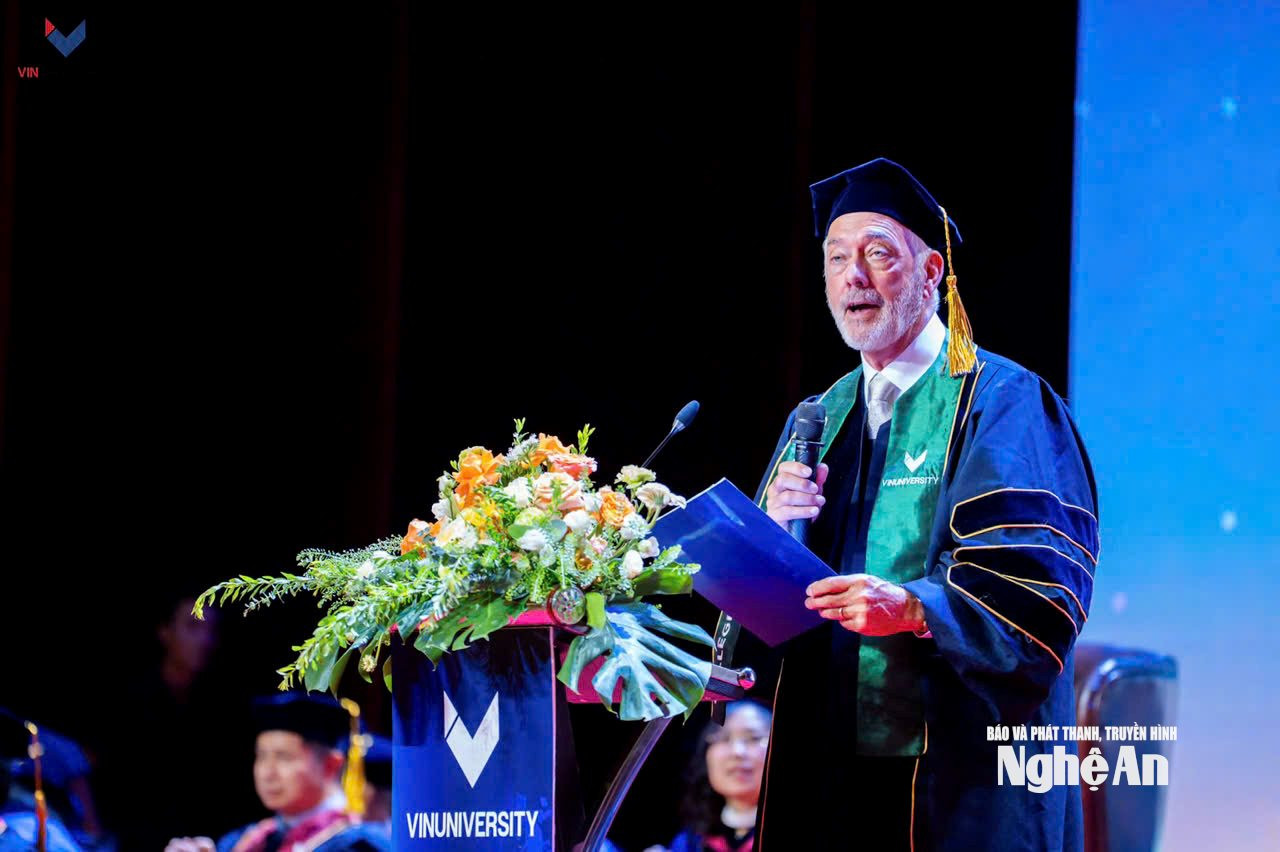
UPenn was one of the first two Ivy League schools to agree to partner with VinUni. The two sides spent seven months working closely together before reaching the initial cooperation agreement in 2018. Under this agreement, UPenn supported VinUni in designing strategic models, developing curricula, and training faculty to world-class standards in health science education. To ensure quality and final results, UPenn also seconded personnel to serve as program directors.
Although considering this a "rare opportunity" to create a completely new, world-class university and "truly inspired" by VinUni's aspirations, Professor Glen Gaulton, Vice Dean of the Perelman School of Medicine and Director of UPenn's Center for Global Health, said that he and UPenn's leadership were also very worried at the time. Naming UPenn alongside a university that was only on paper could risk the school's reputation if the program was unsuccessful.
"However, both sides decided to cooperate based on trust and understanding, and the facts have proven that decision to be the right one," said Professor Glen Gaulton.
After eight years, the relationship has qualitatively changed. From a university that needed UPenn's professional support and quality validation to develop its programs, VinUni has gradually affirmed its international academic quality to become an equal partner, fully capable of collaborating with this world-leading university to design and deliver master's programs.
“In the initial phase, UPenn helped Vingroup build a ‘startup’ like VinUni, but now our relationship is a balanced partnership, not just one-sided consulting,” Professor Glen Gaulton emphasized. In other words, VinUni is now not just a recipient of UPenn’s standards, but has become a capable academic partner working with UPenn to develop programs, train faculty, expand research, and create regional impact.
Reputation is proven by practice, not just by certificates.
According to experts, UPenn's expanded cooperation affirms the recognition of VinUni's prestige and world-class training quality. This is not only a major milestone for VinUni itself but could also become a prime example of how a six-year-old university can rapidly build academic prestige with a partner with a 286-year history.

VinUni is the first and only university in Vietnam with ACGME-I accredited residency programs for physicians, as well as an ACEN-accredited Bachelor of Nursing program – the world's highest accreditation standards for these fields of study.
In 2024, VinUni achieved a remarkable feat by becoming the youngest university in the world to achieve comprehensive QS 5-star accreditation, reaching the highest level in just four years with the first graduating class.
But UPenn doesn't just measure quality through international certification documents; they look at verifiable quality.
“We have been working with VinUni for eight years, with over 250 UPenn faculty members coming to work alongside VinUni faculty. UPenn has also welcomed many VinUni faculty and students for exchange programs. This allows UPenn to realistically assess the quality of education at the university,” Professor Glen Gaulton shared.
Over the past three years, VinUni has sent 16 students to UPenn to pursue the VinUni-UPenn integrated master's program. This fall, six more students will join UPenn under this program. The acceptance rate for VinUni students is 70%, compared to the average of only 5% – an impressive figure. Of the 10 students who have completed their master's degrees, two received full scholarships from UPenn to pursue doctoral studies, while the others have joined international corporations or Vingroup's technology companies.
"Some UPenn faculty members have commented that VinUni students are of comparable, or even better, quality than UPenn students," Professor Glen Gaulton stated.
Dr. Le Mai Lan proudly stated that while eight years ago VinUni had to struggle to get UPenn's support, now, continuing the collaboration for a new phase comes naturally.
"In high-quality education, there are no shortcuts. We must strive to demonstrate quality through perseverance, steadfastness, and consistency year after year," said Ms. Mai Lan.
Accompanying cconquer new goals
VinUni has announced its goal of ranking among the top 100 best universities, competing with prestigious universities with centuries of history around the world – an incredibly ambitious goal.
“UPenn wants to partner with VinUni on this journey to achieve our goals and aims to create more opportunities for growth, focusing on talent development,” said Associate Professor, Dr. Julie Sochalski, Vice Dean for Training, UPenn School of Nursing.
Dr. Le Mai Lan added that, despite being a latecomer, VinUni has a particularly rare advantage: the diverse and powerful ecosystem of Vingroup. Therefore, in addition to announcing the VinUni 500 program to attract talent, VinUni also recently announced the construction of the V-RIC Research and Innovation Complex, oriented as a system of labs and sandbox testing spaces, operating under a co-creation mechanism, directly linked to the product development cycle of units within the ecosystem.
This will be a place where VinUni students and researchers can access real-world problems, test real solutions, and become familiar with an innovative environment in the fields of AI, robotics, electric vehicles, semiconductors, and high-tech startups.
According to Dr. Le Mai Lan, the three pillars the university aims for are technology, integration, and service to humanity. Continuing the collaboration with UPenn at a higher level is an important step towards achieving these goals.
The journey and goals that VinUni is pursuing are precisely the aspirations of bringing Vietnamese universities to the top ranks in the world, and elevating Vietnamese education to the top 20 globally, as set forth by the Politburo in Resolution 71 on breakthroughs in education and training development.
According to Professor Nguyen Dinh Duc, prioritizing cooperation with world-class universities is also the path that universities in China, South Korea, Japan, etc., have taken to improve their quality.


