
WB: Many Vietnamese banks will be merged.
The World Bank predicts that by 2017, Vietnam will significantly reduce the number of banks from the current 34, but will still struggle to reach the target of 15-17 banks.
The World Bank (WB) has just released its report on the Vietnamese economy and its forecasts for 2016. According to the report, the Vietnamese economy has weathered global fluctuations remarkably well thanks to increased domestic demand and strong performance from its export-oriented manufacturing sector.
Regarding the banking sector, the World Bank stated that some progress has been made in consolidating the industry, with several mergers and acquisitions completed, but it remains difficult to achieve the target of reducing the number of banks to 15-17 by 2017. Currently, the total number of banks is 34.
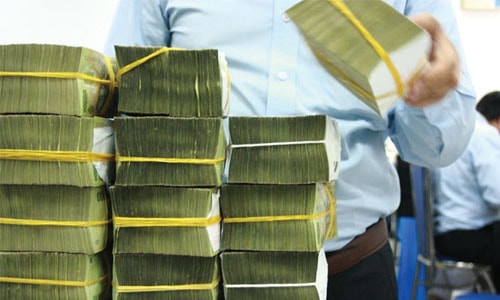 |
In 2017, Vietnam had only 15-17 banks. |
Sandeep Mahajan, Chief Economist of the World Bank, said that Vietnam has too many small banks, so reducing the number to 17 is necessary, but it will be difficult to achieve this pace in 2017.
"Reducing the number of banks should not be rushed; what's important is the appropriate method and process for mergers and consolidations. The numbers are not as important as the reforms of the State Bank of Vietnam," a World Bank representative said.
This expert estimates that the officially announced non-performing loans of banks have decreased to 3% of the total value of loans. This reduction in non-performing loans was achieved mainly due to credit growth and the transfer of bad debts to the Vietnam Asset Management Company (VAMC). Although banks are required to gradually provision for the assets transferred to VAMC, the credit and related risks that harm capital have not been completely eliminated.
The World Bank assesses Vietnam's economic outlook for 2016 as relatively positive, but negative risks remain dominant. Therefore, the agency has lowered its forecast for Vietnam's economic growth in 2016 to 6.2%, down from the 6.5% forecast at the beginning of the year. Inflation is also expected to slow due to the less-than-optimistic global situation and falling global energy and food prices. The fiscal deficit is expected to begin to decrease, reducing the risk of rising public debt. The trade deficit is expected to increase, leading to a slight decrease in the current account balance.
Mr. Sandeep suggested that there were two reasons for the World Bank's sudden reduction in GDP growth forecasts: firstly, the presence of several "headwinds," meaning that economic risks in the US, India, and Japan still exist; and secondly, the ongoing global economic recession, which is affecting Vietnam's short-term and medium-term growth.
In addition, according to the Q1/2016 economic report, Vietnam's economic growth reached only 4.6%, lower than the same period last year; agriculture experienced negative growth for the first time due to the impacts of extreme weather, saltwater intrusion, drought, etc. Agricultural production will decline as a result of these impacts.
At the same time, Vietnam's export growth has tended to decline, even the FDI sector - the main driver of Vietnam's export growth - has slowed down in the past quarter.
However, compared to other countries in the region, Vietnam still boasts spectacular growth, performing better in the context of participating in a series of free trade agreements.
The World Bank forecasts that this year the Vietnamese economy will face many challenges, such as the slow pace of economic restructuring, which poses risks to medium-term growth. Fiscal risk is a significant concern. Rapid credit growth increases the risk in the banking sector. Weakening external demand and global financial instability require continuous attention to sound macroeconomic management to avoid potential shocks.
In 2016, Vietnam's public debt was projected to rise to 63.8% of GDP, with a budget deficit of 5.9% of GDP. Inflation was expected to increase to 3.5%.
Therefore, the World Bank recommends that Vietnam implement fiscal stabilization, enhance exchange rate flexibility, and increase foreign exchange reserves to mitigate these vulnerabilities.
According to VNE
| RELATED NEWS |
|---|


