
WEF: Investors place their trust in Vietnam's commitment to reform.
The Prime Minister's trip has built confidence among major global investors in a Vietnam determined to innovate and reform.
On the afternoon of January 21st, Vietnam time, Prime Minister Nguyen Xuan Phuc and the high-level Vietnamese delegation arrived back in Hanoi, successfully concluding their participation in the 47th Annual Meeting of the World Economic Forum, held from January 17-21, 2017, at the invitation of World Economic Forum Chairman Claus Schwab. This trip was successful in many respects, promoting the image of a dynamic Vietnam and building confidence among major global investors in a Vietnam determined to innovate and reform.
With a busy and continuous work schedule, Prime Minister Nguyen Xuan Phuc had 36 activities, including 25 bilateral meetings, 2 dialogues with senior leaders of many large corporations, meetings with some leading news agencies and newspapers worldwide; attending and speaking at 6 discussion and dialogue sessions of the Conference, including: The future of manufacturing from a regional strategic perspective; Prospects for ASEAN after 50 years of establishment and development; Proactive and responsible leadership in a multipolar world; Strong governance in the Fourth Industrial Revolution; Manufacturing identity: Has ASEAN become a community yet?...
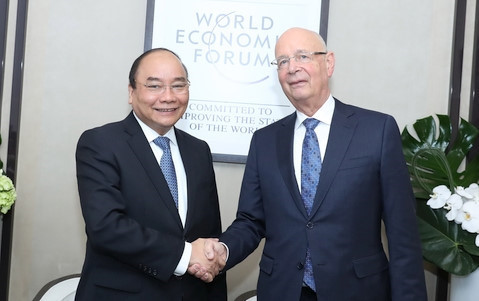 |
| Prime Minister Nguyen Xuan Phuc and WEF Chairman Klaus Schwab. |
Sharing the essential elements for proactive and responsible leadership, Prime Minister Nguyen Xuan Phuc emphasized that countries need to act responsibly towards peace and stability in the world and the region; and highly appreciated the role of multilateral organizations, especially the United Nations, in promoting the common interests of the international community.
The Prime Minister also highlighted the opportunities and challenges of the fourth industrial revolution for developing countries, including Vietnam; affirming that Vietnam is focusing on improving productivity and competitiveness, encouraging entrepreneurship, innovation, and developing high-quality human resources to seize the opportunities of the fourth industrial revolution.
With approximately 3,000 delegates, including more than 40 high-ranking leaders from countries and international organizations, numerous leaders of major corporations, and leading experts and scholars from around the world attending the conference, the Vietnamese delegation, led by Prime Minister Nguyen Xuan Phuc, conveyed messages about a Vietnam determined to strongly innovate and deeply integrate into the global community.
Over 400 discussion sessions at this year's annual conference revolved around the theme of "Responsible Leadership and Action." This theme aligns with the Vietnamese government's ongoing efforts to build an honest, development-oriented, proactive government that serves the people and businesses. The goal is for Vietnam to be among the top four ASEAN countries in terms of favorable investment environment by 2017 (ASEAN 4). Addressing major global investors, Prime Minister Nguyen Xuan Phuc emphasized the importance of improving institutions, a point that was strongly supported and shared by the investors.
“Among these 12 pillars of competitiveness, institutions are very important. Therefore, the Vietnamese Government is focusing all resources and capabilities on addressing institutional issues in accordance with international practices and market economics in all areas, especially finance and banking, intellectual property, environmental protection, and dispute resolution… This institutional foundation must ensure comprehensiveness and inclusiveness, giving all citizens the opportunity to contribute to successful economic growth and benefit fairly from those achievements,” Prime Minister Nguyen Xuan Phuc emphasized.
According to Deputy Minister of Foreign Affairs Bui Thanh Son, investors recognize that Vietnam is on a path of strong reforms, improving the investment and business environment, and valuing international investors. Deputy Minister Bui Thanh Son feels that investors have great confidence in Vietnam's reform and development, a bright spot in the region's economy. Therefore, they are all committed to expanding investment cooperation in Vietnam. Several corporations have indicated plans to expand cooperation in Vietnam, such as Alibaba Group. Jack Ma stated that he plans to cooperate with Vietnam to enhance capabilities in information technology, software, and training for Vietnamese students.
During this trip, the Prime Minister held a series of bilateral meetings with leaders of countries such as the President of Switzerland, the Prime Minister of Austria, the Prime Minister of the Netherlands, the Queen of the Netherlands, the Prime Minister of Sri Lanka, and the President of Ukraine; met with the Chairman of the World Economic Forum (WEF), the Secretary-General of the United Nations, the President of the World Bank (WB), the President of the Asian Development Bank (ADB), and many other development partners; and met with numerous business leaders.
In addition to discussing and promoting bilateral and multilateral cooperation with Vietnam, the Prime Minister provided information on the Asia-Pacific Economic Cooperation (APEC) Summit and Vietnam's priorities for APEC 2017. With the Summit's theme being "Creating New Momentum, Building a Shared Future Together," APEC 2017 activities and conferences will focus on promoting economic integration and enhancing competitiveness in the digital age. This is a topic of great interest to many investors who wish to contribute to APEC 2017 and explore specific investment opportunities in Vietnam.
Another significant success of this trip was that Vietnam became the first country to sign a cooperation agreement with the World Economic Forum on developing a resilient Vietnamese economy for the future. With a public-private partnership (PPP) model, this is considered a "model" for the World Economic Forum to implement with other countries. Under the agreement, the World Economic Forum will support Vietnam in connecting with the Forum's network of leading businesses and research experts; and collaborate with Vietnam on research and policy advice on areas such as economic restructuring, high-tech agricultural development, national competitiveness, and climate change.
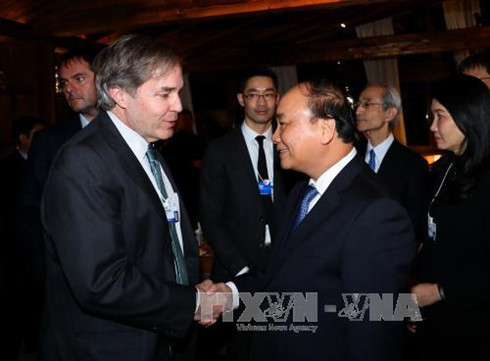 |
| During a meeting with Prime Minister Nguyen Xuan Phuc, WEF Managing Director Philip Roesler (pictured on the left) affirmed: “Vietnam has a strong partner, the WEF. We are ready to support Vietnam.” Photo: VNA |
According to Philipp Roesler, Managing Director of the World Economic Forum, through this collaboration, the World Economic Forum will support Vietnam in all necessary sectors and fields to enable Vietnam to enter the era of the Fourth Industrial Revolution.
According to Philip Roesler, for WEF member companies interested in investing in Vietnam, this is not just an agreement or contract, but "truly a promise."
"Vietnam has a very strong partner in the World Economic Forum, and we are ready to support Vietnam," Philip Roesler emphasized.
With thousands of leading global businesses attending this conference, it presents an opportunity for any country wishing to promote and attract investment. Therefore, despite his busy schedule, Prime Minister Nguyen Xuan Phuc dedicated considerable time to meeting and engaging in dialogue with numerous leaders of leading global corporations such as Mitsubishi, UPS, Microsoft, Facebook, Qualcomm, and Alibaba. UPS expressed interest in investing in air transport services in Vietnam, Alibaba also has plans to invest in Vietnam, and Mitsubishi wanted to know the areas the Vietnamese government prioritizes for future development.
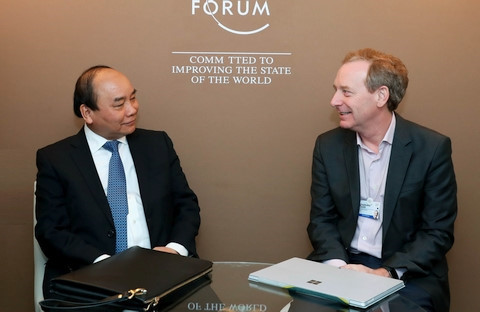 |
| Prime Minister Nguyen Xuan Phuc and Microsoft Chairman Bradford Smith. |
Joe Kaeser, Chairman and CEO of Siemens, said that when he visited Vietnam in 2016, he was very impressed by the dynamism of the Vietnamese people. Siemens became a world leader in digital manufacturing thanks to its internship program for university students. “I hope the Prime Minister can introduce my company to a Vietnamese partner to jointly develop a training program for Vietnamese students and interns. Currently, Siemens has a training program for over 2,000 interns from 48 countries worldwide, and we hope to present this practical internship model in Vietnam to the Prime Minister,” Joe Kaeser expressed.
With an open, frank, and welcoming spirit towards investors, the Prime Minister highly appreciated the proposals and questions from investors and directly answered questions on finance, banking, insurance, information technology, air transport, and many other fields. The Prime Minister affirmed to UPS that Vietnam has a policy of opening its skies and is ready to create favorable conditions for investors to participate in the Vietnamese market; he considered Siemens' proposal excellent and called on business leaders to invest in many sectors in Vietnam, including high-tech agriculture, a sector in which Vietnam has a great advantage.
During the meetings and dialogues, the Prime Minister once again affirmed that Vietnam values foreign investors, an economic sector that contributes over 20% of Vietnam's GDP.
According to VOV


