
WSJ reveals Operation Spiderweb: Ukrainian UAVs strike deep.
The WSJ quoted participants describing the SBU's Operation Spiderweb: trucks disguised as mobile homes, with their roofs open, launched more than 100 UAVs to attack four Russian airfields on June 1; the SBU estimated that more than 10 aircraft were destroyed.
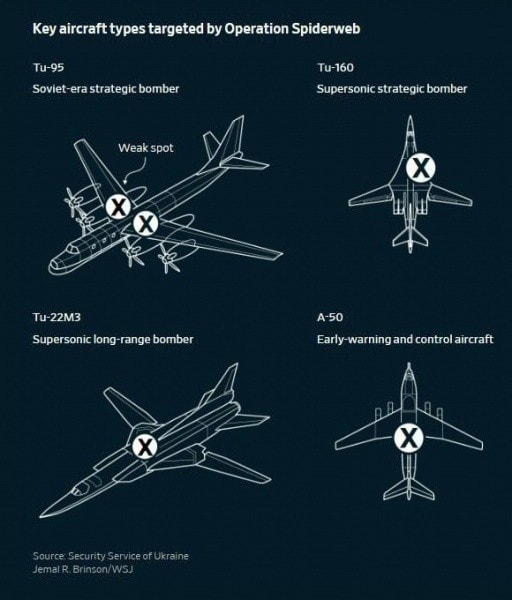
According to the Wall Street Journal (WSJ), the Ukrainian security agency (SBU) conducted a special operation called "Spiderweb," using trucks disguised as mobile homes to transport and launch a series of unmanned aerial vehicles (UAVs) from inside Russian territory. On June 1st, more than 100 UAVs were simultaneously launched, targeting four Russian military airfields. The SBU estimated that 41 aircraft were attacked, with more than 10 completely destroyed.
Campaign Overview
The Wall Street Journal, citing sources directly involved, reported that the SBU built a complex transport network to deliver hundreds of UAVs deep into Russia. The UAVs were hidden in truck trailers designed like mobile homes; the roofs could be opened remotely to launch the UAVs as soon as they reached a predetermined location. Communication systems mounted on the UAVs allowed for control from Kyiv.
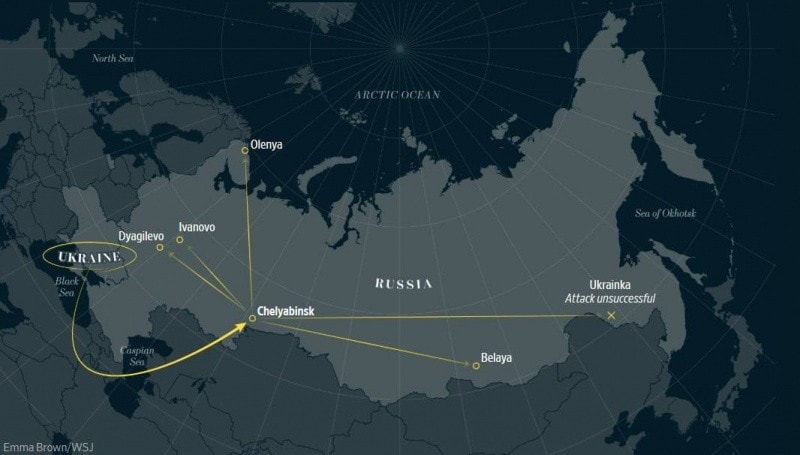
Transportation and camouflage chain
During the preparation phase, the UAVs were installed inside truck cabins disguised as mobile homes, along with solar panels and backup batteries. The WSJ reported that at one point the operation nearly failed when a driver accidentally tilted the cabin roof, exposing the cargo. The driver alerted coordinator Artem Tymofeyev; a cover story was immediately devised to secure the mission and maintain the "mobile home" cover.
In late May, five trucks set off along different routes across Russia. At the precise moment, the truck bed covers swung open and the UAVs were activated to attack their targets as planned.
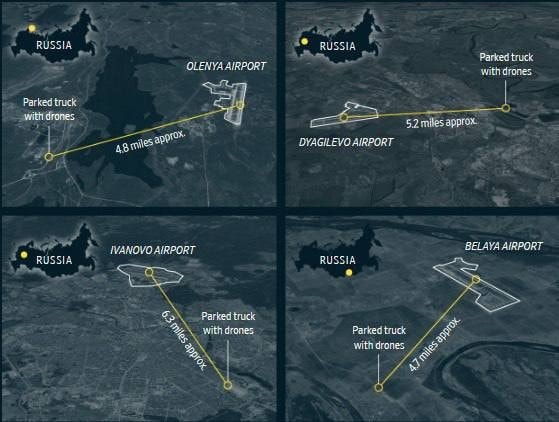
Technical analysis (based on source data)
- Launch vehicle: a modified truck bed acting as a mobile home, with a remotely opening roof, allowing for discreet and rapid deployment of the UAV.
- Power source: The cabin is equipped with solar panels and backup batteries, ensuring the system is powered before launch.
- Control: The UAV is equipped with a communication system that allows control from Kyiv, enabling centralized remote coordination.
- On-site assembly: the UAV components were assembled by Artem Tymofeyev and Kateryna right on Russian territory to reduce cross-border logistical traces.
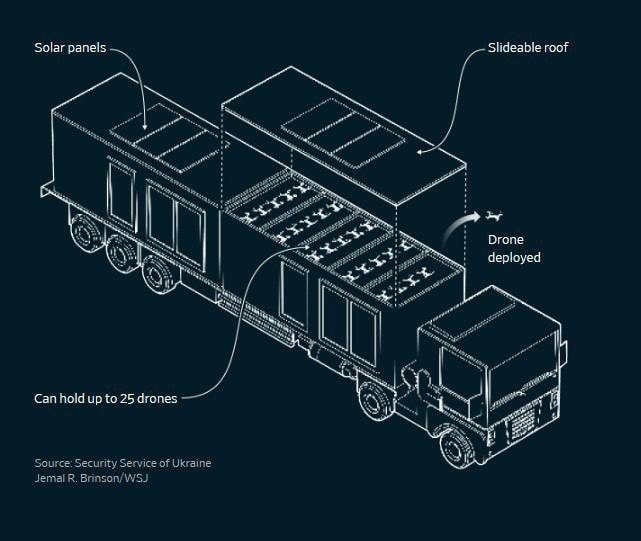
Launch of the attack on June 1st.
According to the WSJ and estimates from the SBU, more than 100 UAVs took off simultaneously, targeting four military airfields: Belaya, Dyagilevo, Olenya, and Ivanovo.
| Time/Location | Developments | Source |
|---|---|---|
| Late May | Five trucks set off on different routes across Russia. | WSJ |
| 1/6 | Over 100 UAVs attacked Belaya, Dyagilevo, Olenya, and Ivanovo. | WSJ/SBU |
| Estimated damage | 41 aircraft were attacked; more than 10 were completely destroyed. | SBU |
Personnel and operational security
According to the WSJ, the secret coordinators Artem and Kateryna Tymofeyev were Ukrainian citizens who moved to Russia after 2014 and held Russian passports. Their fluency in Russian made them less aroused by local authorities.
Before deployment, the couple were taken to Lviv for security checks, including questioning using a lie detector, before returning to Russia. In Chelyabinsk, Artem established a logistics company, hired drivers, built warehouses, and coordinated transportation. The WSJ reported that the drivers were not informed about the nature of the goods.
A few days before the attack, Artem and Kateryna left Russia for Kazakhstan on the pretext of tourism, taking only essential items with them. Following the attack, Russian security forces placed Artem Tymofeyev on their wanted list.
Evaluating tactics within the scope of available information.
- Civilian camouflage and mobile launch: the use of "mobile homes" allows UAV launchers to be moved to advantageous locations, reducing signs of preparation and increasing the element of surprise.
- Dispersing forces, concentrating firepower: five trucks positioned along multiple routes helped to disperse risk; the simultaneous launch created a high density of targets in a short period of time.
- Remote command and control: the ability to control from Kyiv demonstrates a centralized operational approach, supporting coordination between multiple launch sites.
- Logistics within enemy territory: assembling UAVs on-site and using local logistics companies helps conceal operations, but requires tight security discipline and cover-up scenarios should incidents occur.
The data and figures in this article are cited from the WSJ and estimates from the SBU as specifically stated.


