
Xã, phường xã hội chủ nghĩa: Hình thành một hình mẫu công dân mới
The pilot program for socialist communes and wards is not about building the administrative apparatus, but about developing people, aiming to form a new model of citizen who is self-reliant, creative, socially responsible, a lifelong learner, and digitally competent.
After nearly a year of the nationwide implementation of a two-tiered local government model, administrative power has shifted significantly to the grassroots level. Communes and wards – the level of government closest to the people – need to become the space where the values and principles of socialism are directly realized, transforming strategic vision into concrete results in the daily lives of the people.
Building socialist communes and wards is also an essential requirement stemming from modern governance practices, as the grassroots level not only performs administrative management functions but must also shift strongly towards community development governance and serving the people more effectively.
REALIZING THE NATION'S ASPIRATIONS BY 2045

Associate Professor Dr. Nguyen Viet Thong - former Secretary General of the Central Theoretical Council - believes that socialist communes and wards must encompass the eight characteristics of a socialist society as outlined in the Platform for Building the Country during the Transition Period to Socialism (supplemented and developed in 2011). However, the wording will vary from local to locality. Each place offers a different definition, but ultimately, they all apply the eight characteristics to the specific conditions of their commune or ward.
Eight characteristics of a socialist society according to the Platform for Building the Country during the Transition Period to Socialism (supplemented and developed in 2011)
A prosperous people, a strong nation, democracy, fairness, and civilization.
The people are the masters.
It has a highly developed economy based on modern productive forces and appropriate, advanced production relations.
It has an advanced culture, rich in national identity.
People have a comfortable, free, and happy life, with conditions for comprehensive development.
The ethnic groups within the Vietnamese community are equal, united, and respectful of each other.
There is a socialist rule of law state of the people, by the people, and for the people, led by the Communist Party.
We maintain friendly relations and cooperation with the people of countries around the world.
Hanoi is expected to pilot the program in two adjacent communes with a population of approximately 700,000, based on 54 criteria, while Lao Cai will pilot it in Lao Cai ward and Tran Yen commune with around 60-70 criteria.
Emphasizing the necessity of pilot programs, Mr. Thong shared that throughout the history of our Party, anything unclear needs to be piloted, "from the time the Party took leadership until now, we have conducted many pilot programs."
He cited examples from the period of the centrally-controlled economy when model districts were piloted, or from the period of reform when many localities piloted the non-establishment of People's Councils at the district, county, and ward levels.
"Although there have been unsuccessful pilot projects and a return to the old model, that's normal in political science, just like in natural sciences and social sciences."
"We are conducting pilot programs to gain experience; we must not be careless or hasty because this is a politically sensitive issue. Building socialist communes and wards is necessary, but because it is still a new initiative, the pilot programs are not widespread and vary from province to province. Therefore, Hanoi has 126 communes and wards, but only 2 were selected for the pilot program. Lao Cai has about 100 communes and wards, and only 2 were selected as pilot areas," he explained.
Based on that, according to Mr. Thong, after the pilot program, lessons learned will be used to expand it nationwide, aiming to end the transitional period and move towards socialism by 2045.
"The pilot criteria for socialist communes and wards revolve around eight characteristics. The economic, social, security, and defense criteria also have their own specific criteria for each locality, but ultimately, the highest goal remains the happiness of the people," he emphasized.
This is also a practical solution that contributes to realizing the aspiration for national development by 2045, so that the major goals of development, equity, and social progress are clearly felt in every community and every specific living space.

Mr. Thong suggested that localities should base their goals on the Resolution of the 14th Party Congress, which set out the vision for 2030 to 2045. In addition, some localities that have set ambitious goals should apply them to the criteria for socialist communes and wards, such as Hanoi, which has set a goal for 2065 with a "booming" GRDP of approximately 1,920 billion USD and a GRDP per capita of at least 95,000 USD.
SOCIALIST COMMUNES AND WARDS ARE NOT AN OLD-FASHIONED MANAGEMENT MODEL.
Professor Nguyen Quoc Suu, Assistant Director of the Ho Chi Minh National Academy of Politics, observes that the country's rapid development is facing challenges related to inequality, urban pressure, pollution, declining community cohesion, as well as the demands for a higher quality of life and modern governance.
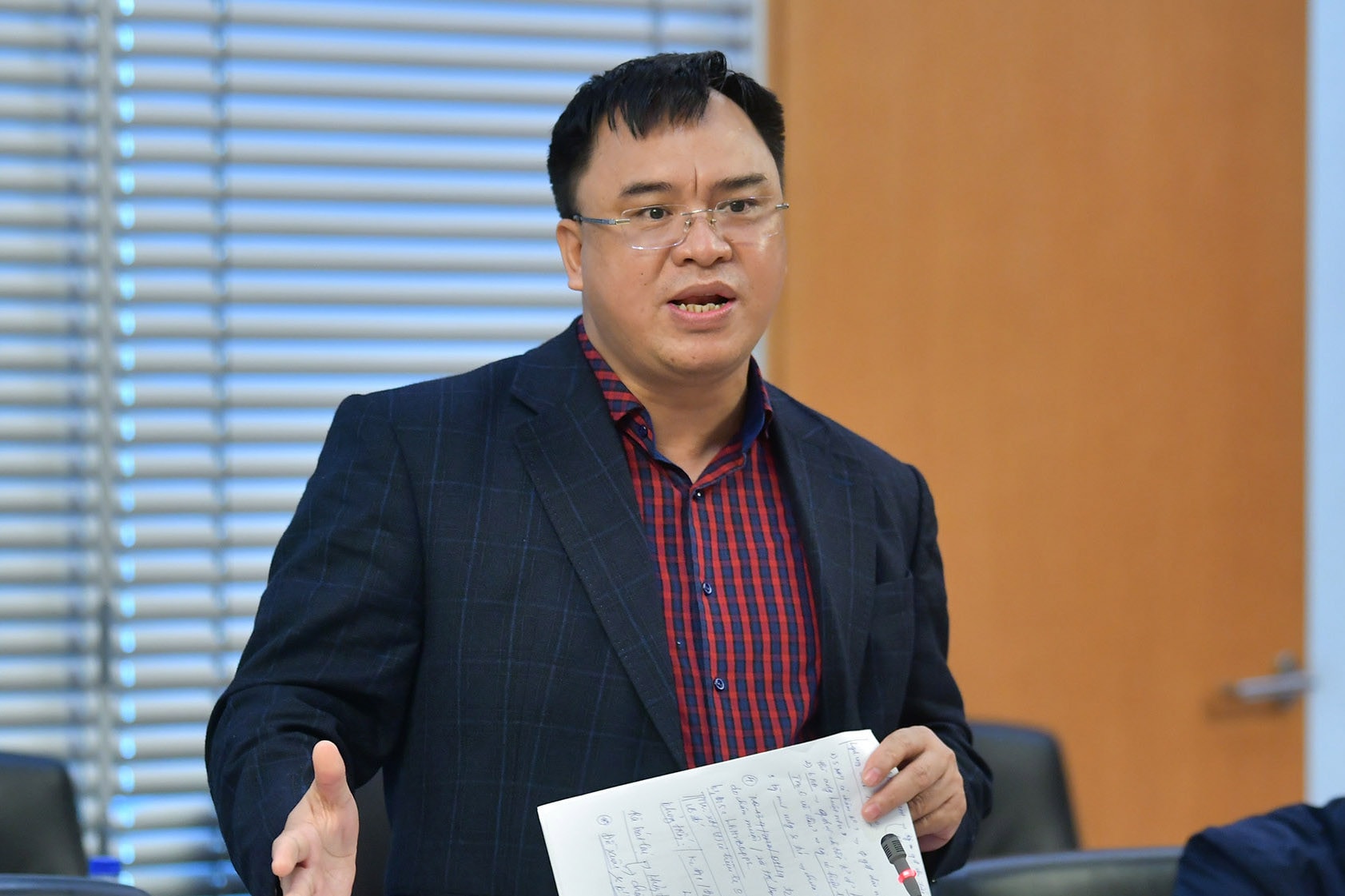
"We are asking ourselves a series of questions: How can growth go hand in hand with equity? How can economic development not come at the expense of the environment and cultural values? How can we modernize without weakening communities? And how can people not only have higher incomes but also truly have better, safer, happier lives with more opportunities for development?" - he posed the questions.
From this perspective, Mr. Suu argues that socialist communes and wards are not merely administrative titles or outdated management models, but rather development models that allow people to experience socialism in their daily lives.
"People don't perceive socialism through slogans, but through the schools where their children are studying, the healthcare system they receive, the environment they live in, transparency, opportunities for development, a service-oriented attitude, and the feeling that they are respected," he further analyzed.

Professor Nguyen Quoc Suu argues that the socialist commune/ward model in the 21st century is fundamentally different from the socialist model of the centrally planned economy era. This model is based on a socialist-oriented market economy, innovation, digital transformation, modern governance, and the empowerment of the people. Furthermore, the model incorporates economic development, digital government, innovation, modern governance, a fulfilling life for individuals, and a strong community.
In that case, according to Mr. Suu,first pillarIt is an inclusive, modern, and humane developed economy. It must be an economy that encourages innovation, legitimate wealth creation, promotes the development of the private sector, strongly applies science and technology, and embraces digital transformation. At the same time, all citizens must have access to employment, education, public services, and opportunities for advancement.
"I wholeheartedly agree with the saying 'economy is not the ultimate goal, but a tool to improve people's quality of life'," Mr. Suu shared.
Second pillarIt is about digital government and modern governance. It must be a model of digital government, data governance, transparency, high accountability, rapid response, and a people-centered approach. Mr. Suu affirmed that this is the foundation for building a government that is more connected to the people, more transparent, efficient, and humane.
Third pillarThe ultimate goal of socialism is the holistic development of human beings. This model should aim to cultivate a new type of citizen who is independent, creative, socially responsible, a lifelong learner, and digitally competent.
Fourth pillarA strong and self-governing community is essential. Socialist communes and wards are not only places with good governance but also places with strong communities. According to him, a strong community is built on trust among its members, working together for the common good. The community resolves its internal problems and protects and develops its shared living environment.
Fifth PillarIt is a green and humane living environment. Socialist communes and wards are a model of economic growth, but at the same time, they are a model of green and humane development; development cannot come at the expense of the living environment and human dignity.

The final pillarThis is genuine democracy. Mr. Suu emphasized that a modern socialist model cannot exist without democracy. Citizens have access to transparent and open information and participate in policy discussions. Citizens make decisions together with the community and monitor the government's activities. Democracy does not weaken governance; rather, it enhances its quality.
Ông nhìn nhận xây dựng xã, phường xã hội chủ nghĩa không thể làm theo phong trào mà là quá trình có hệ thống, có căn cứ và khả năng điều chỉnh.
"Có thể làm sandbox thể chế, tạo ra không gian an toàn để thử nghiệm chính sách mới mà không gây rủi ro cho hệ thống và triển khai theo quy mô nhỏ, thu thập dữ liệu từ thực tiễn. Từ đó làm căn cứ quyết định, rút kinh nghiệm từ thể chế rồi nhân rộng mô hình khi thành công... Chúng ta không nên tìm một mô hình hoàn hảo ngay từ đầu mà cần xây dựng mô hình có khả năng tự học hỏi và tự hoàn thiện" - ông đề xuất.


