
Germany's strange twin-gun tank
In the 1970s, Germany developed a main battle tank equipped with two 105 mm main guns, but the project was soon abandoned due to poor technical specifications.
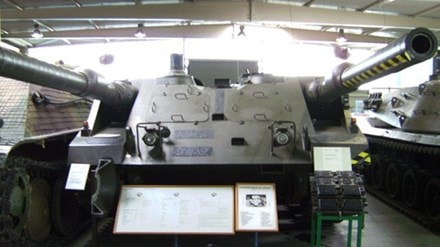 |
| A model of a tank with two main guns is on display at a military museum in Germany. Photo: War History Online. |
According to War History Online, in the 1970s, West Germany planned to develop a new main battle tank. Prior to this, the Leopard 1 main battle tank, manufactured by the country, had proven to be a successful design.
The Germans decided to choose a different design approach to elevate the power of German tanks to a new standard. During the 1960s and 1970s, the Cold War between the North Atlantic Treaty Organization (NATO) and the Soviet Union was raging. Germany and the United States developed a prototype for the joint MBT-70 tank project.
The MBT-70 project was subsequently canceled, and Germany repurposed the prototype to develop a new tank called the Kampfpanzer 3 (KPz 3), also known as Versuchsträger 1-2, abbreviated as VT-1.
Bizarre idea
During the 1960s and 1970s, the Soviet Union successfully developed several formidable main battle tank models. Tanks like the T-64 and T-72 could withstand German 90 mm self-propelled anti-tank guns. Therefore, they needed a new "tank destroyer" weapon to counter the advanced Soviet tanks.
To increase firepower, engineers equipped the vehicle with two main guns. The guns are fixed to the vehicle's hull, allowing for highly accurate firing. The engineers believe that two main guns firing simultaneously can destroy any tank with the first shot.
Initially, Britain supported the project but later withdrew, being more interested in a tank with a rotating turret than the unusual design of the VT-1. Nevertheless, Germany continued to pursue its ambition of creating the world's first tank with two main guns.
In 1974, prototype tanks with two main guns rolled off the production line and underwent testing. The first production model was fitted with two 105 mm main guns, manually loaded. The next model was fitted with two 120 mm guns, automatically loaded, to counter the new Soviet tanks.
In terms of firepower, the VT-1 proved superior to other tanks of its time thanks to being equipped with two main guns. Additionally, the version using the 120 mm gun could fire anti-tank missiles through the barrel. The VT-1 measured 9 m in length, 3.54 m in width, 2 m in height, and had a combat weight of 48 tons.
The vehicle is equipped with an MTU MB803 diesel engine, producing 1,500 horsepower, with a top speed of 70 km/h. The operating crew consists of 4 people with VT 1-1 configuration, and 3 people with VT 1-2 configuration.
Poor technical specifications
If we only consider its firepower, the VT-1 is a formidable tank. However, it has too many drawbacks. The main gun is fixed to the hull, making target selection very difficult as the entire tank must be rotated to face the firing direction. The gun's elevation angle is quite limited, making it impossible to fire from high positions.
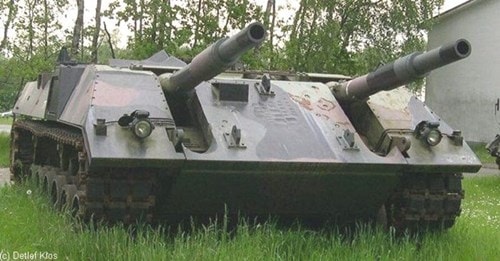 |
| The idea of installing two main guns to increase firepower proved unsuccessful. Photo: Detlef Ktos |
The VT-1's battlefield mobility was relatively poor and unsuitable for standard tank tactics. Tanks already have limited visibility, and the VT-1's lack of a turret made observation even more difficult.
For any weapon system, firepower is only one of the necessary and sufficient factors. The VT-1 tank was not adopted by the German army, even though the manufacturer attempted to improve the engine and suspension to increase maneuverability.
The VT-1 project quickly fell into oblivion when the Leopard-2 main battle tank was introduced, boasting superior technical and tactical characteristics. The Leopard-2 was considered by military experts to be the world's leading main battle tank. Attempts to design a tank different from the traditional one proved unsuccessful.
According to Zing
| RELATED NEWS |
|---|


