
Xiaomi SU7, YU7, and profits after 19 months thanks to the ecosystem.
Xiaomi earned 700 million yuan in profit from its electric vehicle and AI segments in the third quarter, breaking even after 19 months, faster than Tesla, Li Auto, and Leapmotor; thanks to its Chinese user ecosystem and supply chain.
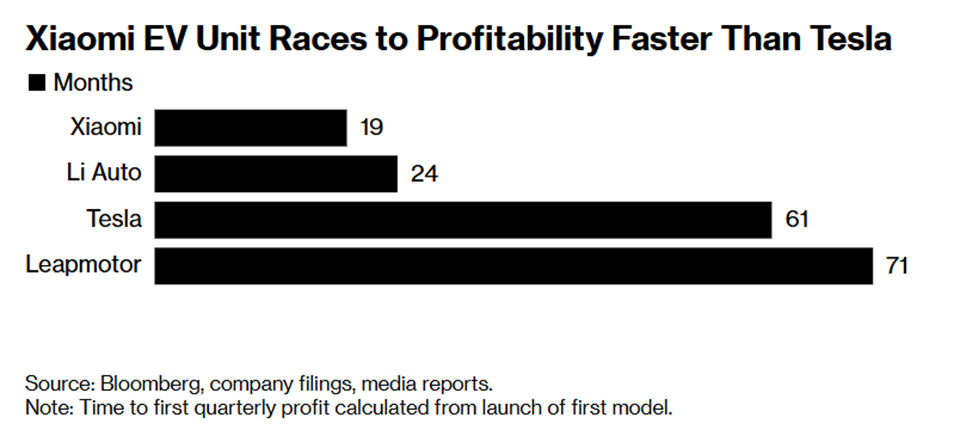
Xiaomi recorded 700 million yuan (US$98 million) in profit from its electric vehicle and artificial intelligence segment in the third quarter ending September 30, reaching this milestone in just about 19 months since the launch of its SU7 electric sedan. This is faster than Li Auto (24 months), Tesla (61 months), and Leapmotor (71 months), while Xpeng and Nio remain loss-making and aim to break even by 2025.
Profit after 19 months: figures and comparisons
According to the announcement on November 18th, this profit marks a rare early milestone in the electric vehicle industry. Tesla first achieved quarterly profit in 2013, more than five years after beginning to distribute the Roadster (2008). Li Auto broke even quarterly after about two years despite focusing on extended-range electric vehicles (EREVs). Xpeng and Nio are still operating at a loss, aiming to break even in 2025, about eight years from the launch of their first vehicles.
| Company | Time to achieve profit on a quarterly basis | Note |
|---|---|---|
| Mobile | 19 months | Profits from electric vehicles and AI segments for Q3 ending September 30 |
| Li Auto | 24 months | EREV Focus |
| Renault | 61 months | The company first reported a quarterly profit in 2013, after distributing the Roadster since 2008. |
| Leapmotor | 71 months | — |
| Xpeng | Not yet | Break-even target: 2025 |
| Nio | Not yet | Break-even target: 2025 |
This is also a notable victory for Xiaomi's founder and chairman, Lei Jun. Previously, a major American technology corporation had halted its efforts to make cars after many years and a $10 billion investment.
Xiaomi's formula: an ecosystem and a software platform.
Bill Russo, founder of Shanghai-based Automobility, noted that Xiaomi entered the market with structural advantages that most EV startups lack: a large existing user base, a strong brand with high credibility, and an integrated ecosystem strategy, resulting in low customer acquisition costs.
Xiaomi's approach is described as moving from a single model, tight supply chain management, and a software-focused architecture, aiming to expand revenue beyond the vehicle. The SU7 is treated like a large-scale consumer electronics launch: generating demand upfront and designed to quickly reach the break-even point.
Following the SU7, Xiaomi launched its second model in June, the YU7 (SUV), and recorded over 289,000 pre-orders in just a few hours.
Mature supply chains: shortening the path to scale.
According to Bill Russo, Xiaomi also benefits from China's mature electric vehicle supply chain. This allows the new company to scale without incurring massive investments, unlike earlier entrants who had to build many links in the supply chain from scratch.
Risks ahead: shrinking incentives, pressure on profit margins.
The industry outlook is being affected as the Chinese government scales back tax breaks for electric and hybrid vehicles from next year, while it remains unclear whether trade-in subsidies will be extended. Electric vehicle sales in China in October were down year-on-year.
To offset the reduced tax incentives, Xiaomi is offering cashback of up to 15,000 yuan to customers who pre-order electric vehicles before the end of November and take delivery in 2026. This will reduce profit margins. The company's chairman, Lu Weibing, said that the gross profit margin from electric vehicles is expected to decrease in 2026.
Markets and Exports: 2027 Targets and a Test of Resilience
Xiaomi aims to become one of the world's top five automakers, competing with Tesla and BYD in China before expanding overseas. The company plans to begin selling electric vehicles in Europe by 2027.
Bloomberg Intelligence analysts Joanna Chen and Jason Zhao assess that the domestic competitive outlook will become tougher as demand growth slows; companies will rely more heavily on exports to boost production and profits. BYD, Geely, Xpeng, and Leapmotor are leading this trend. Xiaomi's lack of plans to expand overseas before 2027 raises doubts about its performance next year.
Short conclusion
Xiaomi achieved profitability early by leveraging its user ecosystem, a one-model launch strategy, and a mature software platform and supply chain. However, the pressure of shrinking incentives, the 15,000 yuan promotional offer, and increased competition could thin profit margins before its export strategy begins in 2027.


