
Xpeng robotaxi: Turing 3,000 TOPS chip, tested in Guangzhou.
Xpeng announced three robotaxi models using four self-developed Turing AI chips with a total of 3,000 TOPS, powered by a VLA version 2 model. The company plans to test them starting next year in Guangzhou and collaborate with AutoNavi/Amaps for ride-hailing services.
Xpeng has announced three robotaxi models utilizing four of its own Turing AI chips, with a total integrated computing power of 3,000 TOPS (according to Xpeng). These vehicles operate on a Vision-Language-Action (VLA) version 2 model and are expected to begin testing in Guangzhou and several other cities in China starting next year. A partnership with AutoNavi and Alibaba's Amaps app will serve as the ride-hailing gateway.
Technical platform: Turing chip and VLA 2
As part of AI Day on November 5, 2025, Xpeng shared the hardware-software architecture for robotaxi: four Turing AI chips integrated into the vehicle, providing a total of 3,000 TOPS to process sensory data and make decisions based on the VLA version 2 model. This AI model combines input signals such as vision to support autonomous driving and robotics applications, according to Xpeng.
CEO He Xiaopeng introduced the robotaxi deployment plan along with a long-term vision for expanding into other automation applications. Co-chairman Brian Gu emphasized that the rapidly increasing computing power is the basis for the company's belief in the "turning point" of self-driving taxis.
| Category | Information according to Xpeng |
|---|---|
| Number of robotaxe models | 3 |
| AI chip in the car. | 4 domestically developed Turing chips |
| Integrated computing power | 3,000 TOPS (Xpeng claims) |
| AI Stack | VLA model version 2 |
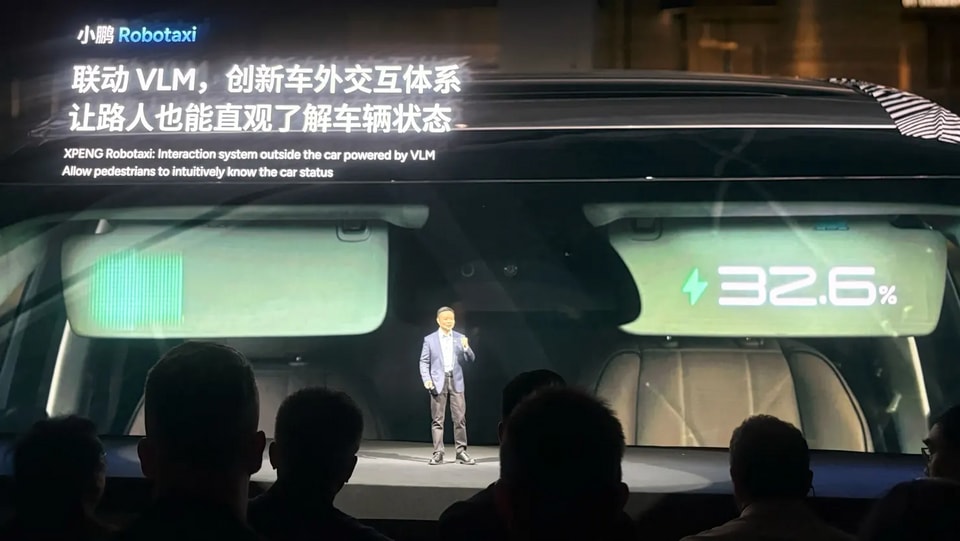
| Display interface | The sun visor displays speed and other information. |
| Trial roadmap | It is expected to start in Guangzhou and other Chinese cities next year. |
| Ride-hailing partners | AutoNavi/Amaps (Alibaba) |
| Product orientation | There are two types: shared commercial vehicles and fully autonomous personal vehicles (shared within a family). |
Passenger experience and interface layout
Xpeng stated that the robotaxi is equipped with a display screen on its sun visor showing speed and related information. Details about other interaction methods were not disclosed by the company at the event.
Implementation schedule and legal aspects
Xpeng is expected to launch trials in Guangzhou next year, then expand to other cities in China. Speaking to CNBC, Brian Gu believes that self-driving taxis "will eventually become a global phenomenon," but it will take time, especially as regulations become increasingly stringent due to safety concerns.
He also acknowledged that his views have changed since April 2024, when he predicted that self-driving taxis would struggle to become a significant business segment for at least five years. The reason is that the rapid development of AI and the significant increase in computing power have reinforced his belief in the technology's progress.
Ride-hailing ecosystem: collaboration with AutoNavi/Amaps
Alibaba is partnering with Xpeng in the robotics sector through AutoNavi and Amaps, taking on the roles of digital map and ride-hailing portal. This collaboration is expected to bridge the gap between technical testing and large-scale user experience.
Two-branch product strategy
Xpeng has developed two lines of robotaxi: one for shared commercial use and a fully autonomous version for personal use, which can be shared within a family. This approach shows the company's intention to simultaneously target urban service needs and private ownership applications.
Competitive landscape
Xpeng's announcement comes as Pony.ai, WeRide, and Baidu have already deployed self-driving taxis to the public in some areas of China and are expanding globally. In the US, Tesla this year launched trials of self-driving taxis in some areas of Texas.
Iron Generation 2 humanoid robot
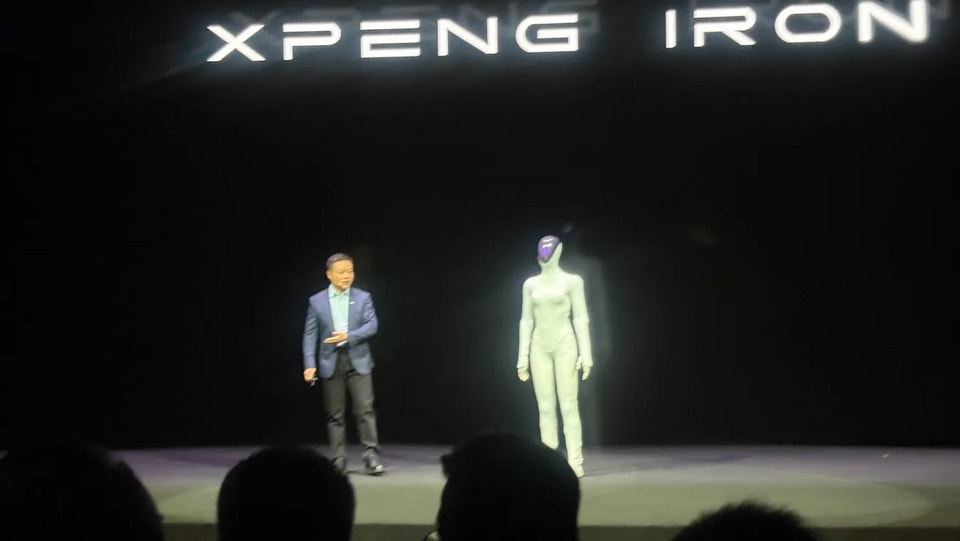
In addition to robotaxi, Xpeng announced the second generation of its humanoid robot, Iron, with mass production expected starting next year. CEO He Xiaopeng believes the robot is not yet suitable for households; and its application in factories is limited due to high costs in the context of low labor costs in China. Instead, the robot will be used as a tour guide, sales assistant, and office guide, initially in Xpeng's own facilities.
The Iron robot uses three Turing AI chips from Xpeng and a solid-state battery. The company plans to allow customization of certain elements such as body shape and hairstyle. He Xiaopeng said it's too early to estimate sales for the next 10 years, but expects the number of robots to outnumber cars. Co-chairman Brian Gu said Xpeng has developed some technologies before Tesla, such as flying cars and humanoid robots, but hasn't been as aggressive in promoting them as its competitor.
Quick review
Based on information released by Xpeng, the highlights include its "homegrown" chip strategy with 3,000 TOPS integrated into the vehicle and the VLA 2 model. The AutoNavi/Amaps collaboration could shorten the transition from laboratory to ride-hailing service. However, the scale of commercialization still depends on the legal framework and actual operational data.
With the Iron robot, the initial positioning of its application in a guidance and support role rather than manufacturing shows that Xpeng is choosing a cautious approach. Both robotaxi and humanoid robots are steps to expand Xpeng from an electric car manufacturer into the field of autonomous mobility and robotics, but their practical effectiveness needs to be proven through long-term testing and operation.


