
The "land" of bamboo and rattan in Vinh City
(Baonghean.vn) - Nestled beside the Cua Tien River, behind the bustling Vinh market, lies a village with a rather unusual name: Tan Kieu village. Known as the "land" of bamboo and rattan, it's a stopover for those seeking simple yet useful materials for everyday life.
Behind the bustling market lies a beautiful, peaceful space. People often call this village the bamboo village simply because it truly is a land of these plants.
The goods are displayed attractively along both sides of the road, giving buyers plenty of choices. In fact, the village is called Tan Kieu village, or some people also call it Kieu Thai village. This residential cluster actually belongs to Group 5 - Block 1 - Hong Son Ward (Vinh City).
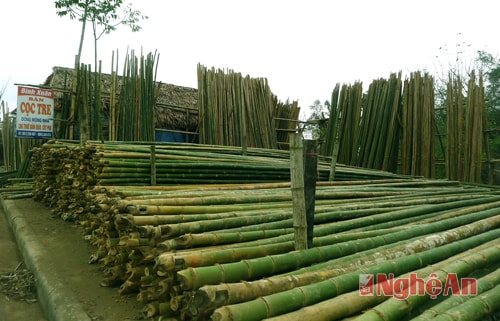 |
| Bamboo and reeds stretch as far as the eye can see along the road leading into Tan Kieu village. |
Learning about the village's history, it's known that in 1945, to escape a terrible famine, the people had to evacuate across the Thai border. However, later, the Thai authorities tightened restrictions on Vietnamese immigration. Faced with this situation, Vietnamese expatriates in Thailand gradually returned home. In 1964, nearly 70 Vietnamese families returned and temporarily settled on the banks of the Cua Tien River. Because most of them came from fishing families, they chose the land near the Cua Tien bridge to make a living.
The people here all came from different places, from districts within the province or from other provinces such as Quang Binh, Thanh Hoa, and Ha Tinh… At that time, the villagers earned their living by fishing. Here, they huddled together, living day by day on boats or in rickety makeshift huts along the river.
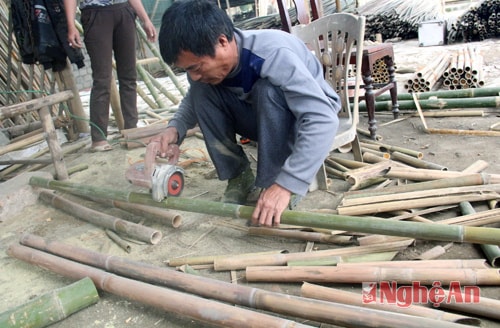 |
| In the village, more than half of the 70 households are involved in the trade and production of products made from bamboo and rattan. |
Making ladders isn't difficult, but it requires carefulness, because even a small mistake can endanger the user's life. Ladder-making is a craft found in many places, and the craftsmen in each place have their own methods. In this small village, people usually use bamboo to build ladders, because it's a straight-trunked tree, and usually, old, small trees are selected.
In the traditional method, after careful selection and balancing, the trees are soaked in water and then sun-dried before being carved and drilled to form ladders. Ladders come in various lengths; some are only 2-3 meters long for indoor use, but the most common are 4-6 meters for construction. The prices are also affordable, with medium-sized ladders costing between 30,000 and 40,000 VND, and longer ladders around 60,000 VND. Generally, people mainly earn their living through labor, but this work also contributes to the livelihood of Tan Kieu village.
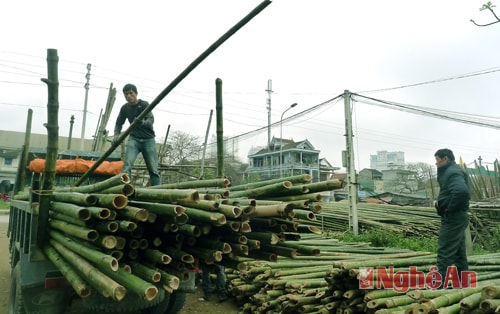 |
| The straightest bamboo and reed stalks are specially selected to make the ladders. |
Besides making ladders, the villagers are now innovating by making decorative items or weaving bamboo panels for cafes and entertainment areas in the neighborhood. The average income from this craft is between 2.5 and 3 million VND per month. Currently, out of approximately 70 households in Tan Kieu village, about 35 are engaged in this work.
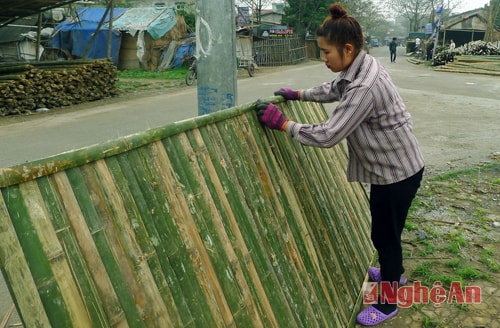 |
| A product made by locals from bamboo for decoration in cafes. |
From March to August, a period often referred to as the "construction season" or the end of the year, the bamboo ladder "street" becomes bustling with customers. People come here to buy ladders and poles to prepare for cleaning and tidying their houses to welcome the new year.
This is the busiest time of year, when the village transforms into a quiet, unassuming wholesale market, creating a unique charm. Both sellers and buyers choose inexpensive items familiar to the daily lives of Vietnamese families. The profits aren't high, but the tradition of selling simple goods remains, offering a sense of calm and tranquility amidst the hustle and bustle of city life.
Thanh Quynh
| RELATED NEWS |
|---|


