
The meaning of clasped hands in Buddhist rituals.
(Baonghean.vn) - Clasping hands (or clasping hands) is one of the important mudras in Buddhism. Clasping hands is expressed by placing both hands together, fingers pressed tightly together, palms empty, resembling a lotus bud about to bloom.
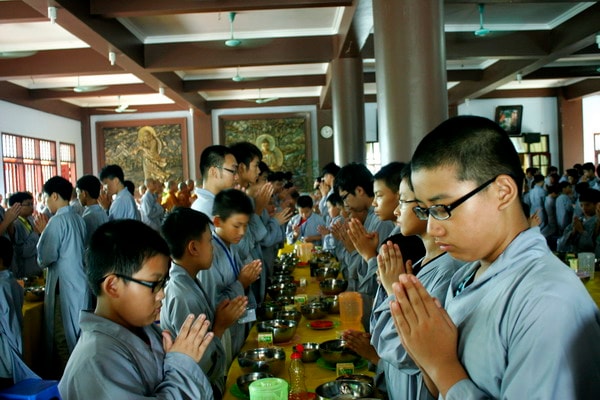
In Buddhist statues, reliefs, and paintings, we often see Buddhas, Bodhisattvas, and holy monks with their hands forming mudras (hand gestures), which represent different meanings in Buddhist doctrine. Among these mudras, one is frequently performed during Buddhist rituals, bows, and greetings, called "hiệp chưởng," meaning the palms of both hands are pressed together.
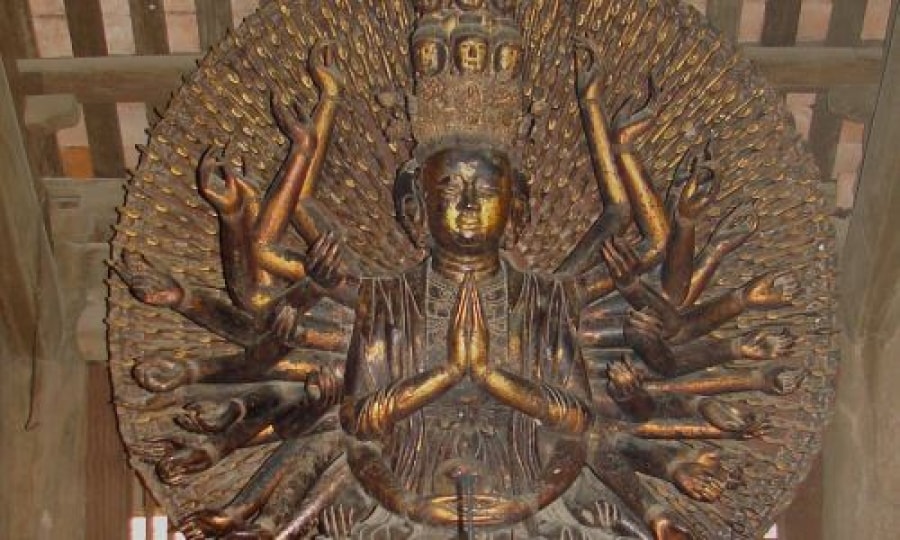 |
| Statue of the Thousand-Eyed, Thousand-Handed Goddess of Mercy. Photo: Internet |
Here are 16 meanings of clasping your hands:
1. Two clasped hands symbolize peace, friendship, solidarity, and cooperation; avoiding conflict and not harming others.
2. The space between the two palms symbolizes the principle of emptiness, meaning we must realize the emptiness of all phenomena.
3. The palms closed together symbolize the cessation of restless activity, the detachment from worldly attachments, and the cessation of karma created by greed, anger, and delusion.
4. The back of the hand facing outward represents the external world of sensory perceptions, while the palm facing inward represents the enlightened mind of Bodhi. Therefore, clasping hands also signifies turning away from the worldly realm and returning to the enlightened mind.
5. The right hand and left hand are merely illusions and attachments. In reality, both right and left are false designations, both are illusory. When both hands are joined together, there is no longer right or left, the distinction of appearances is broken, and they become one and the same.
6. Ten fingers clasped together symbolize the ten realms of existence returning to one mind; everything is created by the mind, everything manifests from the mind.
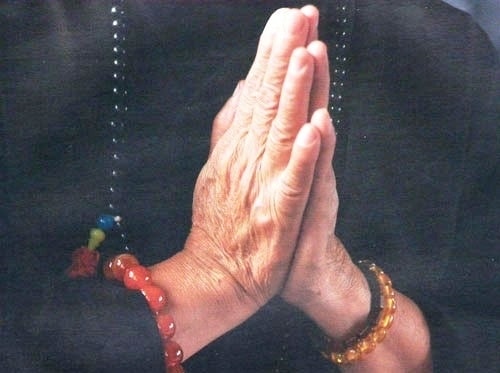 |
7. Ten fingers, clasped together in front of the chest, represent the ten directions, signifying that all beings in the ten directions are equal, and also signifying the gathering of all beings in the ten directions to guide them towards the Buddha's path. Ten fingers also represent the Buddha realms in the ten directions, clasped together in front of the chest, signifying the offering of reverence to the Buddhas and Bodhisattvas in the ten directions, and also signifying the gathering of the merits of the Buddha realms in the ten directions to adorn one's own mind and cultivate virtuous roots.
8. When Buddhists meet and clasp their hands together while reciting "Amitabha Buddha," it signifies their aspiration to attain Buddhahood through the one-vehicle vow of Amitabha Buddha, and their unwavering pursuit of Buddhahood. It also symbolizes the Buddha realms of the ten directions collectively praising Amitabha Buddha and proclaiming the Pure Land Dharma.
9. The gesture of clasping ten fingers in front of the chest signifies that we must cultivate the ten paramitas to attain Buddhahood. Furthermore, the ten profound teachings of the Avatamsaka Sutra or the ten vows of Samantabhadra all represent perfection; therefore, clasping ten fingers symbolizes the potential for achieving Buddhahood.
10. The left hand is usually still, signifying "understanding"; the right hand is usually moving, signifying "practice"; both hands clasped together signify the unity of understanding and practice, only then can supreme enlightenment be achieved.
11. The left hand is usually still, signifying "self-awareness" (enlightenment of oneself); the right hand is usually moving, signifying "enlightening others" (helping others to attain enlightenment); both hands clasped together signify the combination of self-awareness and enlightening others. Only in this way can one be a Bodhisattva practitioner, and only in this way can one achieve perfect enlightenment.
12. The left hand represents the vow, the right hand represents the action; both hands clasped together represent the unity of vow and action, using the vow to initiate action and action to realize the vow. Only in this way can the great vow be fulfilled.
 |
13. Hands clasped together symbolize the equality of all dharmas, without distinction of superiority or inferiority. Zen and Pure Land are one, Pure Land and Esoteric Buddhism are not different; although the methods may differ, their essence is the same, sharing the same goal.
14. The left and right hands join together to form a single entity, symbolizing the principle of "non-duality." Affliction and enlightenment are not two, self-practice and benefiting others are not two, self-Buddha and other Buddhas are not two, nature and form are not two…
15. Clasping your hands in the center of your chest symbolizes the middle way, not clasping them to the sides as if they were permanent or incomplete, non-existent or existent.
16. Hands clasped together like an unopened flower bud symbolize the stage of spiritual practice. When the flower blooms, it signifies the attainment of enlightenment.


