
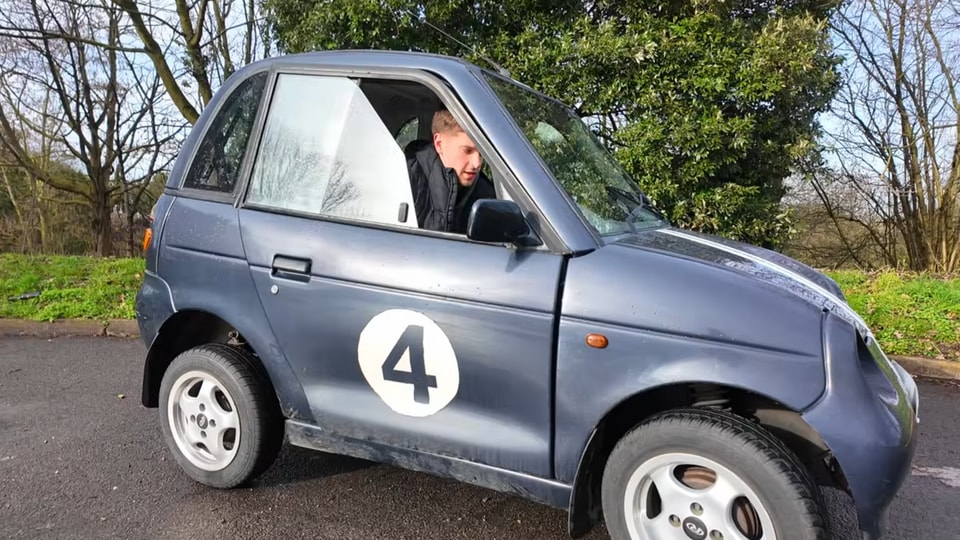
YouTuber Chris Doel built an electric car powered by 500 disposable vapes.
By repurposing over 500 lithium-ion batteries from vape waste, YouTuber Chris Doel created a 2.5 kWh battery pack that powers the Reva G-Wiz electric vehicle and can be charged via a USB-C port.
Chris Doel, a British YouTuber, recently completed an impressive engineering project, powering an electric car using over 500 disposable vapes. The vehicle not only operates smoothly but also stands out for its ability to charge via a USB-C port, similar to a laptop, opening up a new perspective on recycling electronic waste.
The process of manufacturing batteries from electronic waste.
To complete the project, Doel collected over 500 discarded vapes from music festivals. He manually disassembled them to extract the lithium-ion batteries, meticulously testing the performance of each working battery before assembling them.
These batteries are arranged in 14 rows of 3D-printed plastic frames, forming a complete battery pack with a voltage of 50 volts and a capacity of 2.5 kilowatt-hours (kWh). This power source was then installed in the Reva G-Wiz, a low-power mini electric car from the early 2000s, which was well-suited for alternative energy experiments.
Performance and unique USB-C charging capabilities.
In real-world testing, the Reva G-Wiz, powered by vape fuel, achieved a range of approximately 29 km on a single charge. It can maintain a top speed of 64 km/h, a performance level sufficient for navigating smaller urban areas.
Notably, this entire energy storage system is capable of charging via a USB-C port using a 138-watt laptop charger. This is considered the world's first electric car to adopt the common charging method used for portable electronic devices in a four-wheeled vehicle.
Warning about the problem of lithium battery waste.
The context behind Chris Doel's experiment carries an important environmental message. According to estimates from the United Nations, at least 844 million vapes were discarded in 2022 alone. By 2023, this number increased to approximately 500,000 per day, even though the lithium-ion batteries inside them are fully rechargeable and reusable.
This YouTuber highlighted the waste of resources, stating, "None of the 500 people who vaped those devices ever thought their devices would one day power an entire car." The project not only demonstrates its technical feasibility but also serves as a call for a change in how current electronic waste is handled.
| Specifications | Detail |
|---|---|
| Number of vape batteries | Over 500 units |
| Battery type | Recycled lithium-ion |
| Battery pack specifications | 50V - 2.5 kWh |
| Maximum speed | 64 km/h |
| Scope of operation | 29 km |
| Charging method | USB-C (138W) |


