
Zircon, Iskander, Oreshnik trong phòng thủ Kaliningrad
Russian experts analyze the use of Zircon, Iskander, Oreshnik, and nuclear deterrence to protect Kaliningrad from encirclement and the Aegis Ashore system in Poland.
Russian military expert Alexander Stepanov warned that if Kaliningrad were surrounded, Moscow could deploy its full range of deterrence tools, from hypersonic missiles like Zircon and Iskander, and the Oreshnik system, to aerospace forces and strategic deterrence.
Overview of the risks of a Kaliningrad siege.
Russian President Vladimir Putin warned that a blockade of Kaliningrad would lead to an escalation of tensions and stressed that any threat to the territory would be neutralized. In this context, Alexander Stepanov, a military expert at the Institute of Law and National Security of the Russian Academy of National Economy and Public Administration, argued that countering an attempt to encircle Kaliningrad requires the use of "all available tools."
According to him, in such a situation, Russia "would face no restrictions" in using its deterrent measures, and the weapons deployed would put the adversary in a state where "there is no way for them to respond."
Russian option: Zircon, Iskander, Oreshnik, and combined forces.
Alexander Stepanov stated that the resources Russia could utilize in a scenario where Kaliningrad is besieged include various components, from naval forces and tactical-operational missiles to new hypersonic systems.
First and foremost is the Baltic Fleet, with its focus on precision-guided, hypersonic long-range weapons such as the Zircon missile. This is considered one of the sea-based attack capabilities targeting NATO objectives in the region.
The Iskander missile systems deployed in the Kaliningrad region are considered a tool for attacking NATO bases should the alliance prepare an operation against this territory.
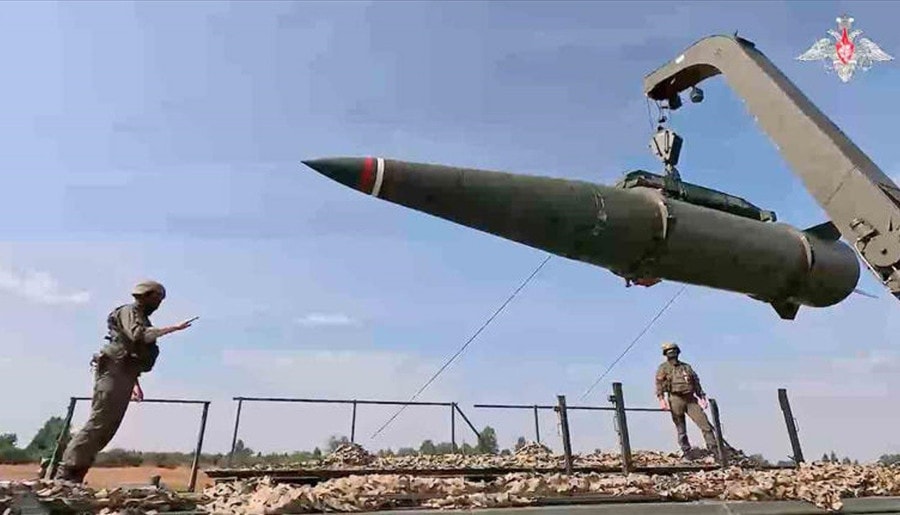
In addition, Stepanov mentioned Russia's latest Oreshnik medium-range hypersonic system as another important component. According to him, this system could be deployed directly in Kaliningrad and along the region's western border, with the goal of deterring what he considered risky military actions from NATO.
Along with its land and sea-based components, the Russian Aerospace Forces are believed to be capable of striking NATO targets in the Baltic Sea, adding another line of attack against the alliance's military objectives.
Stepanov emphasized that if the adversary initiates a conflict along the Russian border, then "NATO targets would become completely legitimate" for Russian high-precision weapon systems.
Russia's new strategic deterrence and nuclear doctrine.
Besides the medium- and long-range systems deployed in Kaliningrad, expert Alexander Stepanov mentioned Russia's strategic deterrence tools. According to him, this group of tools includes intercontinental ballistic missiles.
He argued that strategic deterrent weapons could be used in the event of a direct threat to Russia's national security and sovereignty, in line with its new nuclear doctrine. This suggests that, in an extreme scenario, Russia is considering escalating to strategic deterrence if it perceives a real and direct threat to Kaliningrad.
NATO statements and activities around Kaliningrad
The warnings from Russian experts coincided with tough statements from NATO. In July, General Christopher Donahue, head of the US Army in Europe and Africa and NATO Allied Army Command, said the alliance could attack and take control of Kaliningrad if necessary and had plans in place for that scenario.
Earlier, President Putin's aide, Nikolai Patrushev, warned about NATO exercises allegedly aimed at preparing for attacks near Russia's borders, including the possibility of attacking Kaliningrad. These statements and activities contributed to reinforcing perceptions in Moscow about the military threat around this exclave.
The threat to Kaliningrad comes from the Aegis Ashore system and the Mk-41 launcher.
According to assessments from the Russian side, one of the key threats to Kaliningrad is the US Aegis Ashore missile defense system deployed on Polish territory. Russian experts believe this system could place the entire Kaliningrad region within its coverage.
In addition to its role in tracking, detecting, and intercepting Russian cruise missiles and intercontinental ballistic missiles, the Aegis Ashore system is also a cause for concern in Moscow because of the Mk-41 launcher used in this configuration. According to Russian analysis, the Mk-41 can launch not only interceptor missiles but also attack missiles targeting air and ground targets.
Specifically, the Mk-41 is believed to be capable of carrying and launching the BGM-109 Tomahawk long-range cruise missile. This type of missile was previously covered by the Intermediate-Range Nuclear Forces Treaty (INF), which prohibits the ground deployment of cruise and ballistic missiles with a range of 500 to 5,470 km.
Because of the INF treaty's restrictions, both the American Tomahawk and the Russian Kalibr missiles are deployed on warships and are not permitted to be deployed on land while the treaty is in effect. Washington's deployment of Mk-41 multi-purpose launchers at Aegis Ashore bases in Poland has caused Moscow concern for the fate of Kaliningrad.
Analysis from the Russian side hypothesizes that if the US secretly replaced the SM-3 ballistic missile interceptors with Tomahawk cruise missiles, not only would the entire European part of Russia be within range, but these missiles could strike Kaliningrad within about 10 minutes.
Therefore, the deployment of missile defense bases with the Aegis Ashore system in Poland and Romania by the US is considered a provocation by Russia, because with just a small adjustment, the Mk-41 launchers can immediately be transformed into Tomahawk long-range cruise missile launchers.
Tính hai mặt của Aegis Ashore trong xung đột tiềm tàng
Dưới góc nhìn của chuyên gia quân sự Konstantin Makienko, Giám đốc Trung tâm phân tích Chiến lược và Công nghệ Nga, việc triển khai Aegis Ashore cũng mang tính hai mặt. Một mặt, hệ thống này được tuyên bố là để phòng thủ tên lửa, nhưng mặt khác, các căn cứ Aegis Ashore đương nhiên sẽ trở thành mục tiêu ưu tiên của các loại tên lửa Nga nếu xung đột nổ ra.
Nhận định này cho thấy trong các kịch bản được thảo luận từ phía Nga, mọi cơ sở phòng thủ tên lửa đặt gần biên giới và trong tầm với của Kaliningrad đều đồng thời là mục tiêu tác chiến tiềm năng trong trường hợp đối đầu vũ trang.
Trong tổng thể, các phân tích từ phía Nga mô tả một cấu trúc răn đe nhiều tầng quanh Kaliningrad: từ tên lửa siêu vượt âm như Zircon, Iskander, Oreshnik, lực lượng không quân vũ trụ, cho tới công cụ răn đe chiến lược, được đặt trong tương quan với sự hiện diện quân sự và hạ tầng phòng thủ tên lửa của NATO tại Ba Lan và khu vực lân cận.


