
10 important things to keep in mind when driving on slippery roads.
(Baonghean.vn) - For inexperienced drivers, driving a car on slippery roads is not easy; especially on unpaved roads that are both steep and slippery.
1. Check your tires before you set off.
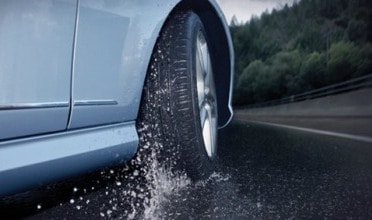
To reduce the risk of skidding, you need to check your tires regularly. The faster you drive, the more the water pressure lifts the car, and it will skid on a thin layer of water between the tires and the road surface.
Therefore, to maintain better contact between the road and the tires, you should keep your tires properly inflated, maintain good tread, and replace tires when necessary. In particular, do not drive when the tires are worn beyond the indicator line.
 |
2. Ensure good visibility.
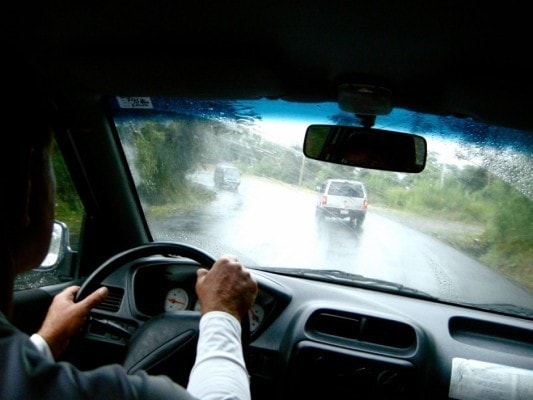
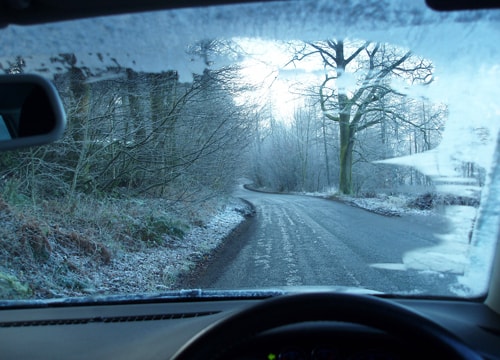
Drivers' visibility is often limited in the rain, so the windshield and rearview mirrors need to be clean. For the windshield, not only the outside but also the inside must be clean and free of condensation. Therefore, check and replace your wipers regularly to ensure good visibility in the rain.
3. Check the lighting system.
Other drivers on the road need to see you, just as you need to see them, so you should turn on your lights even in light rain. If your vehicle has daytime running lights, you should turn them on so that vehicles behind you can see you more clearly. Therefore, check to make sure your headlights, taillights, brake lights, and turn signals are all working properly. Before each trip, clean the surfaces of the lights to ensure optimal visibility.
4. Avoid taking shortcuts.
In harsh weather conditions, you should choose routes with heavy traffic, as they are safer. Absolutely avoid taking shortcuts, especially village roads and dirt roads, because rainwater makes them very slippery, not to mention potholes and bumps, making travel very difficult.
 |
5. Reduce speed and maintain distance.
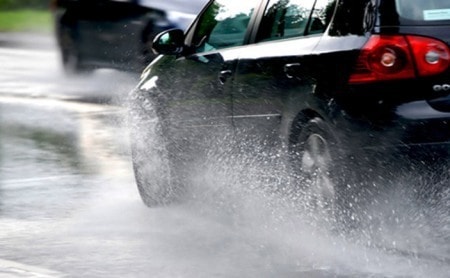
When it rains, roads are often slippery, reducing braking effectiveness. Visibility is also limited. This is why accidents occur if drivers are careless or speeding.
Drivers should reduce their speed by at least 20%, even on familiar roads, when driving on slippery surfaces. On unfamiliar roads, at intersections, or around curves, reduce speed as much as possible to observe all directions.
You should stay in your lane to avoid the risk of your car skidding into the opposite lane when changing direction, especially on slippery roads.
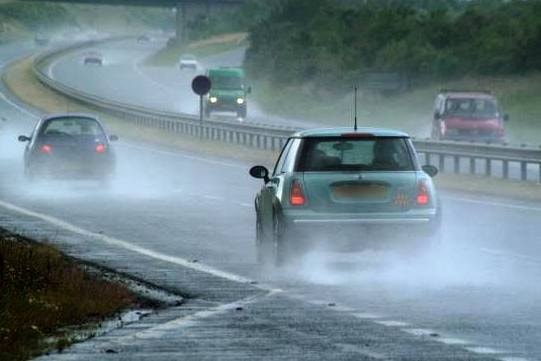
The safe distance between vehicles when driving on slippery roads is 30m (a 40% increase compared to normal conditions). Note that vehicles with higher ground clearance are more prone to overturning, so extreme caution is advised.
 |
6. Avoid wheel slippage.
For vehicles equipped with an anti-lock braking system (ABS), drivers should firmly press and hold the brake pedal while trying to avoid the vehicle in front. The ABS system will help the vehicle decelerate quickly and regain control. Do not pump the brakes, as this will reduce the effectiveness of the ABS system.
For vehicles without ABS, press the brake pedal firmly but avoid locking the wheels. Try to keep your heel on the floor and use the ball of your foot to press the brake pedal firmly and steadily.
7. Only brake when absolutely necessary.
One important safe driving tip when driving on slippery roads is to only brake when absolutely necessary, avoiding sudden actions such as slamming on the brakes, accelerating, or swerving, as these can easily cause the vehicle to skid and lose control. To do this effectively, you need to stay focused on driving, be able to anticipate situations, and perform maneuvers smoothly and gracefully.
Maintain a safe distance from the vehicle in front. Drive in a way that allows you to stop the car without having to brake, because on slippery roads, braking will certainly not be of much help.
If you're on a downhill section of road, you should proactively reduce your speed before descending and maintain a low speed.
 |
8. Avoid sudden steering movements.
When you lose control of the vehicle, many people's natural reaction is to continue steering, but this is a mistake as it doesn't yield any results and often makes the situation worse. At this point, you need to remain calm, firmly grip the steering wheel, release the accelerator, and gently apply the brakes until the vehicle comes to a safe stop.
If you happen to skid, vehicles without automatic brake locking should avoid using the brakes; vehicles with ABS should brake firmly when going over the skid mark. At the same time, gently release the throttle and carefully steer the wheels in the direction you want the front of the car to enter until the front of the car moves straight.
9. You should follow the tire tracks of the car in front.
When driving on slippery or muddy roads, the wisest approach is to follow the vehicle in front and drive along its tire tracks. The tracks of the vehicle ahead have cleared the way for your car, reducing the adhesion between rainwater and dirt on the road surface, thus preventing slippage.
Additionally, you should turn on your headlights or fog lights (even in light rain) so that the light helps you see the road more clearly and makes it easier for other vehicles to see your car.
 |
10. Use air conditioning.
To prevent condensation from forming in the cabin and fogging up the car windows, turn on the air conditioner and select the outside air intake mode.
Ngoc Anh
(Synthetic)
| RELATED NEWS |
|---|


