
13 Ministers and Provincial Governors were criticized by the Prime Minister.
The disbursement rate of public investment capital in 2017 has been slow, reaching only over 20% of the plan so far. Thirteen ministries, sectors, and localities have been named for their excessively slow progress. In investigating the reasons, the Minister and Head of the Government Office expressed frustration, noting that some projects under one ministry took up to nine months just waiting for review and approval from another ministry.
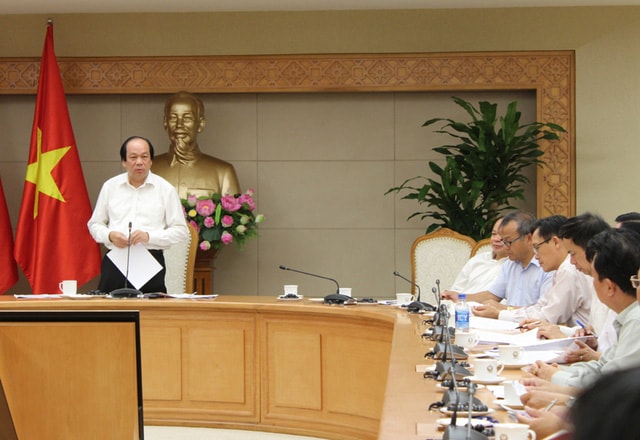
On the morning of July 25th, the Prime Minister's Task Force inspected ministries, agencies, and localities regarding the implementation of solutions to accelerate the disbursement of public investment capital plans for 2017. The meeting was chaired by the Head of the Task Force, Mai Tien Dung – Minister and Head of the Government Office.
120 trillion VND is always available in the treasury but cannot be spent.
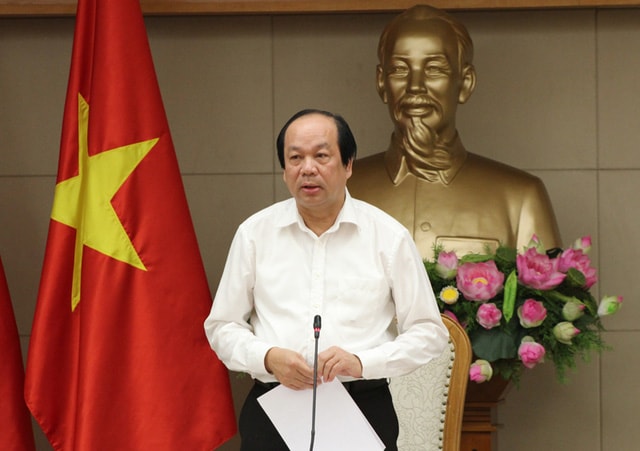 |
| Minister Mai Tien Dung criticized leaders of many ministries and agencies for being absent from meetings. |
According to the report of the Prime Minister's Task Force on the results of disbursing public investment capital in 2017 by ministries, agencies, and localities, the total planned expenditure for development investment from the state budget this year is over 357,000 billion VND (including 307 billion VND from the state budget and 50,000 billion VND from government bonds).
The National Assembly has authorized the transfer of an additional VND 16,500 billion from unallocated bond capital from 2016 to 2017.
As of June 15th, the total disbursed capital amounted to VND 85,000 billion, reaching 23.9% of the total plan for 2017 and 27.6% of the capital plan allocated by the National Assembly and assigned by the Prime Minister.
Of this, bond capital amounted to VND 323 billion, reaching 0.6% of the total planned capital. State budget capital was nearly VND 85,000 billion, reaching 27.6% of the total planned capital. Only VND 217 billion of the VND 16,500 billion worth of bond capital carried over from 2016 has been disbursed, reaching 1.3%.
The slow disbursement of public investment funds is considered a bottleneck for economic growth. According to the Task Force, if urgent solutions are not implemented to accelerate disbursement, it will negatively impact economic growth, while the ratio and obligations of public debt repayment are increasingly at risk.
Furthermore, slow disbursement forces the government to bear the interest burden on the people's loans. By the end of 2017, public debt will increase to 65% – reaching the debt ceiling set by the National Assembly. With public debt reaching the ceiling, the government will have to consider borrowing domestically. To borrow and cover the budget deficit, macroeconomic tools such as interest rates and exchange rates will be used. This will put pressure on inflation and the entire economy. The issuance of government bonds, only to have the funds not spent or delayed in spending, resulting in money remaining in banks, creates a vicious cycle.
"The treasury always has over 120,000 billion VND in surplus funds, even though we allocated the capital very early this year," – Mai Tien Dung, Head of the Prime Minister's Task Force and Minister and Chairman of the Government Office, pointed out the paradox.
The Task Force's report also pointed out that 13 ministries, sectors, and localities had low disbursement rates: the Ministry of Planning and Investment, the Ministry of Foreign Affairs, the Ministry of Health, the State Bank of Vietnam, the Committee for Ethnic Minorities Affairs, the Vietnam News Agency (VNA), the Vietnam Veterans Association, Hanoi, Ho Chi Minh City, Da Nang, Binh Duong, Binh Phuoc, and Tay Ninh (rates ranging from only 4% to approximately 20%).
Minister Dung emphasized that the Prime Minister criticized the Ministers and Chairmen of Provincial People's Committees who were named for slow disbursement of funds. According to Mr. Dung, the reasons are primarily due to the leadership of ministries, sectors, and localities, including procedural issues, a lack of decisive direction, and the capacity of the construction units.
Furthermore, according to the Head of the Task Force, there are instances where units increase their capital but do not invest it in development; instead, they deposit it in banks.
Officials sit in air-conditioned offices and "create" procedures.
 |
Addressing specific issues within ministries and agencies, a representative from the Ministry of Planning and Investment stated that the total disbursed capital by the end of June was 54 billion VND, reaching 13.3% of the initial plan (406 billion VND). The reason for the slow disbursement is attributed to two projects: the "Investment in the construction of the Academy of Policy and Development" (allocated 202 billion VND, accounting for 50% of the Ministry's allocated capital, but only 1.3 billion VND has been disbursed) and the PPP project "Application of e-commerce in government procurement under the public-private partnership model" (allocated 26 billion VND, but only the project management board's expenses have been disbursed; the remaining state-funded capital has not yet been disbursed).
Deputy Minister of Planning and Investment Dao Quang Thu explained that the project for the headquarters of the Academy of Policy and Development had its design and construction plan submitted to the Ministry of Construction for review at the end of 2016. Following the review process, the project would proceed to the appraisal stage, but due to changes in legal policies, the Hanoi Department of Construction was responsible for appraisal. However, according to regulations, the agency that conducted the review is also the agency that will conduct the appraisal, but since the Ministry of Construction had already conducted the review, the Hanoi Department of Construction could not appraise the project.
"So, from October last year to July this year, nine months were spent just on the procedures for project implementation," a representative from the Ministry of Planning and Investment explained.
The head of the task force – Minister Mai Tien Dung – shook his head in dismay: "If even the procedures between ministries are like this, then the relationship between localities and ministries will surely take even longer."
Regarding the Ministry of Foreign Affairs' report complaining about the funding for the construction of its headquarters (the funds were available, but the project was carried over from 2016, taking half a year to complete the procedures), the Head of the Government Office flatly rejected it, stating that it was a procedure the Ministry had "invented" itself and that there was no such "absurd" regulation.
The head of the Government Office humorously summarized the situation: "The situation is very much a situation/The situation is caused by ourselves. For officials who create obstacles, just send them down to the localities to work; only then will they understand what hardship is. Sitting in air-conditioned offices drawing up procedures only slows down overall progress."
Minister Mai Tien Dung also frankly criticized the fact that many ministries were asked to explain issues but no representatives attended the meeting.
"All the ministries are absent, not a single person is present, only a few specialists who don't understand the issue. The Ministry of Planning and Investment is fortunate to have Deputy Minister Dao Quang Thu here, but only as a member of the Task Force, not as a leader of the Ministry."
According to Dan Tri


