
14 things you should teach children aged 3-4 years old.
According to Dr. Vu Thu Huong (Hanoi University of Education), children aged 3-4 know a great deal. Therefore, parents should let their children take care of themselves more and learn more.
The child knows how to bathe.
It's a bit strange if your child can't bathe themselves at this age. If you didn't let your child bathe themselves at a younger age, you absolutely must. Your child's body is their private space and needs to be respected. Parents can prepare a large basin of water beforehand, instructing the child to undress and sit in the water to bathe. After bathing, the child should also know how to dry themselves and put on clean clothes. Parents should also teach their child to clean up the basin and dirty clothes after bathing to develop good habits.
I know how to prepare my sleeping place and make my bed after waking up.
Many parents complain that their children, even in middle or high school, still throw blankets and pillows around haphazardly after waking up. But why don't parents teach their children properly from a young age? Parents need to teach their children to get their blankets and pillows ready for bed. More difficult tasks, like putting up mosquito nets (if necessary), should be done by the parents.
When waking up, parents should also teach their children to tidy up. The simplest way is for parents to tidy a corner of the wardrobe beforehand so that the child can fold their blankets and pillows and put them away in that corner. This way, the bed quickly becomes tidy without any help from the parents.
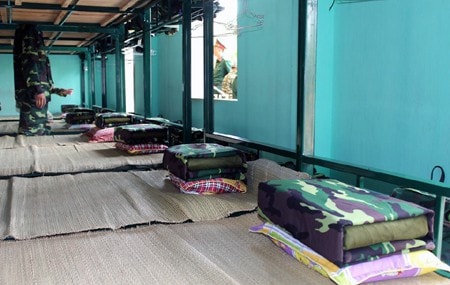
Help your child learn to prepare their sleeping space and make their bed after waking up. (Illustrative image)
I know how to set the table and prepare meals.
When the family is about to eat, clearing the table is essential. Children can certainly get the bowls, set the chopsticks, and arrange the items on the table. Parents can help them with hot soups or foods that are easily broken.
After meals, parents often ask their children to clear the dirty dishes and wipe the table. Children do this very well and enjoy doing it to show they are helpful. Therefore, parents should remember to create opportunities for their children to demonstrate this.
Flit
At this age, children are very agile. They might not be able to sweep the floor perfectly clean, but they are incredibly excited about it. Therefore, parents should create opportunities for their children to practice.
Choose what clothes to wash.
Families who use washing machines know that before washing clothes in the machine, it's necessary to sort them. Light-colored clothes should be washed together, and dark-colored clothes should be washed together. Not to mention, expensive items that can't be machine-washed must be kept separate.
With a little guidance from parents, children can do this very well. Parents should pile the dirty clothes in a corner of the house and ask their children to help sort them, instead of letting them go near the washing machine. Children don't know how to use it and are often mischievous. Many children have climbed inside washing machines to play, which is very dangerous.
Draw a picture
In reality, children don't like coloring. But they love smearing paint. Instead of forcing them to color the way you want, parents should buy them a box of crayons (powder crayons are inexpensive, easy to draw with, and easy to wash off; parents can choose powder crayons), a large A0 sheet of paper, and let them be creative.
Remember to dress your child in old clothes because they might get paint all over them. After they've finished creating, guide them to change clothes, clean up their art area, and mop the floor if it gets dirty. The paint is very easy to clean, so parents can rest assured.
Listening to music
Children of this age should listen to a lot of music. Parents shouldn't limit themselves to children's songs; they can also listen to gentle, relaxing instrumental music. Letting your child listen to music and occasionally asking them what songs they like will help them develop their own musical taste and simultaneously enhance their auditory perception.
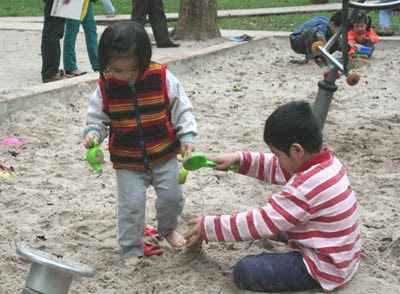
Your child will learn a lot from the sand because it's an important lesson (illustrative image).
Take your child to see the museum.
At this stage, children's learning should focus on listening, seeing, touching, and feeling. Museums have so much for them to explore. Parents should take their children to museums often.
Learn traffic laws.
At school, the teacher has already taught the children about traffic laws. Parents should take their children outside to observe and point out who is following the rules and who is violating them. Afterwards, together with the child, open a book and find out what penalties those who violate the rules will face if caught by the police. This is the best and gentlest way for both children and parents to learn about traffic laws.
Exercise
At this stage, your child's body is developing quite well, and it's time for them to play sports. Parents can let their children try a few sports and choose the ones they like. When practicing, parents should remember to ensure their child's safety by using protective equipment such as helmets and gloves if roller skating.
Learn how to respond to dangerous situations.
Parents should prepare for certain situations in advance and discuss escape plans with their children. This learning method will greatly help children if they unfortunately find themselves in a similar situation. Therefore, parents need to teach their children more about this.
Playing jigsaw puzzles
Building blocks can greatly help children improve their thinking skills, patience, and composure. Parents should buy age-appropriate shapes and encourage their children to be creative.
Creating from simple discarded items.
Parents should give their children large boxes and cardboard containers, then let them play with them independently. They will be able to unleash their creativity.
Sand play
Don't forget this lesson, moms! Your child will learn so much from sand. This is an extremely important lesson, so children need at least one hour a day playing with sand from the age of one to seven. Parents, remember to create opportunities for your children to learn.


