
2020: Vietnam exports cars, allowing people to buy affordable vehicles.
Many policies and incentives are in place to develop the automotive industry. By 2020, Vietnam aims to export 20,000 cars. At that time, Vietnamese people hope to be able to buy cars at affordable prices.
The strategy for developing Vietnam's automotive industry until 2025, with a vision to 2035, has been officially approved, aiming to develop the automotive industry into a key sector of the country.
Accordingly, small trucks, passenger buses with 10 seats or more, and small-sized vehicles with up to 9 seats that consume less energy and are suitable for the transportation infrastructure and income levels of the people are among the priority product groups.
The goal is for the automotive industry to meet the maximum domestic market demand for these types of vehicles and strive to become a supplier of components, parts, and some high-value sub-assemblies in the global automotive production chain.
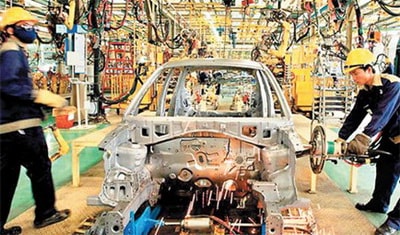 |
| Many policies and incentives are in place to develop the automotive industry. |
It is projected that passenger cars with up to 9 seats will account for 60% of domestic demand by 2020; 65% by 2025; and 70% by 2030. Vehicles with more than 10 seats will account for 90% by 2020 and 92% by 2030. Trucks will account for 78% by 2020 and 80% by 2030...
In addition, exports are projected to reach 20,000 units in 2020, 37,000 units in 2025, and 90,000 units in 2035.
Regarding the localization rate, by 2020, passenger vehicles with 9 seats will reach 30%-40%, those with 10 seats or more will reach 35%-45%, and trucks will reach 30%-40%; by 2025, passenger vehicles with up to 9 seats will reach 40%-45%, those with more than 10 seats will reach 50%-60%, and trucks will reach 45%-55%; by 2035, passenger vehicles with up to 9 seats will reach 55%-60%, those with more than 10 seats will reach 70%-80%, and trucks will reach 70%-75%...
The Strategy also outlines the application of high incentives for vehicle manufacturing projects, domestic enterprises participating in global supply chains, and the export of components and spare parts.
Accordingly, tax and fee policies will be adjusted to facilitate the development of the automotive industry, applying lower tax rates to priority vehicle types. These policies will be issued and implemented stably for a minimum of 10 years, building confidence among investors and manufacturers.
Thus, after a long wait, businesses and investors finally have a clear understanding of the Vietnamese government's stance on the development of the automotive industry in the new phase. However, investing in this industry still requires waiting for many specific policies to be issued in the near future.
Many automotive companies have indicated that they are most interested in incentives for the production of passenger vehicles with fewer than nine seats, as this segment is expected to experience high demand from 2025 onwards, when Vietnam enters the period of motorization.
However, the time to remove tariff barriers on automobiles is drawing near, with only 4 years left until the import tax rate on completely assembled cars from ASEAN countries to Vietnam will be reduced to 0%.
If the incentives are not attractive enough, businesses will not be able to invest in production and will instead shift to importing complete vehicles for distribution.
According to an official from the Ministry of Industry and Trade, they have proposed several specific incentives for relevant authorities to consider, such as projects producing automobiles and components like engines, gearboxes, transmissions, and bodywork stamping... to receive incentives for specially encouraged investment projects, including access to low-interest loans.
In addition to the above incentives, for passenger vehicles with up to 9 seats and engine capacities of 1.5L or less, the Ministry of Industry and Trade is also proposed to reduce the special consumption tax. Specifically, those with engine capacities of 1.2L-1.5L would be reduced by 10% and those under 1.2L would be reduced by 15%, compared to the current rate of 45%.
Along with that, there will be a change: excise tax will be based on the import invoice value of the component parts, rather than on the vehicle price as it is currently.
According to this official, if the policy receives strong support and becomes a reality, taking effect from 2015, then in the next four years, domestically manufactured and assembled vehicles will receive significant preferential treatment compared to fully imported vehicles in terms of import tax and special consumption tax, and will be completely competitive with imported vehicles.
With these incentives, domestically produced cars will be able to reduce prices and the market size will increase rapidly, creating opportunities for businesses.
After 2018, tax incentives were no longer available, but imported cars are still unlikely to flood into Vietnam due to proposals to build non-tariff barriers such as stricter standards for import dealers regarding financial capacity, warehousing, warranty and maintenance systems, quota allocation, increased tax valuation, and limiting the import of complete vehicles to only 2-4 seaports...
Meanwhile, domestic car manufacturers have enjoyed four years of significant incentives, and with strong investment and the establishment of a solid foundation for development, they can hopefully compete effectively with imported cars.
According to several sources, the Government will issue a more detailed plan for the development of the automotive industry at the end of August, and many businesses are hoping for the results of this plan.
According to Vietnam+


