
3 options for organizing the national high school graduation exam.
On the morning of July 29th, the Ministry of Education and Training announced the draft plan for organizing the national high school graduation exam, replacing the high school graduation exam and the university and college entrance exam.
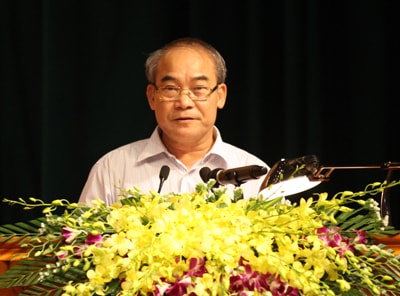 |
| Deputy Minister of Education and Training Nguyen Vinh Hien announced three options for the 2015 national unified examination. |
Accordingly, the Ministry of Education and Training has proposed three options for organizing the national high school graduation exam to solicit feedback from education leaders in all 63 provinces and cities nationwide.
Option 1:The exams will be organized by subject, in the traditional way. Candidates will take 8 subjects: Mathematics, Literature, Foreign Language, Physics, Chemistry, Biology, History, and Geography; the exams will be held over 8 sessions in 4 days, with one subject per session.
To be considered for high school graduation, each candidate must take four subjects (referred to as the minimum required subjects), including three compulsory subjects: Mathematics, Literature, and a Foreign Language, and one elective subject from Physics, Chemistry, Biology, History, and Geography.
The results of the four subjects are used to determine eligibility for high school graduation; these four subject results are also used for applying to universities and colleges that have subjects suitable for their training programs.
In addition to the four subjects mentioned above, candidates have the right to register for additional subjects in the remaining national high school graduation exam to use for admission to universities and colleges according to the requirements of the training programs specified by each institution.
According to the reform roadmap, exam subjects will gradually be transformed into integrated tests with varying levels of integration, from less to more, and from basic to advanced, in line with changes in teaching and learning in schools.
The advantages of this approach are that the exam is subject-based and allows candidates to choose subjects that align with the direction of Resolution 29; it facilitates the creation of exam questions, ensuring an assessment of general education levels and better differentiation of candidates' abilities; it strongly promotes career guidance for students after high school; and it helps universities and colleges select candidates suitable for their training programs.
This option is considered to be less disruptive, causing less anxiety and psychological pressure for teachers and students, especially for students who completed the high school program in 2014 or earlier and are participating in the exam; grading the exam papers will be convenient and easy.
Students take exams in many subjects, giving them more opportunities to apply to universities and colleges.
The drawback of Option 1 is that the exam takes place over 4 days (8 exam sessions), so teachers have more work and the cost of organizing the exam also increases; this method of organization could also easily lead to rushed teaching or cutting short the curriculum for subjects not included in the exam.
Option 2:The national high school graduation exam will be organized by test papers. Specifically, the 8 subjects in 12th grade (Mathematics, Literature, Foreign Language, Physics, Chemistry, Biology, History, Geography) will be combined into 5 test papers: Mathematics; Literature; Foreign Language; Natural Sciences (Physics, Chemistry, Biology); and Social Sciences (History and Geography).
The exam will take place over 5 sessions – 2.5 days; each session will consist of one exam. Each candidate must take 4 exams, including 3 compulsory exams: Mathematics, Literature, and Foreign Language, and 1 exam in either Natural Sciences or Social Sciences.
According to the Ministry of Education and Training, the advantage of Option 2 is that the exam is more streamlined in terms of organization and cost. The level of integration of subjects into the exam is stronger and faster than Option 1. This option will limit the practice of cramming or cutting short the curriculum for subjects not included in the exam, as was done previously.
However, a limitation of this approach is that teachers and students are not fully prepared for the comprehensive exams, which can cause anxiety and negatively impact the psychology of teachers, students, and parents.
If this plan is implemented in 2015, it will face difficulties and require tremendous effort from all levels and organizations, from the stages of question setting, invigilation, marking, and teacher training.
At the same time, grading combined exams requires multiple teachers from different subjects to grade the same exam. For example, the Natural Sciences exam should have teachers from three subjects—Physics, Chemistry, and Biology—grading together; the Social Sciences exam should have teachers from two subjects—History and Geography—grading together.
With less time allocated for each subject in the combined exam, designing questions that simultaneously meet general education standards and include advanced material to differentiate students' abilities for university and college admissions is more challenging.
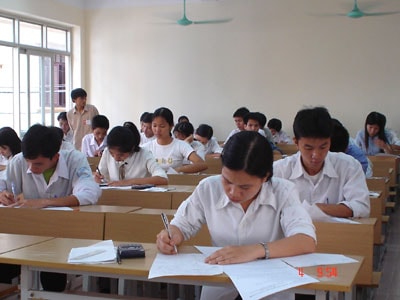 |
| Illustrative image |
Option 3:The 11 subjects in grade 12 are combined into 4 exams: Mathematics-Informatics; Natural Sciences (Physics, Chemistry, Biology, Technology); Social Sciences (Literature, History, Geography, and Civic Education). Candidates must take all 4 exams over 4 sessions, totaling 2 days, with one exam per session.
With two exam days, the exam is organized more efficiently, reducing organizational costs. The integration of subjects into a single exam is stronger and faster than in Option 1, while also limiting the practice of cramming or cutting short the curriculum for subjects not included in the exam, as was the case previously.
The difficulty with this approach is that teachers and students are not adequately prepared for teaching and learning in a way that supports the comprehensive exam format.
If this plan were implemented starting in 2015, it would present difficulties and require extensive preparation in all stages, from question setting and invigilation to grading, and teacher training and development, in order to successfully organize the exam.
Grading combined exams requires multiple teachers from different subjects. The time allotted for each subject in the combined exam is less, making it more difficult to design questions that simultaneously meet general education standards and differentiate students for university and college admissions. Using 11 subjects combined into 4 exams puts pressure and stress on students as they have to study and review many subjects.
The Ministry of Education and Training has also outlined specific scenarios for the Foreign Language exam in schools where the language is not taught or is taught under inadequate conditions; and applied the recognition of exam results from the National Center for Foreign Language Proficiency Assessment for use in graduation and university/college admissions.
The Ministry of Education and Training has proposed a plan to use exam results to determine graduation eligibility, including exam scores and bonus/incentive points (if any).
Universities and colleges may use the results of the national high school graduation exam for admissions, supplemented with other forms of aptitude testing (preliminary selection, interviews, essay writing, etc.) depending on the specific characteristics of the institution. Alternatively, universities and colleges may choose not to use the national high school graduation exam results and instead have their own admissions plans to ensure the quality of their student intake.
According to chinhphu.vn


