
30 minutes of artillery fire during the 1974 Battle of the Paracel Islands.
At exactly 10:25 AM on January 19, 1974, Colonel Ha Van Ngac ordered an attack on Chinese naval warships in an attempt to retake the Paracel Islands. Naval artillery from both sides fired continuously.
In preparation for the battle, the Command of the 1st Coastal Naval Region of the Republic of Vietnam established a special task force to protect the Paracel Islands, consisting of warships and officers reinforced from the Naval Command in Saigon. The commander of the task force was Colonel Ha Van Ngac.
During the 1950s, 1960s, and 1970s, the US Navy often refurbished old World War II warships and provided them as aid to allies in Asia such as Taiwan, South Vietnam, and the Philippines. The weapons, electronics, and control systems of these aid ships were all outdated. Meanwhile, the navies of the Soviet Union, China, and several Eastern European countries equipped their navys with the philosophy of upgrading amenities and electronics to gain an advantage in speed and weaponry, and using smaller warships to attack larger warships.
The Battle of the Paracel Islands took place primarily within the Crescent Moon Islands area. The small Chinese warships, positioned close to the water's surface, were difficult to hit, while also allowing them to easily raise the elevation of their naval cannons, creating an effective offensive position.
The Vietnamese warships' naval guns were positioned higher than the Chinese naval guns, making them difficult to maneuver at close range. Furthermore, when the US transferred the warships to the South Vietnamese navy, advanced equipment such as the 76.2 mm rapid-fire automatic cannons with radar control and lock-on systems had been removed or were no longer usable.
The 127mm guns on the South Vietnamese cruisers were all manually adjustable, resulting in a very slow rate of fire, making them only effective for naval gunfire support.
China possessed a full complement of naval, land, air, and submarine forces, all on standby and ready for combat. The Republic of Vietnam, on the other hand, only had the F5E fighter jets, which had a short range and could only fly to the Paracel Islands and return without staying to provide support or engage in combat. (Balance of forces between the two sides).
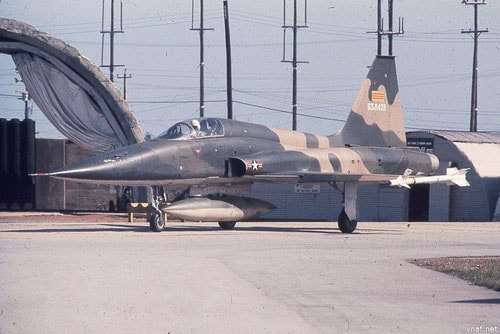 |
| The F5E aircraft of the Republic of Vietnam only had enough fuel to fly to the Paracel Islands and then return. (Archival photo) |
Before firing
The events considered to be the beginning of the naval battle occurred on January 11, 1974, when China declared the Paracel Islands (Xisha and Nansha) as belonging to Chinese territory. Immediately, the Foreign Minister of the Republic of Vietnam, Vuong Van Bac, rejected this baseless claim and condemned China's aggressive actions. From this point on, tensions continuously escalated both on the ground and diplomatically until the fighting began.
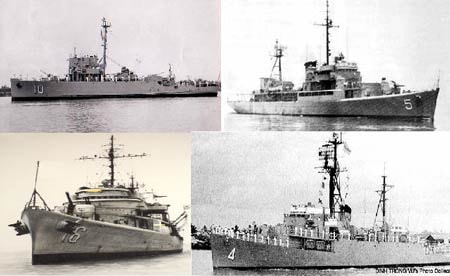 |
| Four South Vietnamese warships participated in the battle. |
On January 15, 1974, the Chinese Navy violated Vietnamese territory and territorial waters by landing and occupying the islands of Quang Hoa, Duy Mong, and Cam Tuyen.
At 10:00 AM, the patrol vessel HQ16 spotted a Chinese flag flying on Cam Tuyen Island, and nearby, a gray-blue Chinese fishing vessel named Nam Ngu, number 402, equipped with a 25mm cannon. HQ16 used signal lights to request the Chinese vessel to leave the island, but it did not respond. Later that afternoon, the Chinese vessel finally departed the island.
On January 16, 1974, Foreign Minister Vuong Van Bac sent a diplomatic note to the President of the United Nations Security Council to draw attention to the serious tensions, which could threaten international peace and security, arising from China's territorial claims.
Early that morning, HQ16 was on patrol and discovered a tall watchtower and guard post flying the Chinese flag on Quang Hoa Island, along with a Chinese warship circling the island. HQ16 ordered the ship to withdraw, but received no response. Duy Mong Island was uninhabited, but two small Chinese vessels were near the shore.
At noon on January 16th, HQ16 deployed 16 permanent staff members to Vinh Lac Island for reconnaissance, where they discovered a tomb and a gravestone inscribed with Chinese characters. At 3:35 PM, HQ16 observed two Chinese fishing vessels armed with 25mm cannons, numbered 402 and 407, southwest of Cam Tuyen Island.
On January 17, the Government of the Republic of Vietnam sent a diplomatic note to the United Nations Security Council requesting that all appropriate measures be taken to improve the situation.
On the ground, at 11:00 AM, HQ16 completed the landing of a 15-person crew to reinforce the defense of Vinh Lac Island. This group was tasked with destroying the tombstones and organizing the island's defenses.
At 3 PM on the same day, HQ16 arrived at Cam Tuyen Island, positioning itself to the southeast to support HQ4's landing of 27 commandos on the west side of Cam Tuyen Island, while the two Chinese ships 402 and 407 were south of Cam Tuyen Island.
At 6 PM, HQ4 detected two Chinese ships, Kronshtadt 271 and 274, approaching Cam Tuyen Island from Quang Hoa Island. HQ4 used signal lights to request the ships to leave, but the Chinese ships responded with signal lights, claiming the islands were under their sovereignty and demanding that the South Vietnamese warship withdraw. Subsequently, these ships circled HQ4 and moved to block the warship's path, disregarding international maritime rules.
On January 18th, one of the four Chinese ships left Quang Hoa Island and headed towards HQ4 at 4:30 AM. However, after HQ4 approached the enemy ship, it retreated towards Quang Hoa Island. At 8:45 AM, HQ16 spotted another Chinese ship moving southeast of Duy Mong Island. A Chinese flag was seen on the island.
At 10:30 AM, HQ4 completed the landing of a 15-person crew to reinforce the defense of Cam Tuyen Island and withdrew all 27 special forces back to the warship. Chinese ship number 407 advanced towards HQ16.
At 3 PM that same day, Colonel Ha Van Ngac and HQ5 arrived at Hoang Sa. The naval squadron, consisting of HQ4, HQ5, and HQ16, proceeded towards Quang Hoa with the hope of landing a naval commando unit on the island. Two Chinese ships, 271 and 274, approached and blocked their path. The two sides exchanged radio signals, confirming that Hoang Sa was their territorial waters and demanding that the other side leave immediately. Given the deliberate blocking of their path, which could have resulted in a collision, the naval squadron returned south of Hoang Sa Island, continuing to monitor the Chinese warships.
At 7:15 PM, HQ5 detected two more Chinese T43-class warships, numbered 389 and 396.
At 11 PM, Colonel Ha Van Ngac received orders to peacefully retake Quang Hoa Island. The Commander divided the naval task force into two special detachments: Detachment one, consisting of HQ4 and HQ5, commanded by Lieutenant Colonel Vu Huu San, was tasked with being present south and southwest of Quang Hoa Island to land two naval commando and special forces teams. Detachment two, consisting of HQ10 and HQ16, commanded by Lieutenant Colonel Le Van Thu, was tasked with maintaining its position in the area around Nguyet Thiem Island to support the landing. If the landing failed, the warships would use their firepower to destroy the enemy's two main warships (271 and 274), with the Chinese troops being the final target.
January 19, 1974 - A 30-minute artillery duel.
At 7:00 AM, HQ5 landed 22 naval commandos on the southwestern shore and HQ4 landed 27 special forces on the southern shore to retake Quang Hoa Island, but failed due to overwhelming Chinese firepower. Around the same time, Chinese ships 402 and 407 reinforced their forces with approximately two companies on the northeastern shore of Quang Hoa Island.
At 8:50 and 10:00, the Commander of Coastal Region 1 instructed Colonel Ha Van Ngac to launch a maximum attack on the islands. If the enemy fired, he was to use all available means to retaliate. Realizing that this directive would be disadvantageous to the naval squadron because the enemy warships had full force while the Vietnamese squadron was dispersed, Colonel Ha Van Ngac proposed to the Commander of Coastal Region 1 that they destroy the enemy ships first. The Commander agreed.
At 10:00 AM, Commander Ha Van Ngac ordered the withdrawal of naval commandos and special forces. The detachments prepared for attack at their designated positions. Detachment one, consisting of HQ4 and HQ5, confronted escort ships 271 and 274 southwest of Quang Hoa Island. Detachment two, consisting of HQ16 and HQ10, confronted T43 escort ships 389 and 396 northwest of Quang Hoa Island.
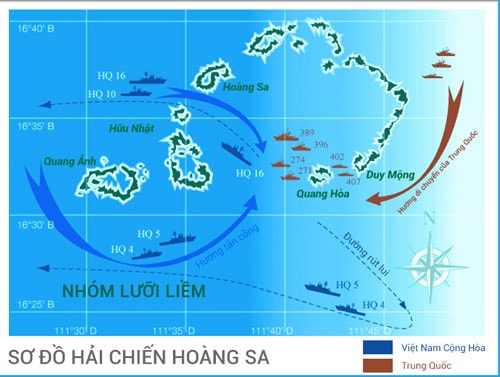 |
| The diagram of the naval battle is as described in the book "Documents on the Battle of the Paracel Islands" by Vu Huu San and Tran Do Cam. |
The attack by the 2nd Division, consisting of HQ16 and HQ10, took place north of Quang Hoa Island. At exactly 10:25 AM, Colonel Ha Van Ngac ordered an attack on the Chinese Navy warships in the Paracel Islands. HQ16 and HQ10 remained stationary, with all their large and small guns, from the bow to the stern, aimed at the Chinese ships. The naval guns on both sides fired continuously at the Chinese vessels.
At 10:35 AM, HQ10 reported that its command bridge had been hit by gunfire, the captain was seriously wounded, and the engine room was on fire and flooded. The captain of HQ16 ordered the deputy captain of HQ10, Captain Nguyen Thanh Tri, to take over command. HQ10 continued its fierce attack on the approaching Chinese vessel 396.
At 10:45 AM, the 389 aircraft was hit by gunfire and was emitting thick smoke.
At 10:55 AM, the 396 was hit by gunfire, becoming uncontrollable. It collided with HQ10, then bounced away, was hit by more bullets, caught fire, spun around a few times, and drifted onto the coral reef northwest of Duy Mong Island. HQ10 also suffered heavy damage, was hit by bullets, and became uncontrollable.
Meanwhile, HQ16 was hit by stray bullets from HQ5, its right engine room flooded, and a few minutes later, the ship began to list. Radio communications were interrupted due to a power outage. Realizing it could not continue fighting, HQ16 left the basin and headed towards Da Nang.
At 11:10 AM, HQ10 was abandoned. The captain and several crew members were killed. The deputy captain ordered an escape.
The attack by the 1st Division, comprising HQ5 and HQ4, took place southwest of Quang Hoa Island. At 10:25 AM, the 76.2mm naval gun of HQ4 at the bow malfunctioned right from the start and required repairs. This disrupted Colonel Ha Van Ngac's plans. Nevertheless, HQ4 utilized its remaining firepower, continuing to pursue its target within machine gun range.
At 10:40 AM, the 76.2mm gun on the aft bridge of HQ4 suffered a malfunction in its automatic firing mechanism, requiring manual adjustment, resulting in slow and cumbersome single-shot firing. Colonel Ngac ordered HQ4 to withdraw from the battle for repairs and instructed HQ5 to provide cover for HQ4's withdrawal to a safe distance. Although HQ4 sustained several hits, its main machinery and communication systems remained operational.
At 10:55 AM, the 274 was hit by gunfire, caught fire, and drifted ashore on the coral reef south of Quang Hoa Island. Most of the guns on HQ5 were malfunctioning, except for the 40mm cannon on the left; the high-frequency radio was no longer working, and the radio on the command bridge was also shattered by gunfire. Colonel Ngac had to go to the War Intelligence Center to use the VRC46 radio to take command.
At 11:00 AM, the 271, reinforced by the 389, joined forces to attack HQ5. HQ5 was hit by many bullets but counterattacked fiercely, inflicting heavy damage on the enemy ship and forcing it to retreat.
Upon receiving news that enemy reinforcements were approaching, and with HQ10 unusable, HQ16 taking on water in its engine room and listing, and HQ4 and HQ5 heavily damaged with very limited firepower, the Commander of the Special Task Force ordered HQ5 to retreat southeast.
The two enemy ships were also severely damaged and retreated towards the northeast of the Paracel Islands. HQ5 and HQ4 retreated towards the southeast and proceeded to Da Nang.
At 11:10 AM, three warships of the Republic of Vietnam Navy were forced to withdraw when reinforcements from the Chinese South Sea Fleet entered the area (escort ships 281 and 282 arrived earliest, about 30 minutes after the Republic of Vietnam Navy withdrew). Fifteen permanent staff members of HQ16 were stranded on Vinh Lac Island, and 15 permanent staff members of HQ4 were stranded on Cam Tuyen Island. The Vietnamese islands were left with only military forces for defense, without naval artillery support.
From this point onwards, the entire Paracel Islands archipelago fell into Chinese hands.
According to vnexpress


