
4 jars that teach children how to spend money from the age of 3.
Family and children's finance expert Neale S. Godfrey (USA) suggests that parents should teach children about managing money and give them pocket money starting from the age of three.
Many parents believe that since young children are already taken care of by adults, they shouldn't be involved in or learn about money-related matters. They think it's never too late to teach children how to manage money when they're old enough to understand and know how to spend it. This mindset is not the right way to teach children about money.
At the "Financial Education for Children" workshop held on the afternoon of May 18th in Ho Chi Minh City, Ms. Neale S. Godfrey, CEO of the world's first children's bank (The First Children's Bank - USA), stated thatthree years oldAt this age, children are able to understand what they want, and this is a good time to introduce them to money.
|
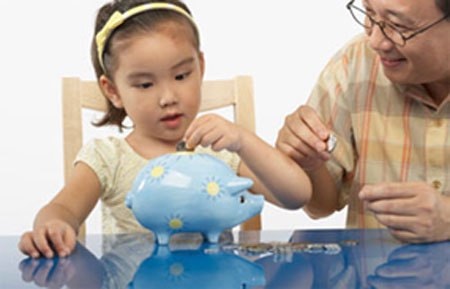
Children should be introduced to money from the age of three. (Image)PV |
According to her, parents should first help children understand the principle of "you only get paid for what you do." This means parents should divide tasks assigned to children into two categories. One category is tasks that the child must do themselves and will not receive payment for, such as brushing teeth, eating, or studying well... because these are activities directly related to the child's personal well-being that they must do independently.
Parents can pay their children for chores such as watering plants, feeding animals, or cleaning their rooms to encourage a work ethic and a sense of responsibility towards money. The amount given should be based on age; for example, a 3-year-old could receive 3,000 dong for each successful task, while a 5-year-old could receive 5,000 dong.
Once parents have given their children money, the next step is to help them create a sound budget. To do this, Neale S. Godfrey introduces the "four jars" model.
Accordingly, she advised parents to prepare four jars for their children to divide their money into, and then teach them how to allocate it. Jar 1 contains money for charitable activities. Jar 2 contains money for daily expenses such as buying snacks, candy, breakfast, etc. (under family supervision). Jar 3 is for medium-term savings; children can only use the money in this jar to buy things they have planned to buy beforehand, such as toys. Jar 4 is for long-term savings, which children can use to fulfill their future dreams such as going to university, opening a small shop, or traveling far away.
The money in the four jars will come from the children's earnings (weekly allowance, gifts, rewards, money from part-time jobs, etc.) with the following distribution: Jar 1 contains 10% of the money; the remaining three jars contain 30% of the money.
From her own experience, she never wanted her children to understand that loving them meant giving them things unconditionally. "I told them that I love them simply because I love them, and the most important responsibility of parents is providing them with food and shelter. Besides that, what children need most from their parents is time, not fulfilling every financial request," she said.
According to Neale S. Godfrey, many working women today want to give their children everything their friends have. "Don't compensate for a lack of time by giving your children gifts and money unconditionally and without control. This is very bad for children," Neale emphasized.
Talk withVnExpress.netMs. Hai, a parent with a six-year-old child, said that she teaches her child to save money daily, starting from kindergarten, by turning off lights when not in use and putting money into a piggy bank. "When the school or family participates in charity programs, we take a portion of the money from the piggy bank to contribute, helping the child understand the lesson of compassion and also teaching them to manage their own finances," she said.
Ms. Thanh Loan, a parent from District 3, also believes that it's not necessary to forbid children from asking for money to buy a reasonable item. The important thing is to guide children to be aware of how to save and spend wisely.
Mr. Pham Ngoc Thanh, Deputy Director of the Ho Chi Minh City Department of Education and Training, believes that educating children about financial management skills from a young age is essential. This has a significant impact on their ability to make sound financial decisions in the future. "In the near future, we may implement a program to introduce first-grade students to money and teach them how to spend it. At this age, children are already quite aware of the situation," he stated.
Ms. Quách Thu Nguyệt, representative of Dân Trí Book Company, also emphasized that educating children about financial skills is one of the issues that society has been particularly concerned about recently. Teaching children how to manage money helps them to self-regulate and appropriately satisfy their desires, thereby enhancing their ability to live independently. In Vietnam, this issue is still quite new. Therefore, financial skills for children need to be widely disseminated from a young age.
According to VnExpress - NT


