
5,400 Vietnamese workers may return to South Korea to work.
The Korean Ministry of Labour and Employment has informed Vietnam of the approval of a quota for over 5,400 Vietnamese workers who have been working in Korea and returned home on time since January 1, 2010, and who wish to return to Korea to work in 2013.
The Korean Ministry of Labour and Employment has informed Vietnam of the approval of a quota for over 5,400 Vietnamese workers who have been working in Korea and returned home on time since January 1, 2010, and who wish to return to Korea to work in 2013.
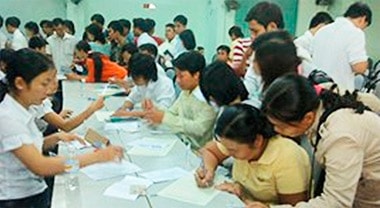
The number of workers who returned to their home country on time since January 1, 2010, and wish to return to South Korea for work.
According to Mr. Phan Van Minh, Director of the Center for Overseas Labor, Ministry of Labor, Invalids and Social Affairs, the South Korean government has granted quotas for more than 25,000 workers from 13 countries to return to South Korea to work.
Of these, the Philippines had the highest number of workers returning to South Korea, with over 6,000; followed by Vietnam. These are workers who completed their contracts and returned home on time, and are allowed to register for a computer-based Korean language test to return to South Korea for work in the future if they so desire.
Mr. Phan Van Minh stated: “Workers who have completed their contracts and returned home on time are allowed to register for the computer-based Korean language proficiency test quarterly, as stipulated by the Korean side. Accordingly, the test is held once every quarter. Quarter 1 will be held in March, Quarter 2 in June, Quarter 3 in September, and Quarter 4 in November. As for new workers, the Korean Ministry of Labor and Employment has temporarily not renewed the agreement to send Vietnamese workers to Korea, which was signed in 2010.”
Mr. Phan Van Minh also stated that, in addition to facilitating the quick return of contracted workers to South Korea, Vietnamese and South Korean authorities are continuing to strengthen measures to bring back more than 10,000 workers who are currently absconding, working, and residing illegally in South Korea.
Resolving this issue could open the door to working in South Korea for nearly 12,000 workers who have already taken the Korean language proficiency test domestically.
According to (VOV) - LH


