
5 must-visit historical sites in Nghe An on September 2nd.
(Baonghean.vn) - On Independence Day, September 2nd, legendary landmarks serve as significant sites for the younger generation to remember the origins of the nation's founding and defense.
1. Cuong Temple
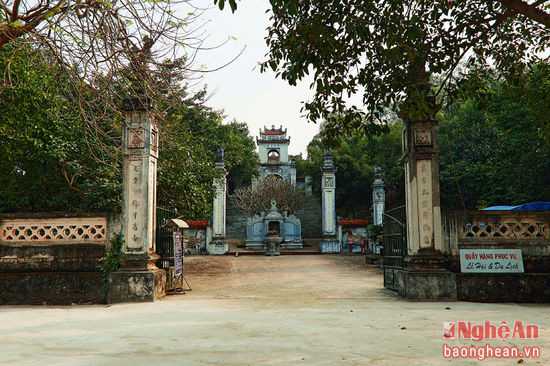 |
| Cuong Temple. Archival photo. |
Cuong Temple is associated with a legend in the history of the nation's resistance against foreign invaders. Thuc Phan – after being ceded the throne by the 18th Hung King – united the strength of the entire army, decisively defeated the Qin army, and ascended the throne, taking the title Thuc An Duong Vuong. After his coronation, An Duong Vuong changed the name of the country from Van Lang to Au Lac, moved the capital from Phong Chau to Co Loa, and ruled the country for 50 years (from 257 to 208 BC).
The Cuong Temple, dedicated to the legendary An Duong Vuong, is located on Mo Da Mountain. Behind it lies Dien Chau beach, to the north is Tu Hien Gate, where the tomb of Princess My Chau is located, and to the west is Mua Mountain, shaped like an elephant bowing towards the temple.
2. Temple of Emperor Quang Trung
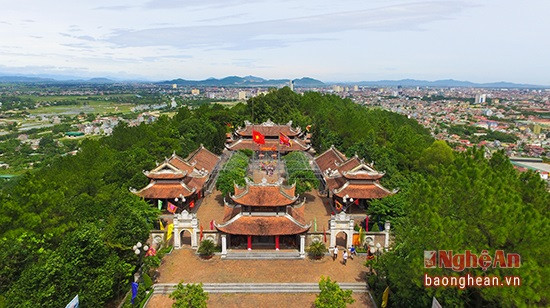 |
| Temple of Emperor Quang Trung. Archival photo. |
With the aim of preserving the historically significant events related to Emperor Quang Trung, on April 28, 1962, the complex of historical sites and scenic spots of Dung Quyet Mountain and Phuong Hoang Trung Do was recognized by the Ministry of Culture and Information as a National-level historical and scenic site.
Following a 1km winding mountain road, visitors will enjoy the fresh air of nature and the surrounding landscape. Nestled in a picturesque pine forest at an altitude of 97m above sea level, the Temple of Emperor Quang Trung, located on Dung Quyet Mountain in Trung Do Ward, Vinh City, is an indispensable destination in the spiritual tourism guide for visitors to Nghe An.
3. Ho Chi Minh Square
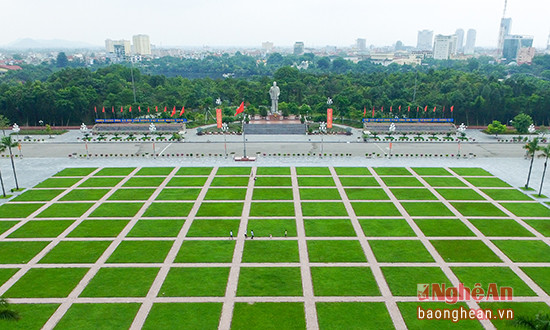 |
| Ho Chi Minh Square. Archival photo. |
Ho Chi Minh Square is a national-level cultural landmark, a work of great ideological and artistic value, reflecting the deep respect and love of the people of Nghe An province and the entire nation for the great leader of the Vietnamese people.
Ho Chi Minh Square features many elements such as: a ceremonial platform, a flagpole, a parade route, a ceremonial grounds, a lighting system, trees, a system of decorative fountains, and a replica of Chung Mountain, modeled after Chung Mountain in Lang Sen, President Ho Chi Minh's birthplace.
Over 1,650 representative tree species from all regions of the country have been brought and planted, and at the summit there is a commemorative garden of trees planted by Party and State leaders and international friends during their visits.
4. Kim Lien Historical Site
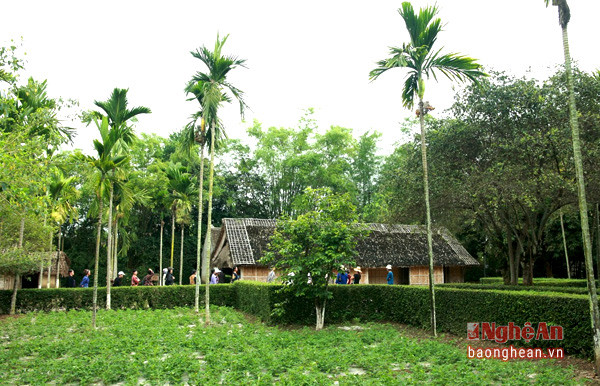 |
| Sen Village is located in Kim Lien commune, Nam Dan district. (Archival photo) |
The Kim Lien historical site is located about 15km from Vinh city along Provincial Road 46. It is one of the four most important historical sites in Vietnam related to President Ho Chi Minh, preserving numerous documents, artifacts, and cultural and historical spaces about President Ho Chi Minh's childhood and his family members. The Kim Lien historical site comprises two main clusters of relics, with dozens of smaller relics.
The cluster of historical sites in the ancestral village of Sen, Kim Lien commune, includes: the house of Deputy Scholar Nguyen Sinh Sac, the house of Nguyen Sinh Nham, the Nguyen Sinh family ancestral temple, the house of Bachelor Vuong Thuc Quy, the old blacksmith's forge of Co Dien, Coc Well, Chung Mountain, Sen Village stadium, Sen Village temple...
The cluster of historical sites in his maternal hometown - Hoang Tru village, Kim Lien commune - includes the following relics: the house of President Ho Chi Minh's family in Chua village, the house of Mr. Hoang Xuan Duong (his maternal grandfather), the ancestral temple of the Hoang Xuan clan...
In addition to the two aforementioned historical sites, the Ho Chi Minh National Special Historical Site also includes the tomb of Mrs. Hoang Thi Loan and the tomb of Mrs. Ha Thi Hy, located in Nam Giang commune, Nam Dan district.
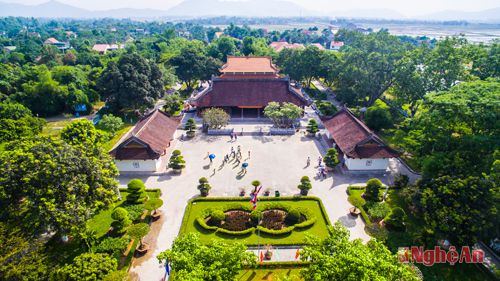 |
| Kim Lien - Nam Dan historical site. Archival photo. |
To this day, President Ho Chi Minh's paternal and maternal hometowns still preserve artifacts associated with his simple childhood life. In particular, the humble thatched house of his family evokes a feeling of closeness and affection in visitors.
5. Truông Bồn National Historical Site
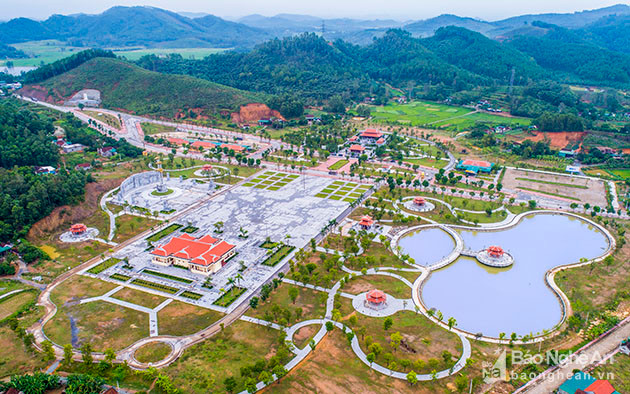 |
| A view of the Truông Bồn National Historical Site. (Archival photo) |
Today, the Truông Bồn National Historical Site has become a historical symbol of the Vietnamese Youth Volunteers, a "red address" for educating the younger generation about revolutionary traditions. Here, it bears witness to the heroic deeds and glorious sacrifices of our army and people in the great national struggle for liberation in the 20th century.
In 2010, the Truông Bồn historical site was preserved and restored to the scale of a National Historical Site, covering an area of 217,327 square meters. A mass grave and a temple dedicated to the heroic martyrs of the Youth Volunteer Force were also built within the grounds of the Truông Bồn National Historical Site.
Hoa Le
(Synthetic)
| RELATED NEWS |
|---|


